Modern healthcare did not grow only from peaceful laboratories or quiet university halls. Many of the tools, techniques, and systems we rely on today were invented, tested, or perfected during war.
In fact, some of the biggest leaps in medicine came from battlefield doctors facing impossible conditions — limited supplies, high-pressure decisions, and a need to save lives fast.
This is the story of how wartime medicine transformed into everyday civilian healthcare.
From MASH units in Korea, to trauma care in Iraq and Afghanistan, to telemedicine and portable surgery, war shaped the hospitals we know today.
And even though war is tragic, the medical breakthroughs that came from it changed the world.
1. The Problem Wars Forced Medicine to Solve
Throughout history, war created one major challenge for doctors:
How do you treat wounded people fast, before they die?
In the early 20th century, most soldiers died not from their main wounds, but from:
- shock
- blood loss
- infection
- slow evacuation
- lack of trained medics
World War I saw horrifying rates of death from basic injuries. By World War II, doctors knew something had to change.
Wartime pushed countries to create new ideas:
- move medical care closer to the front
- train medics who were not full doctors
- develop new tools for quick treatment
- build systems to move casualties fast
These ideas formed the foundation for modern emergency medicine, which civilians now depend on every day.
2. MASH Units: The Birth of Modern Emergency Medicine
If you’ve heard of MASH (Mobile Army Surgical Hospital), you may think of the famous TV show.
But the real MASH units were one of the most important medical revolutions of the 20th century.
What MASH Units Were
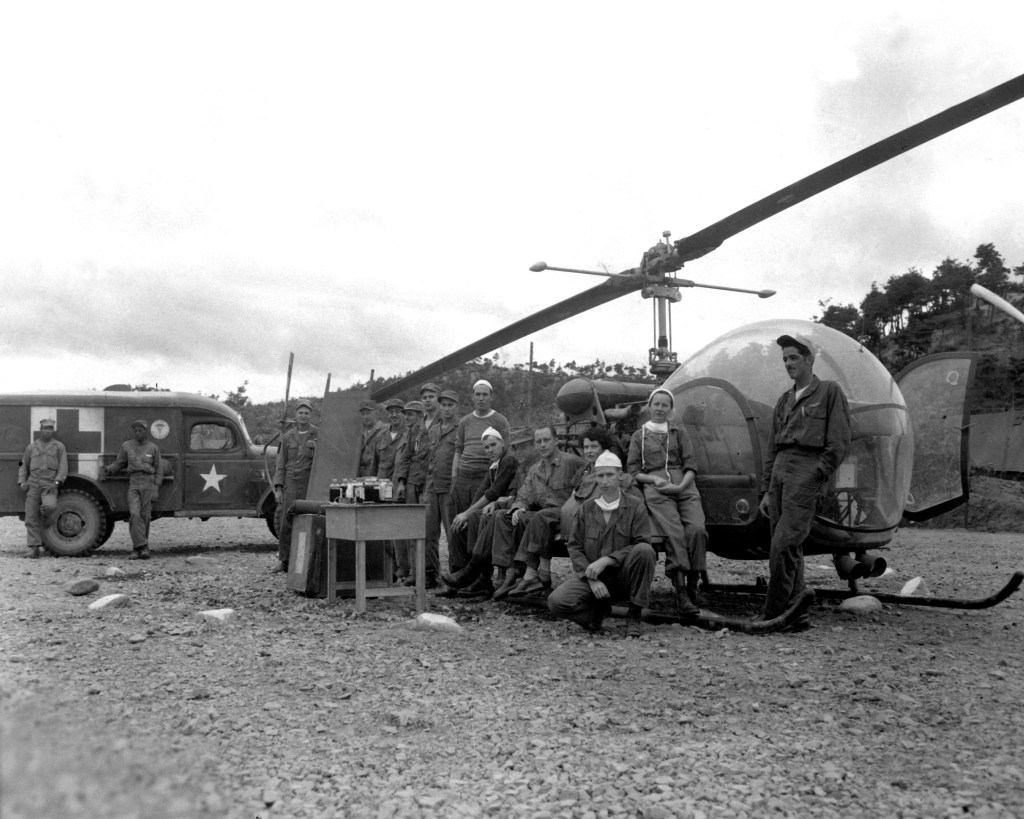
A MASH unit was a mobile, fast-moving trauma hospital used heavily during the Korean War (1950–1953). It could be set up in tents and moved as battle lines shifted.
Compared to WWII field hospitals:
- MASH units were closer to the battlefield
- They performed surgery within hours
- They used helicopters to bring wounded soldiers
- They had specialized teams, not general doctors
This led to a huge breakthrough:
Over 97% of soldiers who reached a MASH unit survived — an incredible statistic for its time 【1】.
Helicopter Evacuation (MEDEVAC)
Korea was the first war where helicopters were widely used to move wounded troops.
Helicopters cut travel hours into minutes.
This concept is now the backbone of civilian:
- air ambulances
- trauma centers
- organ transport systems
If you’ve ever seen a red helicopter landing at a hospital, that is a direct legacy of MASH.
3. Vietnam: Trauma Care Goes High-Tech
If Korea invented fast care, Vietnam improved the science behind it.
The U.S. military studied wounds, blood loss, and survival more deeply than ever.
Key medical advances from Vietnam:
1. Advanced Trauma Life Support (ATLS)
After seeing common patterns in battlefield injuries, doctors created a standardized system:
- Airway
- Breathing
- Circulation
- Disability
- Exposure
This became ATLS, still used in every emergency room today.
2. Better Blood Transfusions
Vietnam research helped create:
- blood-typing systems
- transportable plasma
- safer transfusion methods
Today these save countless lives in civilian hospitals.
3. Improved Burn Treatment
Napalm injuries forced doctors to study burns deeply.
This research modernized:
- burn units
- skin grafts
- fluid resuscitation
Civilian burn care today is a direct result.
4. The Cold War & Beyond: Technology Joins Medicine
While the Cold War did not always include open battle, it pushed massive innovation in:
- computers
- imaging
- materials science
- logistics
These technologies entered medicine rapidly.
Examples:
1. MRI and CT Scanning
Military research into radiation, electronics, and advanced computing helped create the imaging machines we use today.
2. Prosthetics
The need to replace limbs lost in war fueled:
- carbon-fiber prosthetics
- hydraulic joints
- nerve-linked prosthetics (modern bionics)
3. Trauma Systems
By the 1980s, civilian trauma centers were built using military models:
- triage
- rapid transport
- specialized trauma surgeons
If you have Level 1 trauma centers in your city, thank the military.
5. Iraq & Afghanistan: The Modern Era of Battlefield Medicine
The wars in Iraq and Afghanistan (2001–2021) created the fastest medical advances since WWII.
1. Tourniquets Save Lives
Early in the wars, doctors discovered something shocking:
Many soldiers died from simple limb bleeding.
The solution?
A return to the old-fashioned tourniquet, redesigned with modern materials.
These new tourniquets dropped death from limb bleeding by 85% 【2】.
Today police officers, firefighters, and even teachers carry them.
2. Combat Gauze (QuikClot)
A special medicated bandage that stops severe bleeding almost instantly.
It is now used in:
- ambulances
- emergency kits
- civilian hospitals
3. Full “Trauma Chains”
The military built complete systems:
- Tactical Combat Casualty Care (TCCC)
- Forward surgical teams
- Drone medical resupply
- Rapid medical evacuation networks
These systems inspired modern civilian emergency services.
4. Telemedicine
Remote diagnosis began on the battlefield — now it’s in your phone.
Doctors in the U.S. could advise medics in Afghanistan instantly.
Today millions of civilians use telemedicine daily.
6. Why War Speeds Up Medical Innovation
War pushes doctors to solve problems they cannot avoid:
- Too many injured at once
- Limited supplies
- Harsh environments
- New weapons creating new types of injuries
This pressure forces rapid experimentation.
Three reasons wartime medicine evolves fast:
1. High Volume = High Learning
Thousands of similar injuries allow doctors to spot patterns quickly.
2. Unlimited Government Funding
Governments spend heavily during war — research becomes urgent.
3. Innovation Without Bureaucracy
Ideas can jump from concept to field test in weeks, not years.
Some breakthroughs would take decades in civilian systems but take months in wartime.
7. How Civilian Healthcare Absorbs Military Innovation
Not all wartime breakthroughs become civilian tools right away.
But over time, most do.
Here’s how military ideas enter hospitals:
Step 1: Military research proves it works
Battlefield results show survival rates increase.
Step 2: Civilian researchers test it
Universities run controlled trials.
Step 3: Hospitals adopt it
Hospitals copy trauma systems, equipment, and procedures.
Step 4: Government regulators approve it
FDA and global health agencies authorize public use.
This is how we got:
- trauma centers
- air ambulances
- advanced prosthetics
- portable ultrasound
- telemedicine
- MASH-style emergency tents used in disasters
Almost every modern emergency room today has a “military fingerprint.”
8. Hidden Innovations You Use Every Day (Thanks to War)
Here are common things that exist because of wartime medicine:
1. Penicillin mass production
WWII forced large-scale antibiotic production.
2. Plastic surgery techniques
Developed after soldiers suffered severe burns in WWI and WWII.
3. Ambulances & EMT standards
Vietnam and civilian riots pushed the creation of modern EMT training.
4. ER Triage Systems
Born directly from battlefield triage.
5. Portable defibrillators
Miniaturized through Cold War research.
6. Hydration packets (ORS)
Improved during Vietnam; now used for children worldwide.
7. Vaccination campaigns
The military organized some of the first large-scale immunization programs.
Wartime breakthroughs surround us daily.
9. Case Study: How MASH Still Saves Lives in 2025
Natural disasters today — earthquakes, typhoons, wildfires — often destroy local hospitals.
In response, countries deploy mobile surgical units, directly inspired by MASH.
These units:
- unfold in hours
- run on generators
- include mini-ICUs
- perform full surgeries
- are airlifted into remote areas
During COVID-19, several countries built field hospitals using military concepts.
MASH never really disappeared — it simply became part of everyday disaster response.
10. The Future: How Modern Wars Will Shape Tomorrow’s Healthcare
The next generation of medicine is already being tested on modern battlefields.
Here’s what’s coming:
1. Drone Medical Delivery
Drones are already used to move:
- blood
- medicine
- vaccines
- organs
2. AI Battlefield Diagnosis
Smart algorithms can analyze:
- bleeding
- breathing
- medical scans
Even in chaotic environments.
3. Robotic Surgery
Robots can perform surgeries closer to war zones, controlled by doctors far away.
4. Smart Bandages
Bandages will:
- monitor wounds
- release antibiotics
- send alerts
- track healing
5. Regenerative Medicine
Research on injured soldiers is pushing breakthroughs like:
- lab-grown skin
- tissue scaffolding
- regenerating bone
Conclusion: War Is Tragic — But Medicine Learns and Saves Millions
War should never be celebrated. But history shows a clear truth:
Wartime medicine becomes peacetime healthcare.
What doctors learn in the worst conditions often saves more lives in peace than in war.
MASH units, helicopter evacuation, trauma systems, telemedicine, prosthetics, and modern emergency rooms — all of these owe their existence to wartime innovation.
And the next medical revolution may already be happening, somewhere on a battlefield, ready to enter the civilian world.
📚 Citations
- Baskin, L. (2002). Military Medicine in Korea: The MASH Legacy. Military Medicine Journal.
- Butler, F. (2017). Tactical Combat Casualty Care: Achievements and Lessons. Journal of Special Operations Medicine.
- U.S. Army Medical Department. History of Army Medical Evacuation.
- Hardaway, R. (2006). The Development of Combat Trauma Care. Trauma Journal.
- Coupland, R. (2001). War and Medicine: The Science of Casualty Care. International Committee of the Red Cross.
- U.S. Department of Defense. (2012). Joint Theater Trauma System Annual Report.
- Gawande, A. (2004). Casualties of War — Advances in Trauma Care. New England Journal of Medicine.
- Kragh, J. (2008). Battlefield Tourniquets and Limb Hemorrhage Survival. Annals of Surgery.
- National Academies of Sciences. (2016). A National Trauma Care System: Integrating Military and Civilian Trauma Systems.
- Spinella, P. (2011). The Influence of Military Medical Research on Civilian Trauma Care. Transfusion Medicine Reviews.
 Vellum Insights