Tag: Cold War history

  • The Forgotten Front: Why the Korean War Faded from Memory

    The Forgotten Front: Why the Korean War Faded from Memory

    The War Everyone Fought, but No One Remembered

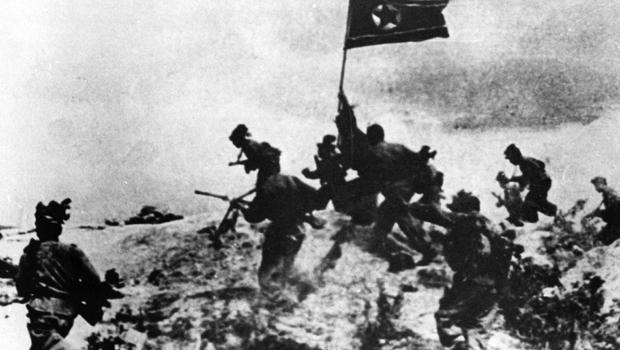
    The Korean War began on June 25, 1950, when North Korean forces poured across the 38th parallel and invaded South Korea.

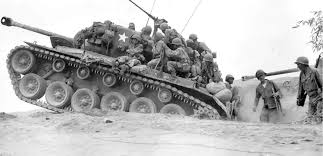
    For three years, soldiers from across the world — especially the United States, South Korea, and United Nations allies — fought in freezing mountains, bombed-out cities, and muddy trenches.

    Yet today, when people speak of great wars, most remember World War II or Vietnam. The Korean War rarely makes the same lists, documentaries, or memorials. It’s often called “The Forgotten War.”

    Why did a conflict that claimed more than three million lives fade so quickly from public memory? The answer lies not just in the battlefield, but in the politics, media, and timing that shaped how the war was remembered.


    1. The War That Wasn’t Declared
    Unlike World War II, the Korean War wasn’t officially a declared war — it was a “police action.” U.S. President Harry Truman never asked Congress for a formal declaration. Instead, the United Nations authorized the use of force to defend South Korea.

    That language mattered.
    Without the patriotic speeches, victory parades, and posters that defined World War II, Americans didn’t see the Korean War as a grand crusade — just another distant conflict in Asia.

    For soldiers who fought there, the lack of recognition was painful. They risked their lives under the same dangers as World War II veterans, yet came home to silence and indifference.

    “We went, we fought, and we came back — and nobody cared,” one veteran later said.


    2. The Media’s Quiet War

    During World War II, reporters embedded with troops sent back vivid stories and heroic images. By contrast, the Korean War came at an awkward moment in media history. Television was still new, radio was fading, and newspapers were turning their attention to the early Cold War.
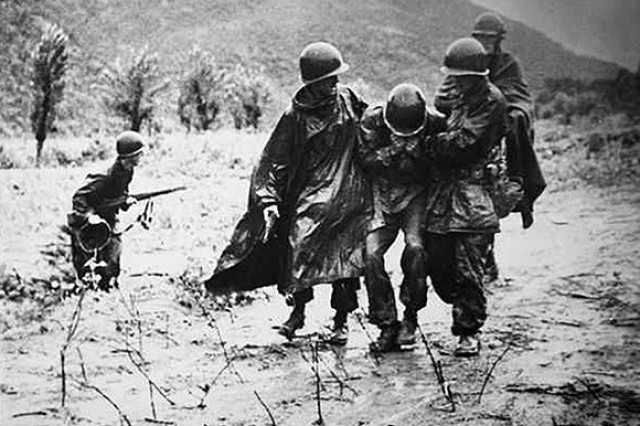
    America marks 70th anniversary of end of Korean War | Article | The United  States Army

    News from Korea was slow, often black-and-white footage of mud and snow. Without dramatic visuals, the public couldn’t connect emotionally.

    Worse, reporters called it a stalemate — a word that killed enthusiasm. Americans didn’t see victory or progress, only endless fighting with no clear end.

    By 1953, as the armistice was signed, few people outside the military even noticed the final battles. The war simply slipped off the front page.


    3. Cold War Fatigue

    The Korean War happened just five years after World War II ended. Many countries were still rebuilding their economies and mourning millions of dead.

    When the Korean War began, people felt war fatigue. They didn’t want another global conflict. Governments avoided dramatic language to prevent panic, while the public tuned out.

    At the same time, the Cold War between the U.S. and the Soviet Union was heating up. Korea became just one front in a much larger struggle — overshadowed by nuclear fears, spies, and propaganda.

    By the 1950s, headlines shifted to the arms race and McCarthyism at home, while soldiers still fought and froze on Korean hillsides.


    4. No Clear Victory

    The Korean War ended in armistice, not victory. The 38th parallel — the line that divided North and South — stayed right where it was.

    Unlike World War II, there was no surrender ceremony, no peace treaty, no victory march through Seoul or Pyongyang. The war simply stopped.

    For many, that felt like defeat. Politicians called it “containment,” not triumph. Veterans came home without medals of victory, only memories of survival.

    This lack of closure made it easy for the war to fade — because there was no clear ending to remember.


    5. The Human Cost Forgotten

    The Korean War | American Experience | Official Site | PBS

    Behind the politics and strategy were millions of ordinary people whose lives were torn apart. Cities like Seoul changed hands four times during the war. Families were split across the border, some never reunited again.

    Over 2.5 million Korean civilians died — many caught in the crossfire or bombings. Refugees poured south in endless columns.

    Yet their stories were rarely told. Western audiences saw Korea as a faraway place, not a people with faces and names.

    Only decades later did historians and filmmakers begin to recover these voices — stories of children orphaned, families divided, and survivors rebuilding from ashes.


    6. The Veterans’ Long Silence

    When American and UN soldiers returned home, there were no big parades. The U.S. was already moving on — new cars, new suburbs, new fears of communism.

    Many veterans didn’t talk about Korea for years. Some felt forgotten; others believed no one wanted to hear.

    In South Korea, too, the war left deep scars. The country rebuilt under strict rule, and memories of the conflict were often suppressed in favor of modernization.

    It wasn’t until the 1980s and 1990s that public recognition grew. The Korean War Veterans Memorial in Washington, D.C. — unveiled in 1995 — finally gave a voice to those who had been forgotten.


    7. Lessons in Memory and Honor

    The Korean War shows that history isn’t just about what happens — it’s about what people choose to remember.

    Wars fade not because they were unimportant, but because they don’t fit simple narratives of victory or loss. The Korean War was a brutal, necessary stalemate that stopped communism from spreading south, setting the stage for South Korea’s eventual rise into democracy and prosperity.

    Remembering it means honoring not only soldiers, but also the civilians who suffered and survived.

    As one veteran wrote in his diary:

    “We didn’t lose. We didn’t win. But we did our duty — and that should count for something.”

    Conclusion: The War That Built the Present

    The Korean War might be called “forgotten,” but its impact still shapes the world. The border at the DMZ remains one of the most dangerous on Earth. South Korea’s rise from rubble to global powerhouse stands as a symbol of resilience.

    For the United States, the Korean War marked the beginning of modern limited warfare — a conflict fought not for conquest, but for containment.

    Remembering the Forgotten War is more than looking back — it’s understanding how fragile peace truly is
  • MiG Alley: The Jet Dogfights That Changed Air Combat Forever

    MiG Alley: The Jet Dogfights That Changed Air Combat Forever

    How the Skies Over Korea Became the Birthplace of the Jet Age


    Introduction: A New Kind of War in the Skies

    In the early 1950s, as the Korean War raged across the peninsula, another kind of battle unfolded far above the clouds.

    This wasn’t like the dogfights of World War II — propeller planes circling in the blue sky. This was something entirely new.

    Jet engines.
    Supersonic speeds.
    Split-second decisions that decided life or death.

    Over a narrow stretch of northwestern Korea, near the Yalu River, pilots from the United States and the Soviet Union (though Moscow denied it) faced off in the world’s first major jet-versus-jet combat.

    They called it MiG Alley — a place where skill, nerves, and technology were pushed to their limits.

    What happened in those skies would change the future of air combat forever.


    The Setting: The Birth of Jet Warfare

    By the time the Korean War broke out in June 1950, jet aircraft were still new technology.

    Both sides started the war flying World War II–era propeller planes — the U.S. used the F-51 Mustang, and the North Koreans flew Soviet-built Yak-9 fighters.

    But that changed fast.

    When the Soviet-built MiG-15 appeared in late 1950, everything changed.

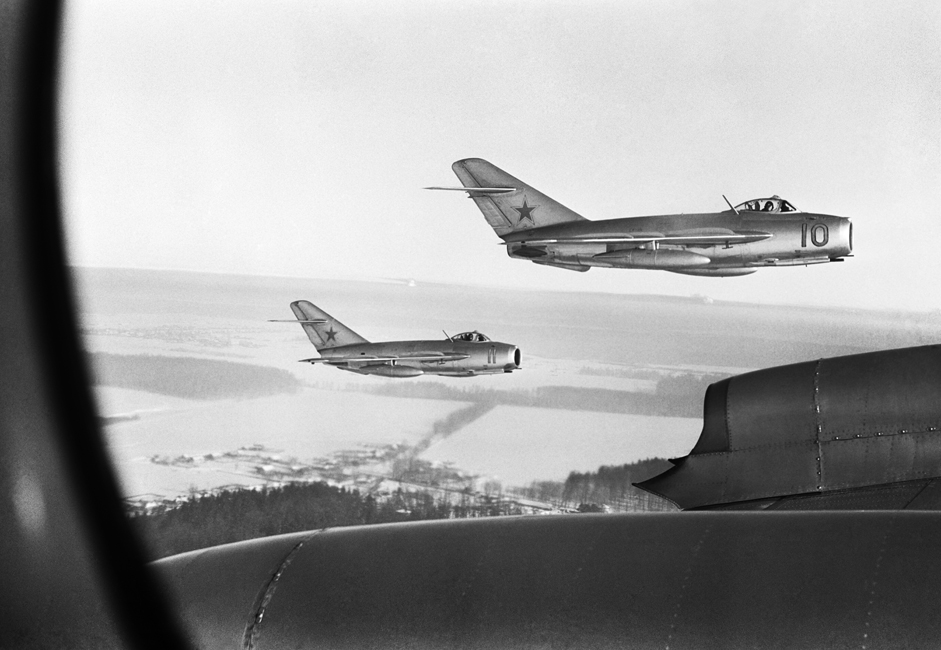
    With swept wings, a pressurized cockpit, and a powerful jet engine, the MiG could climb higher, fly faster, and turn tighter than anything the U.N. forces had seen before.

    It could reach speeds of almost 670 miles per hour and operate at altitudes above 50,000 feet — well beyond the reach of older aircraft.

    For a while, the skies over North Korea belonged to the enemy.


    Enter the F-86 Sabre: America’s Answer

    The U.S. needed something to match the MiG — and fast.

    Enter the North American F-86 Sabre, one of the most advanced fighter jets of its time.

    It had swept wings like the MiG, radar-assisted gunsights, and powerful .50 caliber machine guns.

    But the Sabre’s real strength wasn’t just speed — it was stability and precision.
    At high speeds, it was easier to control than the MiG, giving American pilots an edge in tight maneuvers.

    When the Sabre took to the skies in late 1950, the stage was set for a clash unlike any before.


    MiG Alley: The Deadliest Airspace on Earth

    The battles took place over a stretch of northwestern Korea along the Yalu River, near the Chinese border.

    The area soon earned a name whispered with respect and fear — MiG Alley.

    It became the hunting ground of the USAF’s 4th Fighter Interceptor Wing and the Soviet 64th Fighter Aviation Corps.

    American pilots were told to stay south of the Yalu to avoid provoking China or the USSR, but MiGs would swoop down from the north, strike, and retreat across the river to safety.

    The result?
    A daily aerial chess match between two of the most advanced fighter forces on the planet.


    The Men Behind the Machines

    The dogfights of MiG Alley weren’t just about machines — they were about the men who flew them.

    U.S. pilots were veterans of World War II — experienced, disciplined, and aggressive.
    They called themselves the “Sabre Men.”

    Their Soviet opponents were equally skilled, though officially “volunteers.”
    They wore Chinese or North Korean uniforms, flew aircraft with red star insignias, and operated under strict secrecy.

    Among them was Soviet ace Nikolai Sutyagin, who scored 22 kills — one of the highest of the war.
    On the American side, Captain Joseph McConnell became the top U.S. ace with 16 victories.

    These pilots lived by the second — and often died by it.


    Dogfighting at the Speed of Sound

    Air combat over MiG Alley was brutal and fast.
    A pilot had less than a few seconds to spot, target, and fire before the enemy disappeared into a blur.

    The F-86 Sabre’s advanced gyro gunsight gave it an edge — it predicted enemy movement, helping pilots lead their shots.

    But the MiG-15 had superior climb and altitude performance, often using “boom and zoom” tactics — diving from above, firing, and escaping skyward.

    The result was a deadly dance of angles and velocity.

    At these speeds, every decision was instinct.
    Every mistake, fatal.

    As one Sabre pilot later said:

    “You didn’t fight the MiG. You fought the man flying it.”


    The Shadow War: Soviets in the Sky

    Officially, the Soviet Union never fought in the Korean War.
    Unofficially, they were deeply involved.

    From late 1950 onward, Soviet pilots secretly flew hundreds of missions from air bases in Manchuria.

    Their jets carried North Korean or Chinese markings, and radio operators spoke in broken Korean to maintain the illusion.

    But American pilots weren’t fooled.

    Intercepted radio chatter and combat reports revealed that many of the MiG pilots spoke perfect Russian — and fought with precision far beyond what North Korea could train.

    In truth, MiG Alley had become the first direct aerial clash between American and Soviet pilots — the Cold War’s hidden front.


    Tactics and Technology: The Future Takes Shape

    The duels in MiG Alley changed air combat forever.

    Fighter tactics evolved from turning dogfights to energy warfare — controlling altitude, speed, and position to gain the advantage.

    The concept of the “kill zone” — a cone of fire extending from a jet’s nose — became the standard in aerial gunnery.

    New innovations also emerged:

    • Radar control and early warning systems to guide intercepts.
    • Mid-air refueling to extend range.
    • Jet training schools focused on energy management and teamwork.

    The lessons learned over MiG Alley would shape every air force in the world for decades to come.


    Life and Death in the Cockpit

    Behind every dogfight was a young man pushing the limits of fear and physics.

    Sabre pilots often flew two or three missions a day, facing freezing altitudes and crushing G-forces.
    Cockpits were cramped, noisy, and dangerous.

    When hit, a pilot had seconds to eject — hoping his chute opened before the ground reached him.

    If captured in North Korea, his fate was uncertain.

    But despite the risks, pilots volunteered in droves. The skies over MiG Alley became the ultimate test of skill, courage, and endurance.


    The Numbers: Victory and Controversy

    Official U.S. Air Force records claimed 792 MiGs destroyed for 78 Sabres lost — a stunning 10-to-1 kill ratio.

    Soviet records, however, told a different story, claiming 600 U.N. aircraft destroyed for 335 MiG losses.

    The truth likely lies somewhere in between.

    But what’s undisputed is this — the F-86 Sabre dominated the skies in the war’s later years, and MiG Alley became the proving ground for the modern fighter jet.


    Legacy: The Jet Age Is Born

    When the Korean War ended in 1953, MiG Alley faded into history — but its influence did not.

    The dogfights there were the prototype for modern air combat: radar-guided missiles, supersonic speeds, and electronic warfare.

    Many of the pilots who fought there would go on to shape the Cold War’s air strategy, train new generations of aviators, and even fly in Vietnam.

    And the lessons learned — about technology, adaptability, and pilot psychology — still guide air combat training today.

    As aviation historian Walter Boyne wrote:

    “MiG Alley was where the jet age was baptized by fire.”


    Conclusion: The Battle Above the Yalu

    MiG Alley wasn’t just a stretch of sky — it was the dawn of a new era.

    In that cold, thin air, the world saw what war in the modern age would look like: faster, deadlier, and fought with machines that left no room for error.

    It was a clash of ideologies, nations, and nerves.

    And for the men who fought there, it was the place where courage met speed — and history took flight.

    Cited Sources

    • Boyne, Walter J. MiG Alley: The Fight for Air Superiority. Smithsonian Books, 2000.
    • Thompson, Warren. F-86 Sabre vs MiG-15: Korea 1950–53. Osprey Publishing, 2010.
    • Futrell, Robert F. The United States Air Force in Korea, 1950–1953. U.S. Air Force Historical Study, 1983.
    • Werrell, Kenneth P. Sabres Over MiG Alley. Naval Institute Press, 2005.
    • National Museum of the United States Air Force Archives.
  • The Frozen Chosin: How U.S. Marines Escaped the Chinese Trap

    The Frozen Chosin: How U.S. Marines Escaped the Chinese Trap

    A Battle Fought in Ice and Fire — The Story of Survival at the Chosin Reservoir


    Introduction: The Coldest Hell on Earth

    In the winter of 1950, deep in the mountains of North Korea, U.S. Marines found themselves trapped.
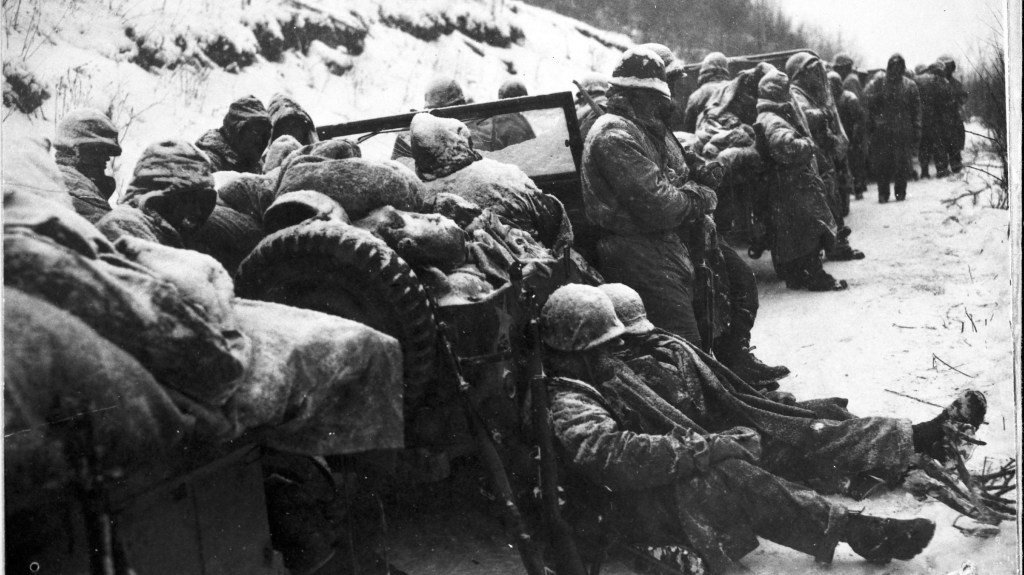
    They were surrounded by 120,000 Chinese soldiers. Temperatures dropped to –30°F. The wind howled. Guns froze. Blood turned to ice.

    This was the Battle of the Chosin Reservoir — one of the most brutal battles in modern military history. What began as a confident U.N. advance to “end the war by Christmas” turned into a desperate fight for survival.

    But in that frozen chaos, the First Marine Division didn’t crumble. Instead, they fought their way out — breaking through encirclement, saving thousands of lives, and writing one of the most legendary chapters in U.S. military history.


    The Setting: A War That Wasn’t Supposed to Happen

    When North Korea invaded South Korea in June 1950, few believed it would become a global conflict.
    The U.N., led by the United States, rushed to defend the South. Within months, U.N. forces under General Douglas MacArthur pushed the North Koreans back across the 38th parallel — the dividing line between North and South.

    By November 1950, MacArthur’s forces had reached the mountains near the Chinese border.
    MacArthur believed victory was near. He even promised his troops they’d be home for Christmas.

    But high above the frozen ridges of the Yalu River, China was watching — and planning.


    The Chinese Counterattack: Mao’s Secret Gamble

    Mao Zedong feared that U.S. forces so close to China’s border would threaten his new Communist government.
    Secretly, he sent the People’s Volunteer Army — 300,000 Chinese soldiers — across the Yalu River under cover of night.

    They moved silently through the mountains, wearing white camouflage, carrying supplies by hand or mule.
    By late November, they surrounded U.N. troops near a place called the Chosin Reservoir.

    The U.S. Marines didn’t know it yet, but they were walking straight into a trap.


    The Trap Closes: Night of Fire

    On November 27, 1950, the temperature plunged to –35°F.
    That night, the Chinese struck.

    Thousands of bugles blared through the darkness. Waves of Chinese infantry charged through the snow, screaming and firing.
    The Marines at Yudam-ni — one of the main camps — were hit from all sides.

    Machine guns jammed in the cold. Wounded soldiers froze if not moved immediately.
    Even morphine syrettes were solid from the cold.

    By morning, the Chosin Reservoir was ringed with fire and bodies. The U.N. forces — mainly U.S. Marines — were surrounded.


    Retreat, Hell! We’re Just Attacking in Another Direction

    The situation seemed hopeless. The nearest safe port, Hungnam, was 78 miles away — through frozen mountains and enemy roadblocks.
    But the Marines refused to surrender.

    Under the leadership of Major General Oliver P. Smith, the First Marine Division made a bold decision:
    They would fight their way out, bringing their wounded, their dead, and their gear with them.

    When asked if he was retreating, General Smith famously replied:

    “Retreat, hell! We’re just attacking in another direction.”


    The March Through Hell

    The breakout from Chosin became one of the most heroic marches in military history.

    For 17 days, the Marines and attached Army units fought their way south through blizzards and ambushes.
    Convoys stretched for miles, crawling along the snow-covered road that wound through the mountains.

    Chinese troops attacked constantly — sometimes from ridges above, sometimes from both sides of the road.
    Every bridge was blown, every hill defended.

    To survive, the Marines relied on air power and teamwork.
    U.S. Air Force and Navy pilots — flying Corsairs, Mustangs, and Skyraiders — dropped bombs, napalm, and supplies from the sky.
    Parachutes carrying food, fuel, and ammunition became lifelines.

    At night, the wounded were loaded into trucks, wrapped in sleeping bags or canvas. Many never woke again.


    The “Frozen Chosin”: A Battle Against Nature Itself

    The enemy wasn’t just the Chinese. It was the cold.

    Engines had to be lit with torches.
    C-rations froze solid.
    Medical plasma had to be thawed over campfires before use.

    Many Marines suffered frostbite so severe that they lost fingers and toes.

    And yet, morale stayed high. The Marines joked, cursed, and fought. They refused to be broken.


    The Air Bridge: Lifeline of the Chosin Campaign

    One of the greatest feats of the Chosin campaign was the air support.

    From bases in Japan and South Korea, U.S. aircraft flew thousands of sorties, dropping supplies and attacking Chinese positions.
    Helicopters — still new to the battlefield — carried out daring evacuations of the wounded from icy mountain ridges.

    At Hagaru-ri, engineers built a small airstrip by hand, using frozen picks and shovels under sniper fire.
    That strip became the lifeline of the trapped division.
    More than 4,000 wounded were evacuated before the Marines broke through.


    Breaking the Trap: The Final Dash to Hungnam

    By mid-December, the Marines reached the coastal town of Hungnam.
    They had fought through 78 miles of mountains, destroyed seven Chinese divisions, and saved their wounded and equipment.

    The U.S. Navy waited at the port with transport ships.
    Operation Hungnam Evacuation began — one of the largest sea evacuations in military history.

    Over 100,000 U.N. troops, 17,500 vehicles, and 98,000 North Korean refugees were evacuated safely.
    When the last Marine boarded the ship, they blew up the port behind them — denying it to the enemy.

    The “Frozen Chosin” had escaped the trap.


    Aftermath: Victory in Defeat

    Technically, the battle was a retreat. But in reality, it was a moral victory.

    The First Marine Division had survived against impossible odds.
    The Chinese army suffered tens of thousands of casualties — far more than the U.N. forces.

    The battle proved the value of discipline, leadership, and logistics in modern warfare.
    It also showed the world that even when surrounded and freezing, U.S. forces could fight their way out — and win.

    The Chosin Reservoir became a symbol of courage under fire, studied in military academies for decades afterward.


    Lessons from the Frozen Chosin

    1. Leadership under Pressure: General Smith’s calm and deliberate command saved his men. He refused to panic, even when superiors demanded a faster advance.
    2. Logistics Matter: Air supply, engineering, and maintenance were as important as rifles. The ability to repair, refuel, and feed men in sub-zero temperatures determined survival.
    3. Morale is Everything: The Marines’ humor, camaraderie, and discipline kept them from breaking.
    4. Adaptation and Flexibility: The phrase “attack in another direction” summed up military resilience — turning retreat into strategy.
    5. The Human Spirit: The story of Chosin reminds us that courage isn’t the absence of fear — it’s the will to keep moving forward through it.

    Legacy: The Chosin Few

    Today, the veterans of the battle are known as “The Chosin Few.”
    Every year, they gather to remember those who didn’t make it out.

    Their story continues to inspire soldiers, Marines, and civilians alike.
    It reminds us that sometimes, the hardest battles aren’t won — they’re survived.

    Cited Sources

    • Appleman, Roy E. East of Chosin: Entrapment and Breakout in Korea, 1950. Texas A&M University Press, 1987.
    • Montross, Lynn, and Nicholas A. Canzona. U.S. Marine Operations in Korea, 1950–1953, Volume III: The Chosin Reservoir Campaign. U.S. Marine Corps, 1957.
    • “The Battle of Chosin Reservoir.” U.S. Marine Corps History Division.
    • Simmons, Edwin H. The United States Marines: A History. Naval Institute Press, 2003.
    • National Archives, Korean War Photo Collections.
  • Operation Paperclip: How Nazi Scientists Built America’s Space Program

    Operation Paperclip: How Nazi Scientists Built America’s Space Program

    From the ashes of war to the stars above — how America’s greatest technological leap came from the unlikeliest of sources.


    Introduction: From Enemies to Assets

    When World War II ended in 1945, the world stood in ruins. Cities were leveled, economies shattered, and millions were dead. Yet, amid the wreckage, a new kind of race was beginning — not on the battlefield, but in the laboratories of science.


    The United States and the Soviet Union both realized that the scientists of Nazi Germany, the very minds behind the V-2 rocket and jet propulsion, held secrets that could change the future of war and exploration.

    That’s how Operation Paperclip was born — a secret U.S. intelligence program that brought over 1,600 German scientists, engineers, and technicians to America. Many of them were former Nazi Party members. Their knowledge would help shape the Cold War, the space race, and even modern technology — all while testing the boundaries of morality.


    The Seeds of Operation Paperclip

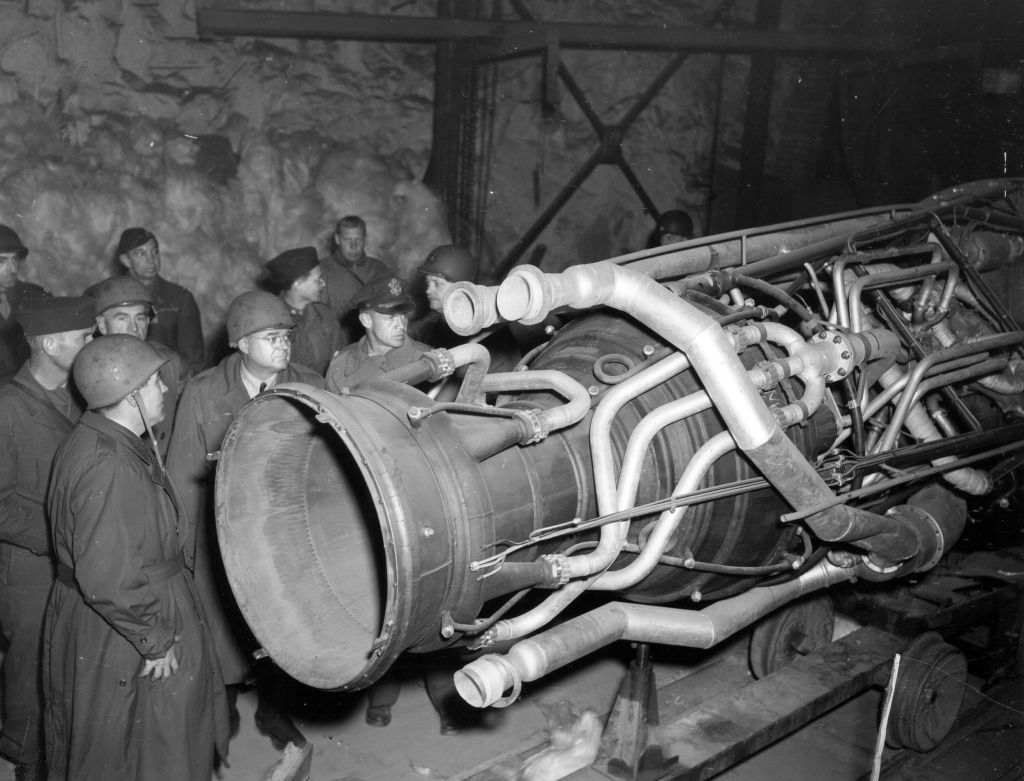
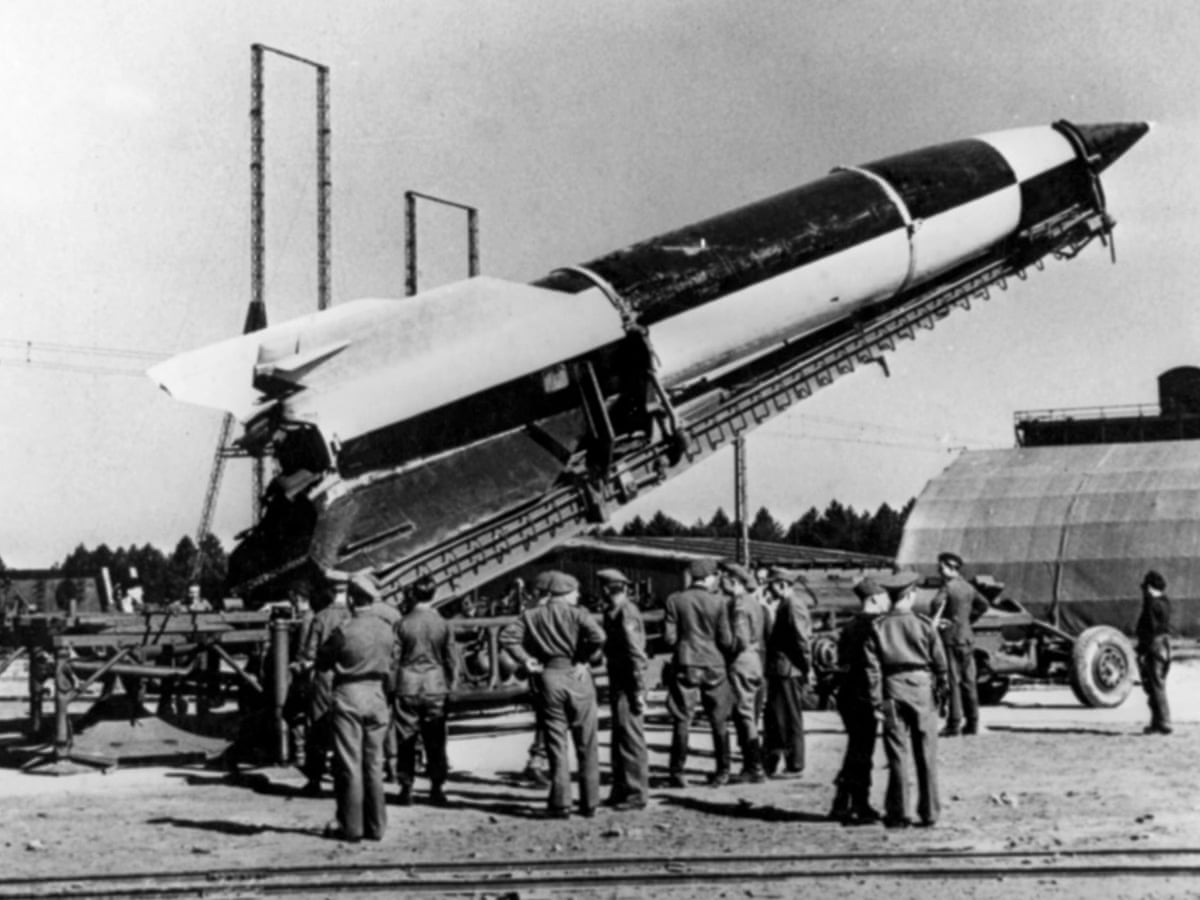
    By 1944, Allied troops were closing in on Germany. U.S. and British intelligence began identifying key figures in German research — men like Wernher von Braun, Arthur Rudolph, and Hubertus Strughold. These were the architects of Hitler’s advanced weapons programs, including the terrifying V-2 rocket, which had bombed London and Antwerp in the final stages of the war.

    The Allies knew the Soviets were also hunting for these scientists. Whoever captured them would gain not just knowledge, but technological dominance for decades to come.

    In late 1945, the U.S. Army launched Operation Overcast, soon renamed Operation Paperclip (because the scientists’ files were marked with paperclips to identify them). Officially, it was about collecting data. In reality, it was about recruiting Germany’s top scientific talent before the Soviets could.


    Who Were the Men Behind the Operation?

    The most famous figure was Wernher von Braun, a rocket engineer who had dreamed of space travel since childhood.

    Under the Nazis, von Braun led the design of the V-2 rocket — a weapon built using slave labor from concentration camps like Mittelbau-Dora.

    V2 rockets strike Britain - archive | Second world war | The Guardian


    After Germany’s defeat, von Braun and his team surrendered to the Americans in Austria. He was soon whisked away to Fort Bliss, Texas, to begin work for the U.S. Army.

    Others joined him — chemists, physicians, aviation experts, and physicists. Some had dark pasts. Many were involved in unethical human experiments or had worked directly under the Nazi regime. But as the Cold War heated up, the U.S. government decided that their value outweighed their crimes.

    The moral line blurred. What mattered now was keeping the knowledge out of Soviet hands.


    The Space Race Begins

    Once in the U.S., these scientists began reshaping American research and defense.
    Von Braun’s team helped develop the Redstone and Jupiter-C missiles — critical steps in U.S. rocket technology.

    Saturn V - Wikipedia

    By 1958, as tensions with the Soviet Union escalated, the newly formed NASA tapped von Braun to lead its space division. His work culminated in the Saturn V rocket, the massive engine that powered the Apollo missions to the Moon.

    Yes — the same man who built rockets for Hitler would later help America land on the Moon in 1969.

    Operation Paperclip had achieved its goal: technological superiority. But at what cost?


    The Cold War Justification

    To U.S. officials, the logic was simple: if we didn’t recruit them, the Soviets would.
    The Soviet Union was aggressively capturing German scientists, relocating thousands to facilities in Russia to boost their weapons and space programs.

    The U.S. couldn’t afford to fall behind.
    The fear of Soviet dominance — from atomic weapons to spaceflight — drove the moral compromises of Paperclip.

    Officially, the U.S. denied bringing Nazis into the country. But classified memos and declassified files later revealed that background checks were altered or destroyed, whitewashing the pasts of key scientists so they could enter the U.S. under false pretenses.

    It was a quiet bargain with the devil — one that reshaped modern history.


    Scientific Breakthroughs and Hidden Shadows

    The scientists brought under Operation Paperclip weren’t just rocket engineers. They included medical researchers, chemists, and aviation experts whose work laid the foundation for American advancements in space medicine, jet propulsion, and even early computing systems.

    • Hubertus Strughold, known as the “father of space medicine,” helped design the life-support systems for astronauts. But his legacy is clouded by accusations that he had overseen inhumane experiments on prisoners during the war.
    • Arthur Rudolph, another key engineer, directed the Saturn V rocket program. Later, he was investigated for his role in Nazi forced labor camps and voluntarily left the U.S. in 1984.

    Their brilliance propelled America into the future. Their pasts remained buried — until decades later, when historians and journalists began uncovering the truth.

    Operation Paperclip wasn’t just about science — it was about secrecy, morality, and the price of progress.


    Public Exposure and Moral Reckoning

    For decades, the American public knew little about Operation Paperclip. It wasn’t until the 1970s, when investigative journalists and declassified documents came to light, that the full story emerged.

    Books like “Operation Paperclip: The Secret Intelligence Program That Brought Nazi Scientists to America” by Annie Jacobsen revealed the hidden side of this grand experiment.

    The revelations shocked many Americans. How could the U.S., the self-proclaimed defender of freedom, employ men tied to a regime responsible for genocide?
    Government officials defended the decision as a strategic necessity — a move that ensured victory in the Cold War and accelerated America’s dominance in technology and space.

    In hindsight, historians still debate the ethics. Some see it as pragmatic survival in a dangerous world. Others view it as moral hypocrisy that stained America’s postwar legacy.


    The Legacy of Operation Paperclip

    Despite its dark origins, the legacy of Operation Paperclip is woven deeply into the fabric of modern science and defense.

    The technologies born from it influenced everything from ICBM systems to satellite launches and space exploration. The Apollo 11 mission, which put Neil Armstrong on the Moon, was a direct descendant of the V-2 program.

    Even modern missile defense systems and space research trace their roots back to the Paperclip scientists.

    But the operation also left behind a more haunting legacy — a reminder that progress often walks hand-in-hand with moral compromise.
    It raised the timeless question: Can scientific achievement ever be separated from the ethics of those who create it?


    Conclusion: A Deal That Changed the Future

    Operation Paperclip was more than a secret mission — it was a turning point in human history.
    By recruiting former enemies, the United States secured a technological lead that would define the 20th century. But it also blurred the moral lines between justice and survival.

    The rockets that once terrorized Europe carried mankind to the Moon.
    The scientists who worked under a dictator helped inspire a generation of discovery.

    It’s a paradox that still defines our modern age — the uneasy balance between ambition and accountability.
    And in that tension lies the true story of Operation Paperclip — the operation that turned war into wonder.


    Citations

    1. Jacobsen, Annie. Operation Paperclip: The Secret Intelligence Program That Brought Nazi Scientists to America. Little, Brown and Company, 2014.
    2. Bower, Tom. The Paperclip Conspiracy: The Hunt for the Nazi Scientists. Little, Brown, 1987.
    3. Neufeld, Michael J. Von Braun: Dreamer of Space, Engineer of War. Alfred A. Knopf, 2007.
    4. NASA History Office Archives, “Wernher von Braun and the U.S. Space Program.”
    5. U.S. National Archives, Operation Paperclip Records, 1945–1959.