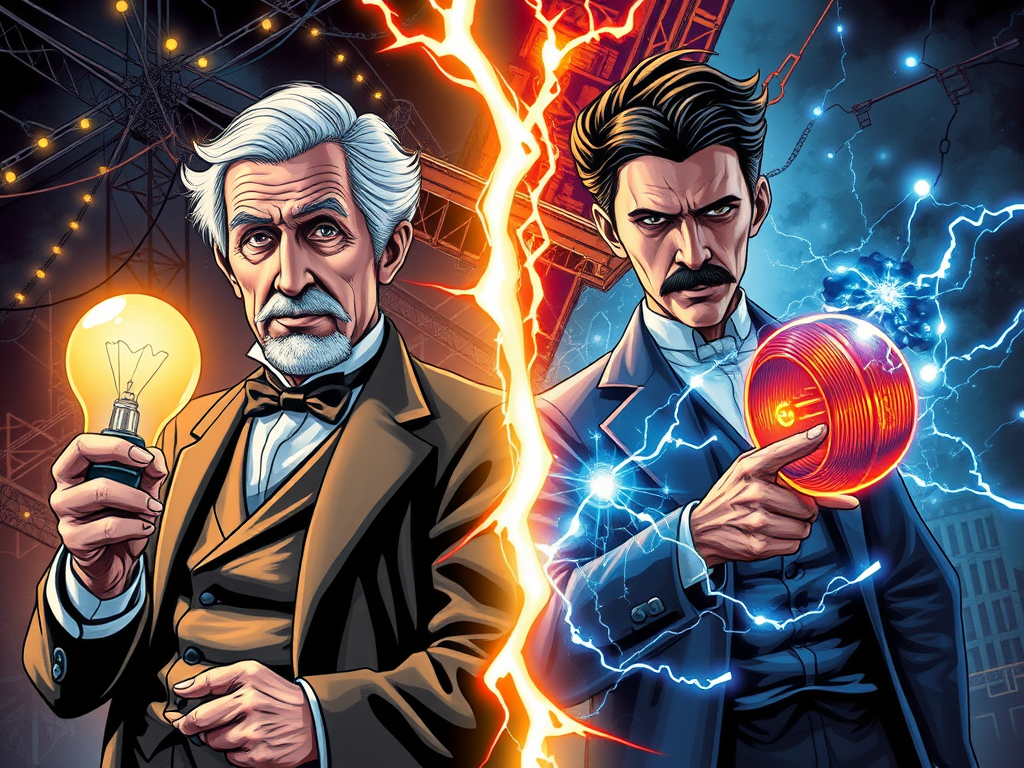
The Shocking Battle That Decided How the Modern World Uses Electricity
Introduction: The World Before Wires
Today, electricity is everywhere. We flip a switch and lights appear. We plug in our phones, laptops, and TVs without thinking. But in the late 1800s, electricity was new, rare, and dangerous. Only a few cities even had electric lights, and most people still used gas lamps or candles.
Before the modern world could be born, humanity needed a safe, powerful, and affordable way to deliver electricity to everyone. And that is where the first great tech war began—a fight between two brilliant men with two very different visions:
- Thomas Edison, the inventor of the light bulb, who believed in direct current (DC)
- Nikola Tesla, a genius immigrant inventor, who championed alternating current (AC)
Their conflict became known as The War of the Currents. It involved science, business, politics, public fear, and even a bit of showmanship. It shaped the power grid we still use today.
This is the story of how two men fought to control the future—and how one idea eventually powered the world.
I. The Rise of Thomas Edison: America’s First Tech Superstar
Edison’s DC Vision
In the 1870s and 1880s, Thomas Edison was America’s most famous inventor. He created:
- The light bulb
- The phonograph
- Early motion picture devices
- The first power company
Edison dreamed of electrifying entire cities. But he believed the safest way to deliver electricity was direct current (DC), which traveled in one direction and had a steady flow.
It worked—but only over very short distances.
DC power plants could serve only a few square blocks. That meant dozens or even hundreds of small power stations would be needed in every city. Edison believed this was the future, and he invested everything into DC power systems.
Edison Builds an Empire
By the early 1880s:
- Edison opened the first commercial power station in New York
- He powered homes, businesses, and streetlights
- His company became the face of modern electricity
To many Americans, Edison was electricity.
But he wasn’t the only one with big ideas.
II. Enter Nikola Tesla: The Outsider Who Saw a Different Future
Tesla’s Early Life and Genius
Nikola Tesla came from what is now Croatia. From a young age, he had a gift for visualizing inventions entirely in his mind. He could design machines without sketches, memorizing every gear and every bolt.
Tesla moved to the United States in 1884 with one goal: work for Thomas Edison.
He hoped to improve Edison’s electrical systems. But the two men were opposites:
| Edison | Tesla |
|---|---|
| Practical | Theoretical |
| Trial-and-error | Mathematical precision |
| Business-driven | Idea-driven |
| Preferred DC | Invented AC |
Edison wanted results fast. Tesla wanted perfection.
Their partnership didn’t last long.
Tesla Builds His AC System
Tesla believed that alternating current (AC) was the key to electrifying the world. AC power flowed back and forth, which meant:
- It could travel hundreds of miles
- It could power entire cities from one plant
- It was cheaper to build
- It could be converted to higher or lower voltages easily
This made AC far more efficient than DC.
But Edison refused to accept AC. He claimed it was too dangerous. Their disagreement created a rivalry that would soon explode across America.
III. The War Begins: Edison vs. Tesla
Edison Launches a Fear Campaign
Edison saw AC as a threat to his business empire. So he began a public crusade to convince people that AC was deadly.
His team:
- Gave public demonstrations shocking animals with AC
- Released pamphlets warning cities about “AC accidents”
- Lobbied politicians to ban AC lines
- Supported the electric chair as a way to label AC as “lethal power”
Edison hoped to paint AC as a hazard that could kill anyone who touched it.
The newspapers called it:
“The Electrical Execution War.”
(Source: Seifer, Wizard: The Life and Times of Nikola Tesla)
Tesla Finds a Powerful Ally: George Westinghouse
George Westinghouse, an inventor and businessman, saw the future in AC. He partnered with Tesla, buying Tesla’s patents and giving him a lab to continue his work.
Together, Tesla and Westinghouse formed a team that could challenge Edison’s entire empire.
This turned the fight into a full corporate war:
- Edison Electric (DC)
- Westinghouse Electric (AC)
The future of electricity—and billions of dollars—were at stake.
IV. The Turning Point: Lighting the World’s Fair
The Battle for Chicago, 1893
The biggest fight of the War of the Currents happened at the World’s Columbian Exposition in Chicago. The fair needed electricity to power thousands of lights, machines, and exhibits.
Two companies bid:
- Edison Electric (DC)
- Westinghouse/Tesla (AC)
Edison’s bid was nearly twice as expensive.
Westinghouse won the contract.
Tesla Lights Up the Night
When the fair opened, more than 200,000 light bulbs powered by Tesla’s AC system lit up the night sky.
People gasped. Many had never seen electric lights before—let alone an entire city block glowing white.
This moment changed everything.
Newspapers wrote:
“The future belongs to alternating current.”
(Source: Jonnes, Empires of Light)
Edison had lost the first major battle.
V. The Final Blow: Harnessing Niagara Falls
A Power Source Like No Other
Niagara Falls was the greatest source of natural energy in North America. Whoever could harness it would control the future of electricity.
Two proposals came in:
- Edison’s DC system
- Tesla’s AC system
In 1895, the decision was made:
Tesla’s AC would power the project.
Tesla’s System Powers a Region
By 1896, AC power from Niagara Falls reached Buffalo, New York—20 miles away. It was the longest and most powerful electrical transmission ever built at the time.
Soon:
- Factories switched to AC
- Cities expanded electric grids
- The telephone, streetcars, and appliances spread everywhere
DC faded from the world stage.
Tesla’s vision had won.
VI. The Aftermath: How the Tech War Shaped the Modern World
Edison Was Forced to Change
After losing the War of the Currents, Edison’s company eventually became part of General Electric, which quietly adopted AC technology. Edison himself stepped back from the electric industry and focused on other inventions.
Tesla Became the Father of Modern Power
AC power became the global standard, used in:
- Homes
- Skyscrapers
- Cities
- Factories
- Power grids
Today, about 95% of the world uses Tesla’s AC systems. (Source: Carlson, Tesla: Inventor of the Electrical Age)
The First Modern Tech Rivalry
The War of the Currents taught the world:
- Innovation is not enough—business strategy matters
- Public fear can shape technology
- The best idea doesn’t always win quickly
- Technology wars shape generations
It was the “Silicon Valley battle” of its time—long before computers, smartphones, or social media.
VII. The Human Side: Two Geniuses, One Dream
Edison: The Builder
Edison was a tireless worker and a brilliant businessman. His factories produced inventions that changed daily life. Even though he fought AC, his contributions to electricity were still vital.
Tesla: The Visionary
Tesla was imaginative, idealistic, and ahead of his time. He dreamed of:
- Wireless global power
- Renewable energy
- Unlimited free electricity
Some of his ideas were too advanced for the era, but many came true decades later.
They Both Changed the World
Even though they clashed, both men helped create the foundation for modern technology. Their rivalry pushed innovations faster and farther than either could have done alone.
Conclusion: The Tech War That Powered the Future
The War of the Currents was more than a fight between inventors. It was a battle over how humanity would use energy for the next 100 years—and beyond.
In the end:
- Tesla’s AC powered the world
- Edison’s systems became the roots of modern technology
- Westinghouse’s investments helped build the power grid
The war proved that innovation takes courage, risk, and sometimes a bit of rivalry.
And today, every time we flip a switch, we are living in the world Tesla imagined—and Edison helped bring to life.
Citations
Carlson, W. Bernard. Tesla: Inventor of the Electrical Age. Princeton University Press, 2013.
Seifer, Marc J. Wizard: The Life and Times of Nikola Tesla. Citadel Press, 1996.
Jonnes, Jill. Empires of Light: Edison, Tesla, Westinghouse, and the Race to Electrify the World. Random House, 2003.
 Vellum Insights