Why a Narrow Waterway Between Iran and Oman Holds the Power to Shock the Entire World
Introduction: The World’s Most Dangerous Bottleneck
A narrow strip of water just a few dozen kilometers wide may be one of the most strategically important locations on Earth.
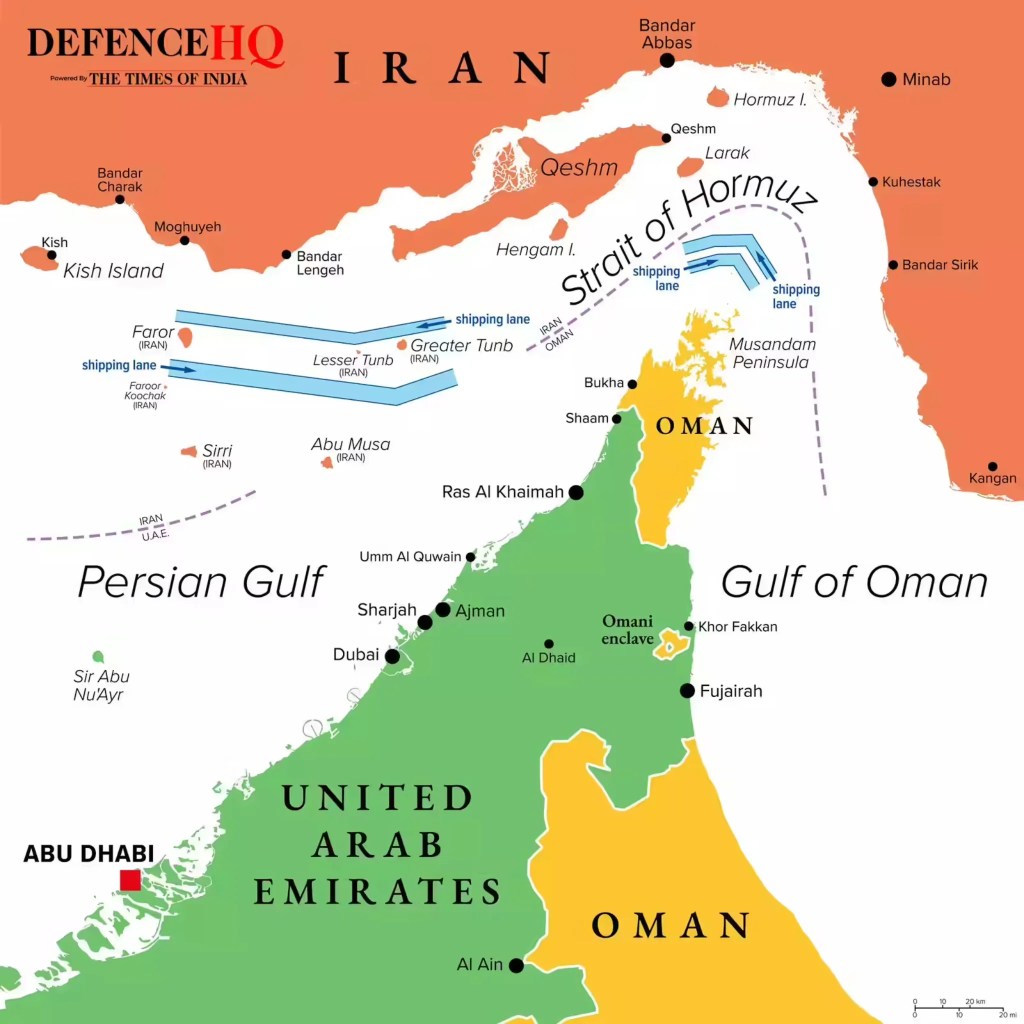
That waterway is the Strait of Hormuz, a narrow channel connecting the Persian Gulf to the Arabian Sea.
Every day, an enormous share of the world’s energy supply flows through this corridor. Tankers carrying oil and natural gas from Gulf producers pass through it on their way to Asia, Europe, and beyond.
Roughly 20 million barrels of oil per day — about 20% of global petroleum consumption — transit the strait, making it the most important energy chokepoint on the planet.
Because of this, any disruption in the strait has immediate global consequences.
Today, rising tensions involving Iran, Israel, and the United States have once again placed the Strait of Hormuz at the center of global attention.
Recent attacks on commercial vessels and threats to block the waterway have raised fears that the strait could become the epicenter of the next global economic shock.
To understand why, we need to explore how geography, energy, and military strategy intersect in this narrow passage.
Chapter 1: The Geography of a Global Chokepoint
The Strait of Hormuz lies between:
- Iran to the north
- Oman and the Musandam Peninsula to the south
At its narrowest point, the strait is only about 33 kilometers (21 miles) wide.
Yet despite its narrow size, it carries a huge volume of global energy trade.
Oil exports from several major producers must pass through this route, including:
- Saudi Arabia
- Iraq
- Kuwait
- Qatar
- United Arab Emirates
- Iran
This concentration of energy exports makes the strait one of the world’s most critical maritime chokepoints.
In fact:
- Around 20% of global oil consumption passes through the strait.
- Nearly one-fifth of global LNG trade also travels through the corridor.
Few alternative routes exist for these exports.
If the strait closes, the global energy market would feel the shock almost immediately.
Chapter 2: Why the Strait Matters to the Global Economy
Energy is the lifeblood of the global economy.
Factories, transportation systems, agriculture, and electricity grids all depend on steady fuel supplies.
Because such a large portion of global oil exports moves through the Strait of Hormuz, any disruption can rapidly drive prices higher.
A full closure could remove tens of millions of barrels of oil per day from global supply, creating a severe market shock.
Recent reports warn that disruptions to the strait could trigger one of the worst energy crises in modern history.
Countries especially vulnerable include major energy importers such as:
- Japan
- China
- India
- South Korea
About 84% of oil passing through the strait ultimately goes to Asian markets, making the region particularly dependent on its stability.
In a worst-case scenario, oil prices could spike dramatically, causing inflation and economic slowdowns across the world.
Chapter 3: The Strait of Hormuz in Past Conflicts
The strait has long been a flashpoint in Middle Eastern geopolitics.
One of the most dangerous periods occurred during the Iran–Iraq War (1980–1988).
During the later stages of that conflict, both sides began targeting oil tankers in what became known as the Tanker War.
Iran and Iraq attacked shipping vessels in the Persian Gulf in an attempt to damage each other’s economies.
The attacks soon drew in outside powers.
The United States launched Operation Earnest Will, escorting Kuwaiti oil tankers through the Gulf to protect them from attacks.
This period demonstrated how quickly regional conflicts in the Gulf can escalate into international crises.
Chapter 4: Iran’s Strategy — The Threat of Closure
For decades, Iran has maintained that it could close the Strait of Hormuz if threatened.
Iran cannot easily match the naval power of the United States or its allies in conventional warfare.
Instead, it relies on asymmetric naval tactics, including:
- naval mines
- anti-ship missiles
- swarm attacks by small fast boats
- drones targeting shipping
These tactics are designed to make the strait too dangerous for commercial traffic.
Even a partial disruption could cause major economic damage.
Recent attacks on cargo vessels and drone strikes in the region illustrate how quickly shipping routes can become unsafe during escalating conflict.
Chapter 5: The Naval Forces Guarding the Strait
Because the strait is so vital, multiple military powers operate in the surrounding waters.
The United States maintains a large naval presence in the region through the United States Navy and the U.S. Central Command.
Its mission includes protecting freedom of navigation and safeguarding global energy supplies.
Other countries also patrol nearby waters, including:
- United Kingdom
- France
- Saudi Arabia
Despite this military presence, the strait remains vulnerable.
The narrow shipping lanes make tankers easy targets for mines, missiles, or drone attacks.
Chapter 6: The Economic Domino Effect of a Closure
If the Strait of Hormuz were closed for a prolonged period, the consequences would ripple across the global economy.
Possible effects include:
Oil Price Shock
A sudden reduction in supply could push oil prices dramatically higher.
Some analysts warn prices could surge above $100 per barrel if shipping disruptions persist.
Global Inflation
Higher energy costs would raise transportation and manufacturing prices worldwide.
This would likely increase inflation in both developed and developing economies.
Shipping Disruptions
Commercial vessels might be forced to reroute around longer and more expensive routes.
Insurance premiums for shipping in the region could skyrocket.
Strategic Oil Reserves
Countries may release emergency reserves to stabilize markets.
In fact, the International Energy Agency has already coordinated massive reserve releases during past energy crises.
Chapter 7: Can the Strait Be Bypassed?
Some countries have attempted to reduce dependence on the strait by building alternative export routes.
Examples include pipelines from Saudi Arabia and the United Arab Emirates that allow some oil to bypass the waterway.
However, these pipelines cannot handle the full volume of exports that normally travel through the strait.
Most energy shipments from the Persian Gulf still depend on the Strait of Hormuz.
This means that even partial disruptions could send shockwaves through global markets.
Conclusion: The Narrow Passage That Holds Global Power
The Strait of Hormuz is a powerful example of how geography shapes global politics.
A narrow waterway between Iran and Oman has become one of the most important strategic locations in the modern world.
Through this small corridor flows:
- a fifth of the world’s oil
- massive LNG shipments
- billions of dollars in global trade
As tensions rise in the Middle East, the strait remains one of the most dangerous flashpoints in international politics.
If conflict escalates and shipping is disrupted, the consequences could extend far beyond the region.
Energy markets, global inflation, and economic stability all depend on keeping this narrow passage open.
In the modern world, the Strait of Hormuz is not just a shipping route.
It is one of the most critical pressure points in the global economy.
Sources & Citations
- U.S. Energy Information Administration – Global Oil Transit Chokepoints Report.
- Reuters Energy Analysis – Strait of Hormuz Oil Transit Data.
- Energy Trade Analysis – Global LNG and Oil Flows through Hormuz.
- International Energy Agency – Strategic Petroleum Reserve Releases.
- Regional conflict updates on shipping attacks in the strait.
- Global energy crisis warnings linked to potential closure.
 Vellum Insights