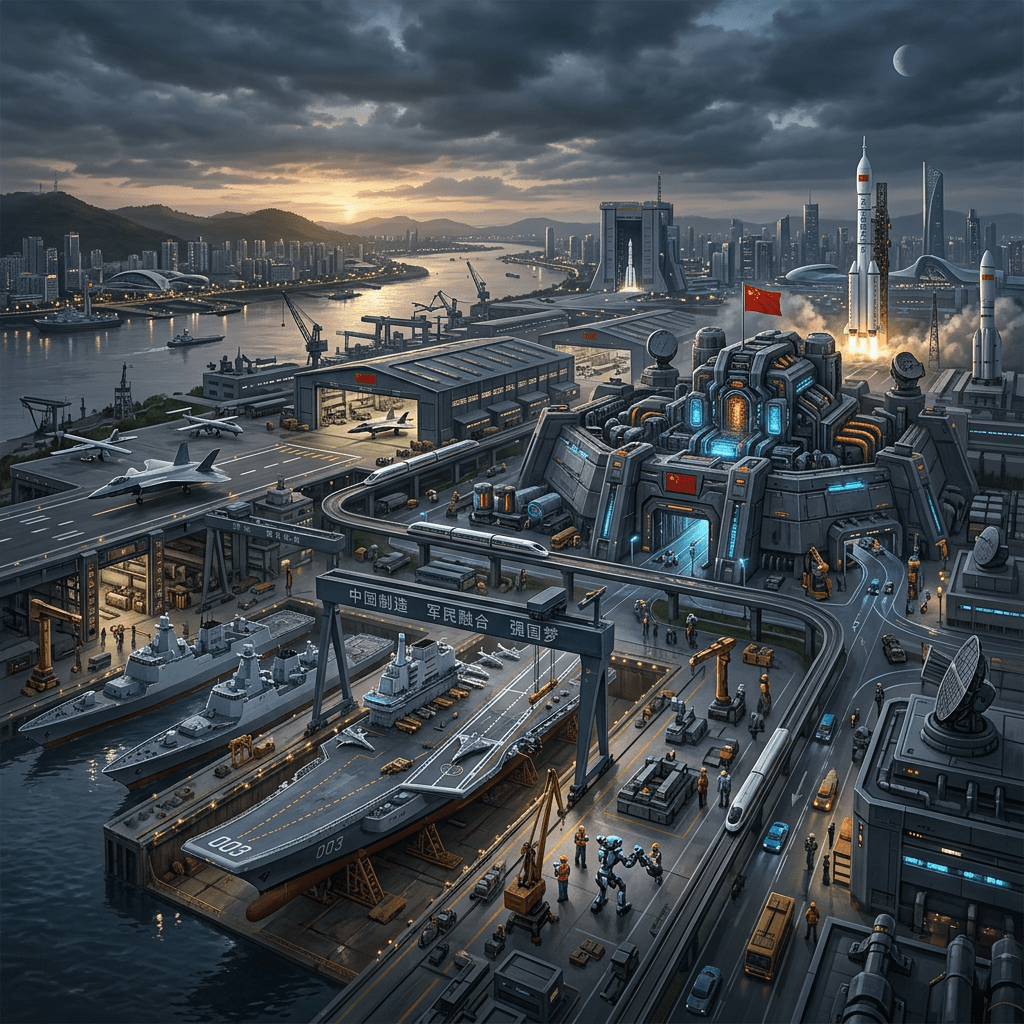
How Beijing Uses Industry, Supply Chains, and Global Trade to Strengthen Its Military Position
Introduction: When Economic Power Becomes Military Power
In modern geopolitics, wars are no longer determined only by tanks, ships, and missiles.
Economic power has become one of the most important foundations of military strength.
Few countries demonstrate this connection more clearly than China.
Over the past four decades, China has transformed from a developing economy into the world’s second-largest economy. This growth has not only improved living standards but also enabled the country to build one of the most advanced and rapidly expanding militaries in the world.
The connection between economics and military strength is not accidental.
China’s leaders have pursued a strategy that links industrial development, technological advancement, and military modernization.
Through this approach, economic success becomes a strategic tool that supports national security.
Understanding how China’s economy strengthens its military power helps explain the country’s growing influence in global geopolitics.
Chapter 1: The Foundation — China’s Manufacturing Powerhouse
One of the key pillars of China’s economic strength is its massive manufacturing sector.
China produces an enormous range of industrial goods, from consumer electronics to heavy machinery.
According to global economic data, China accounts for roughly one-third of the world’s manufacturing output, making it the largest manufacturing economy on Earth.
This industrial capacity provides significant military advantages.
A strong manufacturing base allows a country to:
- produce weapons and equipment at scale
- rapidly expand production during wartime
- maintain complex supply chains for military hardware
China’s industrial capacity supports the modernization of the People’s Liberation Army, the country’s armed forces.
Military equipment such as aircraft, naval vessels, missiles, and armored vehicles all depend on advanced manufacturing capabilities.
Because China controls such a large industrial base, it can sustain long-term military development programs more easily than many other nations.
Chapter 2: The Civil-Military Fusion Strategy
One of China’s most important strategic policies is known as Military-Civil Fusion.
This policy encourages cooperation between civilian industries and the military.
Instead of separating commercial technology from military applications, China actively integrates the two sectors.
Under this approach:
- private companies contribute technological innovations
- universities conduct research useful for defense
- commercial technologies are adapted for military use
The goal is to accelerate military development by using the country’s broader economic ecosystem.
For example, technologies developed for commercial industries—such as artificial intelligence, drones, and advanced electronics—can also enhance military capabilities.
This integration allows the military to benefit directly from China’s rapidly growing technology sector.
Chapter 3: Shipbuilding and the Rise of China’s Navy
One of the most visible examples of economic power translating into military strength is China’s naval expansion.
China’s commercial shipbuilding industry is one of the largest in the world.
This industrial capacity has helped support the rapid growth of the People’s Liberation Army Navy.
Shipyards that build commercial vessels can also produce naval ships.
As a result, China has been able to launch large numbers of modern warships, including:
- destroyers
- amphibious assault ships
- aircraft carriers
In recent years, the Chinese navy has grown into the largest naval fleet in the world by number of ships.
This expansion is directly supported by China’s massive shipbuilding industry.
Without this industrial base, such rapid naval growth would be far more difficult.
Chapter 4: Technology and the Military Innovation Race
Economic growth has also allowed China to invest heavily in technological research and development.
Chinese companies are now major players in areas such as:
- artificial intelligence
- telecommunications
- robotics
- quantum computing
These technologies have important military applications.
For example, artificial intelligence can improve battlefield decision-making and autonomous weapons systems.
Advanced telecommunications technology can strengthen military communications networks.
One example of China’s technological rise can be seen in companies such as Huawei, which has become a global leader in telecommunications infrastructure.
Technological advancements developed by such companies can influence both civilian and military capabilities.
Chapter 5: Control of Critical Supply Chains
Another important aspect of China’s economic strategy is its control over key global supply chains.
China dominates the production and processing of many critical minerals, including rare earth elements.
These materials are essential for modern technologies such as:
- advanced electronics
- electric motors
- missile guidance systems
- military radar equipment
Because China controls a large share of the global rare earth supply chain, it has significant leverage in international trade.
In a geopolitical crisis, control of these resources could influence global technology production and military supply chains.
Chapter 6: Infrastructure and Strategic Logistics
China has also invested heavily in infrastructure that can support both economic growth and military logistics.
Major infrastructure projects include:
- high-speed rail networks
- modern highways
- large deep-water ports
Many of these projects were built under initiatives such as the Belt and Road Initiative, which funds infrastructure projects across Asia, Europe, and Africa.
While these projects are primarily economic, they can also have strategic implications.
Ports built through the Belt and Road Initiative could potentially support naval logistics or resupply operations.
Similarly, domestic transportation networks allow rapid movement of troops and equipment across China’s vast territory.
Chapter 7: Defense Spending and Economic Resources
China’s economic growth has also enabled significant increases in defense spending.
China now has one of the largest military budgets in the world, second only to the United States.
This funding supports:
- advanced weapons development
- modernization of military equipment
- expansion of naval and air forces
- development of space and cyber capabilities
Economic strength allows China to sustain long-term defense investment without placing excessive strain on its national finances.
This financial stability is a key advantage in long-term strategic competition.
Chapter 8: Economic Resilience as Strategic Defense
In modern geopolitics, economic resilience is an essential part of national security.
Countries that rely heavily on foreign supply chains can become vulnerable to sanctions or trade disruptions.
China has worked to reduce these vulnerabilities by strengthening domestic industries and stockpiling key resources.
This strategy includes:
- building strategic reserves of food and energy
- expanding domestic semiconductor production
- diversifying trade partnerships
These measures help ensure that China’s economy—and its military supply chains—can continue operating even during periods of geopolitical tension.
Chapter 9: The Global Balance of Power
China’s economic strength has fundamentally reshaped the global balance of power.
For much of the twentieth century, military dominance was closely tied to economic leadership.
Today, China’s rise as a major economic power is enabling it to expand its influence across multiple domains:
- military power
- technology development
- international trade
- global infrastructure investment
This shift has contributed to increasing strategic competition between China and other major powers.
Economic competition is now deeply intertwined with military and geopolitical rivalry.
Conclusion: The Economic Foundations of Military Power
China’s rise illustrates a fundamental truth about modern geopolitics.
Military strength does not exist in isolation.
It depends on a nation’s economic foundations.
By building a massive industrial base, investing in advanced technology, and controlling key supply chains, China has created the economic conditions necessary to support a powerful and modern military.
These economic advantages help sustain long-term military modernization and strategic influence.
As global competition continues, the relationship between economic power and military capability will remain one of the defining factors shaping the future of international security.
In the twenty-first century, the strongest armies are often built not only in military bases—but also in factories, laboratories, and supply chains.
Sources & Citations
- World Bank – Data on global manufacturing output and economic indicators.
- U.S. Department of Defense – Reports on Chinese military modernization.
- Center for Strategic and International Studies – Analysis of China’s civil-military fusion strategy.
- International Institute for Strategic Studies – Global defense spending reports.
- Organisation for Economic Co‑operation and Development – Research on global supply chains and industrial capacity.

