Inside the Hidden Tunnel Networks Designed to Protect Iran’s Deadliest Weapons
Introduction: The Hidden Arsenal Beneath the Mountains
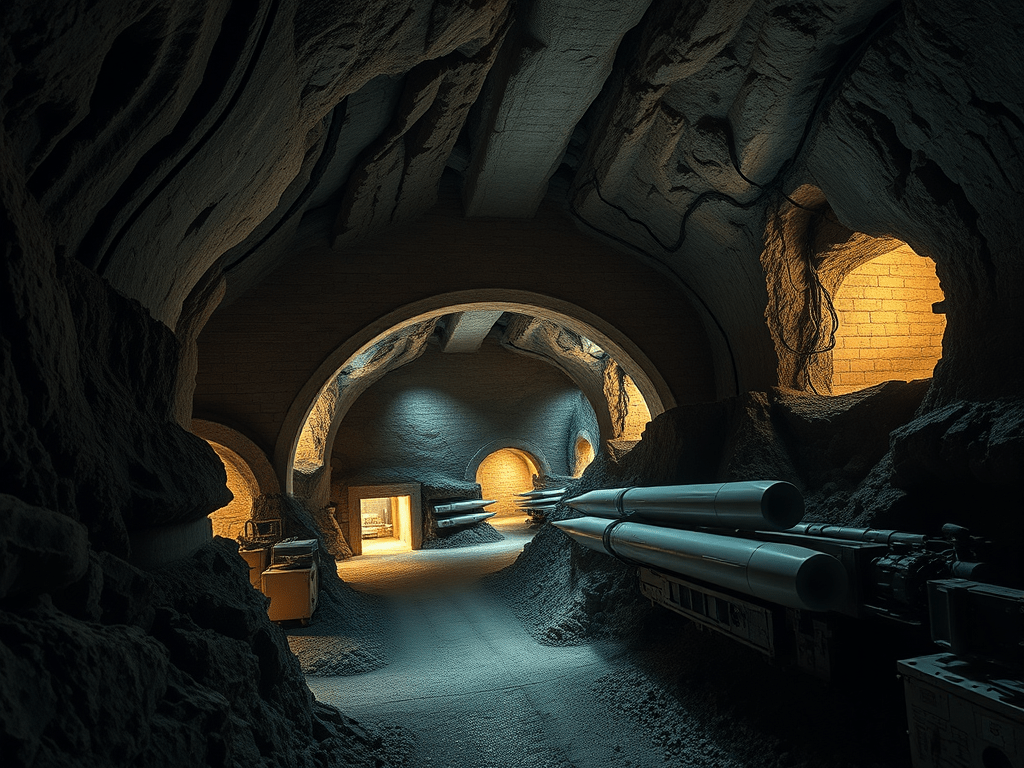
Deep beneath the mountains and deserts of Iran, massive tunnel complexes hide one of the most mysterious military systems in the world.
Iran calls them “missile cities.”
These underground bases are vast networks of tunnels carved into solid rock where ballistic missiles, drones, and launch systems are stored and prepared for war.
Many of these facilities are buried hundreds of meters underground, designed to survive airstrikes and continue launching missiles even during heavy bombardment.
For Iran’s military planners, these hidden bunkers serve one primary purpose:
Guaranteeing that Iran can strike back even if its surface military bases are destroyed.
This strategy—known as second-strike capability—has become the backbone of Iran’s missile doctrine.
But as modern surveillance and precision weapons improve, these secret underground cities are increasingly becoming the focus of global military attention.
Chapter 1: Why Iran Built Underground Missile Cities
Iran’s focus on missile warfare stems largely from its experiences during the Iran–Iraq War (1980–1988).
During that conflict, Iraqi missile strikes hit Iranian cities repeatedly. Iran had little ability to retaliate effectively.
The lesson for Iranian military leaders was clear:
Missiles could determine the outcome of future wars.
However, Iran faced several challenges:
- limited airpower compared with Western countries
- international arms sanctions
- vulnerability of surface military bases to airstrikes
To solve these problems, Iran began building hardened underground facilities where missiles could be hidden from surveillance and protected from attack.
Over the following decades, these tunnel systems expanded across the country.
Today they form one of the most extensive underground missile networks in the world.
Chapter 2: How Iran’s Missile Cities Work
The underground missile cities are not simple bunkers.
They are complete underground military complexes.
Some tunnels reportedly extend hundreds of meters below the surface, deep enough to resist most conventional bunker-busting bombs.
Inside these facilities are:
- missile storage chambers
- launch preparation areas
- command centers
- transportation tunnels
- ventilation and power systems
Some bases even contain rail systems or transport vehicles that move missiles from storage areas to launch points hidden on mountain slopes.
When a launch order is given, missiles are transported through the tunnels to hidden exits where they can be fired.
This design allows Iran to:
- protect its missile stockpiles
- conceal launch preparations
- rapidly deploy missiles during conflict
Chapter 3: The Missiles Hidden in the Mountains
Iran possesses the largest ballistic missile arsenal in the Middle East.
Many of these weapons are stored inside underground facilities.
Examples include missiles such as:
- the Emad ballistic missile
- the Sejjil ballistic missile
- the Ghadr missile
Some of these missiles have ranges between 1,000 and 2,500 kilometers, placing much of the Middle East within reach.
These weapons are operated primarily by the Islamic Revolutionary Guard Corps (IRGC), which controls Iran’s missile forces.
Because missiles can strike distant targets quickly, they are a central element of Iran’s deterrence strategy.
Chapter 4: Known Locations of Missile Cities
The exact locations of many missile cities remain secret.
However, intelligence analysts have identified several likely regions where these facilities exist.
Examples include:
- Kermanshah Province in western Iran
- Semnan Province in northern Iran
- mountainous regions near the Persian Gulf
One well-known installation is the Kermanshah Underground Missile Facility, which stores ballistic missiles such as the Fateh-110 and Qiam-1.
Many of these locations were chosen because Iran’s rugged terrain provides natural protection.
Mountains act as a shield against airstrikes while also hiding tunnel entrances.
Chapter 5: Why These Bases Are So Difficult to Destroy
Underground missile cities are designed to survive war.
Their defenses include:
Extreme Depth
Some tunnels are reportedly built hundreds of meters inside mountains, making them resistant to most conventional bombs.
Multiple Entrances
Many complexes have dozens of entrances spread across large areas.
Destroying one entrance does not necessarily disable the entire facility.
Concealed Launch Sites
Missile launch platforms can appear suddenly from hidden tunnel exits, allowing surprise attacks.
Because of these features, completely eliminating such bases would require extensive bombing campaigns or specialized bunker-penetrating weapons.
Chapter 6: The Growing Hunt for Iran’s Missile Cities
In recent conflicts, these underground facilities have become key military targets.
Iran’s Underground ‘Missile Cities’ Have Become One of Its Biggest Vulnerabilities

Satellite imagery shows extensive damage to Iran’s missile bases

Israel to attack Iran’s underground missile sites in second phase of war, sources say
Reports indicate that U.S. and Israeli forces have increasingly targeted missile city infrastructure such as tunnel entrances and launch systems.
Satellite imagery has revealed damage to facilities in areas like Tabriz and Kermanshah, where buildings near tunnel entrances were destroyed during airstrikes.
Military analysts say the strategy focuses on attacking launchers and access points, rather than attempting to destroy the entire underground complex.
When launch vehicles leave the tunnels, they become vulnerable to surveillance drones and precision strikes.
Chapter 7: The Strategic Purpose — Deterrence
Despite growing threats, Iran’s missile cities serve a clear strategic purpose.
They are designed to ensure that Iran can still retaliate after a first strike by an enemy.
This concept is similar to nuclear deterrence strategies used during the Cold War, where countries protected weapons in hardened silos to guarantee a response.
By hiding missiles underground, Iran aims to make any attack against it too risky for adversaries.
Even if many missiles are destroyed, some would likely survive.
Those surviving weapons would still be capable of launching devastating strikes.
Conclusion: The Hidden War Beneath the Mountains
Iran’s underground missile cities represent one of the most secretive military infrastructures in the modern world.
Hidden deep within mountains and deserts, these bases form the backbone of Iran’s missile deterrence strategy.
They allow Iran to protect its missile arsenal, conceal launch operations, and maintain the ability to retaliate during wartime.
But advances in satellite surveillance, drones, and precision airstrikes are beginning to challenge the effectiveness of these underground fortresses.
As tensions rise in the Middle East, the battle over these hidden bases may play a decisive role in future conflicts.
Because beneath the mountains of Iran lies not just tunnels and bunkers—
but one of the most powerful missile arsenals in the region.
Sources & Citations
- International Institute for Strategic Studies – Iranian missile force analysis.
- Center for Strategic and International Studies – Missile proliferation in the Middle East.
- U.S. Defense Intelligence Agency – Iranian missile capabilities report.
- Analysis of underground missile facilities and tunnel networks.
- Known underground missile bases and missile deployments.
- Reporting on airstrikes targeting missile facilities in recent conflicts.


 Vellum Insights