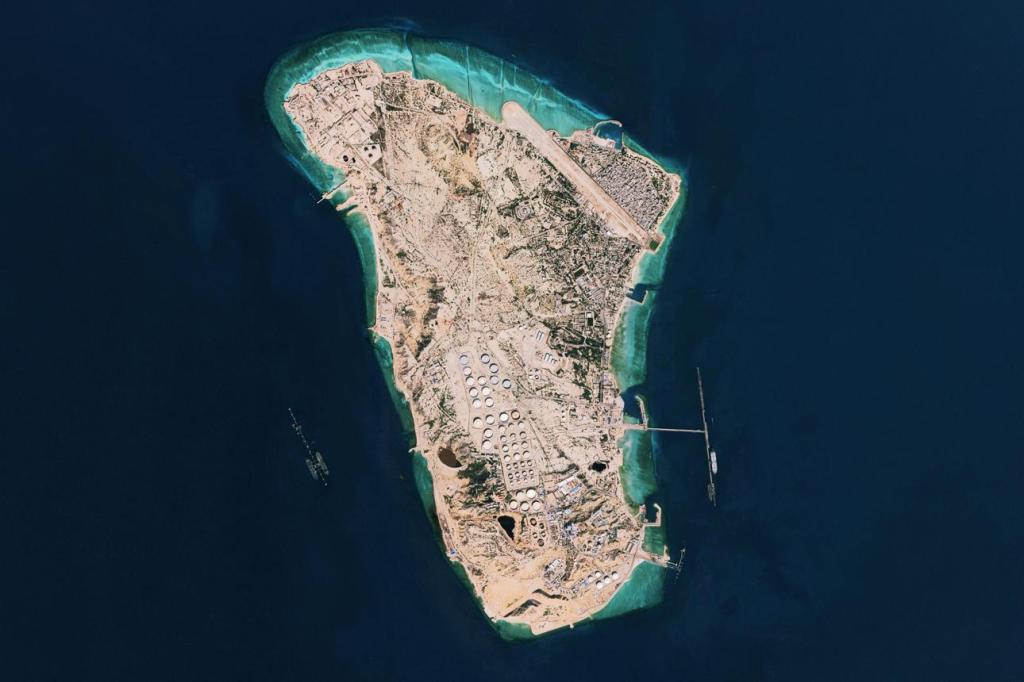
How One Small Island Became the Most Important Oil Target in the Iran–Iraq War
Introduction: The Island That Held a Nation’s Economy
In the waters of the Persian Gulf, about 25 kilometers off Iran’s coast, sits a small and rocky island that most people have never heard of.
At first glance, Kharg Island appears insignificant.
It has no massive cities.
No famous landmarks.
No large population.
Yet during one of the bloodiest conflicts of the twentieth century, this tiny island became one of the most strategically important locations on Earth.
For much of the Iran–Iraq War (1980–1988), Kharg Island handled the vast majority of Iran’s oil exports.
Without it, Iran’s economy could collapse.
Without oil revenue, Iran would struggle to buy weapons, fund military operations, or sustain its war effort.
Recognizing this vulnerability, Iraq launched hundreds of attacks against the island.
Bombers, missiles, and aircraft repeatedly targeted Kharg Island in an attempt to cripple Iran’s economy.
Yet despite years of bombardment, the island continued operating.
Its survival became one of the most remarkable logistical stories of modern warfare.
This is the story of how a tiny island became the beating heart of a nation at war.
Chapter 1: Why Kharg Island Mattered
Before the Iran-Iraq War began, Kharg Island was already one of the most important energy hubs in the Middle East.
The island served as Iran’s primary oil export terminal.
Crude oil from massive fields across Iran flowed through pipelines to Kharg, where giant tankers loaded millions of barrels for customers around the world.
By the late 1970s, approximately 90 percent of Iran’s oil exports passed through Kharg Island.
This made the island a critical economic lifeline.
Oil was not simply another export.
It was the foundation of Iran’s economy.
Revenue from oil sales funded:
- government spending
- infrastructure projects
- military purchases
- national development
In strategic terms, Kharg Island functioned like a giant economic artery.
If it stopped pumping oil, the nation would suffer severe consequences.
This reality did not go unnoticed in Baghdad.
Chapter 2: Saddam Hussein’s Economic War Strategy
When Saddam Hussein launched the Iran-Iraq War in 1980, he hoped for a quick victory.
Instead, the conflict became a brutal stalemate.
As the war dragged on, Iraq searched for ways to weaken Iran without relying solely on ground offensives.
One answer was economic warfare.
Iraqi planners recognized that Iran’s military depended heavily on oil income.
If Iraq could destroy Kharg Island, it could strike directly at the financial foundation of the Iranian war effort.
This strategy was simple:
- Destroy export infrastructure
- Reduce oil revenue
- Weaken Iran’s economy
- Limit Iran’s ability to continue fighting
In theory, it was a logical plan.
In practice, it would prove much harder than expected.
Chapter 3: The Air War Against Kharg Island
Beginning in the early 1980s, Iraq launched an extensive bombing campaign against Kharg Island.
The attacks became increasingly sophisticated over time.
Iraqi aircraft targeted:
- loading terminals
- storage tanks
- pumping stations
- port facilities
- tanker ships
The goal was to shut down oil exports completely.
French-made Dassault Mirage F1 fighters armed with anti-ship missiles became some of Iraq’s most effective tools.
These aircraft could strike targets from long distances and then quickly withdraw.
The attacks became so frequent that some observers described Kharg Island as one of the most heavily bombed economic targets in modern history.
Yet despite the destruction, exports continued.
Repair crews often began rebuilding damaged facilities almost immediately after attacks ended.
This constant cycle of destruction and reconstruction became a defining feature of life on the island.
Chapter 4: The Men Who Kept the Oil Flowing
The survival of Kharg Island was not simply a story of infrastructure.
It was also a story of people.
Engineers, technicians, dock workers, and construction crews remained on the island despite repeated attacks.
Every time facilities were damaged, workers rushed to repair them.
Storage tanks were rebuilt.
Pipelines were patched.
Loading systems were restored.
Many workers understood that keeping oil exports flowing was as important as any battlefield victory.
Without oil revenue, Iran’s ability to continue the war would be severely weakened.
As a result, Kharg Island became a frontline position in an economic war.
The workers stationed there were effectively part of Iran’s national defense effort.
Chapter 5: The Birth of the Tanker War
By 1984, attacks on Kharg Island expanded into something much larger.
The conflict evolved into what became known as the Tanker War.
Instead of focusing solely on oil terminals, both sides began targeting commercial shipping.
Oil tankers moving through the Persian Gulf became military targets.
Iraq hoped that attacks on shipping would discourage international companies from transporting Iranian oil.
Insurance rates skyrocketed.
Shipping companies faced growing risks.
Yet many tankers continued sailing.
The world depended heavily on Gulf oil supplies.
Completely halting exports proved difficult.
Kharg Island remained at the center of this maritime conflict.
Every tanker departing from the island became part of a larger geopolitical struggle.
Chapter 6: Innovation Under Fire
Faced with constant attacks, Iran adapted.
Rather than relying solely on fixed infrastructure, Iranian planners developed alternative methods for exporting oil.
These included:
- offshore loading systems
- dispersed storage facilities
- emergency repair teams
- alternative export routes
This flexibility made it harder for Iraq to achieve decisive results.
Every time a facility was destroyed, Iran found new ways to continue operations.
Military historians often point to this resilience as a key reason why Iraq failed to achieve its economic objectives.
Kharg Island demonstrated an important lesson:
Infrastructure can be damaged, but adaptive systems are much harder to destroy.
Chapter 7: Why Iraq Could Not Knock It Out
Despite hundreds of attacks, Kharg Island never completely stopped functioning.
Several factors explain this outcome.
Geography
The island’s location complicated military operations.
Aircraft had limited time over target areas before facing air defenses.
Redundancy
Iran built backup systems and alternative facilities.
Constant Repairs
Repair crews worked continuously to restore damaged infrastructure.
Global Demand
International buyers still needed oil.
Economic incentives encouraged continued exports despite the risks.
These factors combined to create a situation where Iraq could inflict damage but could not deliver a knockout blow.
Chapter 8: Lessons for Modern Warfare
Kharg Island remains highly relevant today.
Modern conflicts increasingly target economic infrastructure.
Military planners recognize that economies are often more vulnerable than armies.
Recent conflicts have seen attacks on:
- oil facilities
- pipelines
- power stations
- ports
- shipping networks
The story of Kharg Island demonstrates both the power and limitations of economic warfare.
Strategic infrastructure matters enormously.
But resilience matters too.
Countries that can quickly repair damage and adapt to disruption are much harder to defeat.
This lesson continues to influence military thinking around the world.
Chapter 9: The Legacy of Kharg Island
Today, Kharg Island remains one of Iran’s most important energy facilities.
Although modern export routes have diversified somewhat, the island continues to play a major role in the country’s oil industry.
Its wartime experience also shaped Iran’s broader strategic thinking.
The Iranian government has invested heavily in:
- hardened infrastructure
- dispersed energy facilities
- underground storage systems
- alternative export capabilities
Many of these investments reflect lessons learned during the Iran-Iraq War.
The attacks on Kharg Island convinced Iranian planners that economic infrastructure would remain a primary target in future conflicts.
As a result, resilience became a national security priority.
Conclusion: The Island That Refused to Fall
Military history often focuses on famous battles, powerful generals, and advanced weapons.
Yet sometimes the outcome of a war depends on something much simpler.
An island.
A port.
A pipeline.
A tanker.
Kharg Island was never a battlefield in the traditional sense.
But it became one of the most important strategic locations in the Iran-Iraq War.
For eight years, Iraq attempted to destroy the economic lifeline that sustained its enemy.
For eight years, Iran fought to keep that lifeline open.
The result was one of history’s most intense campaigns against energy infrastructure.
And despite relentless attacks, Kharg Island endured.
Its story reminds us that wars are not won only on the front lines.
Sometimes they are won in the ports, terminals, and supply networks that keep a nation alive.
In the modern world, economic infrastructure is often as important as military firepower.
And few places illustrate that reality better than Kharg Island.
Sources & Citations
- The Tanker War: The Assault on Merchant Shipping During the Iran-Iraq Conflict.
- U.S. Energy Information Administration – Historical analysis of Persian Gulf oil exports and strategic infrastructure.
- Center for Strategic and International Studies – Research on energy security and maritime conflict.
- International Institute for Strategic Studies – Military assessments of the Iran-Iraq War.
- The Longest War: The Iran-Iraq Military Conflict.
- Naval History and Heritage Command – Historical records on the Tanker War and Persian Gulf operations.

