The Incredible Story of How a Small Nation Fought a Giant and Refused to Break
Introduction: When a Giant Knocked on the Door
In late 1939, Europe was already on fire. World War II had begun, and powerful nations were fighting for land, resources, and control. But far to the north, another story was unfolding—one that shocked the world and became a symbol of courage.
On November 30, 1939, the Soviet Union, one of the largest military powers on Earth, invaded Finland, a small country with limited weapons and only a few million people. On paper, the war should have lasted a week. The Soviets had:
- More than 20 times Finland’s soldiers
- Thousands of tanks
- Massive artillery
- A huge air force
- Unlimited supplies
Finland had:
- A tiny army
- Almost no tanks
- Old rifles
- A few dozen planes
- And winter gear sewn by hand
Yet somehow, Finland survived. For 105 days—through darkness, blizzards, starvation, and nonstop attacks—Finland fought back with skill, creativity, and sheer determination.
This fight became known as The Winter War, and it remains one of history’s most surprising military stories.
I. Why the Soviet Union Invaded Finland
Stalin’s Plan for Security
Before the war begun, Soviet leader Joseph Stalin believed Finland posed a threat to Leningrad (today’s St. Petersburg). The Soviet border was only 32 km from the city. Stalin demanded that Finland:
- Move its border west
- Lease ports to the USSR
- Hand over key islands
- Allow Soviet bases in Finland
Finland refused.
The Soviets claimed they felt unsafe. Finland felt bullied. Diplomacy failed, and Stalin made a decision:
He would take Finland by force.
The Soviet Military Expected an Easy Victory
The Soviet High Command believed:
- Finland would collapse quickly
- The Finnish people would not resist
- The war would end before winter got harsh
They were wrong on every point.
II. Finland’s First Defense: The Mannerheim Line
A Line of Forts—But Not Enough
Finland’s main defensive barrier was the Mannerheim Line, built across the Karelian Isthmus. But it wasn’t a real “wall.” It was:
- Bunkers
- Trenches
- Forest obstacles
- Concrete positions
Finland had so little money that some “forts” were just logs covered in dirt.
Still, the terrain helped. The area was:
- Dense forest
- Deep snow
- Cold beyond imagining
- Filled with lakes and swamps
The Soviets had never planned to fight here in winter.
The First Attacks Fail
When the Soviets charged the Mannerheim Line with tanks and infantry, they assumed Finland would crumble.
Instead:
- Finnish skis moved faster than Soviet vehicles
- Finnish soldiers knew every hill and frozen lake
- Soviet tanks got stuck in deep snow
- Finnish snipers took out officers
The Soviets were shocked:
Finland was fighting like a cornered wolf.
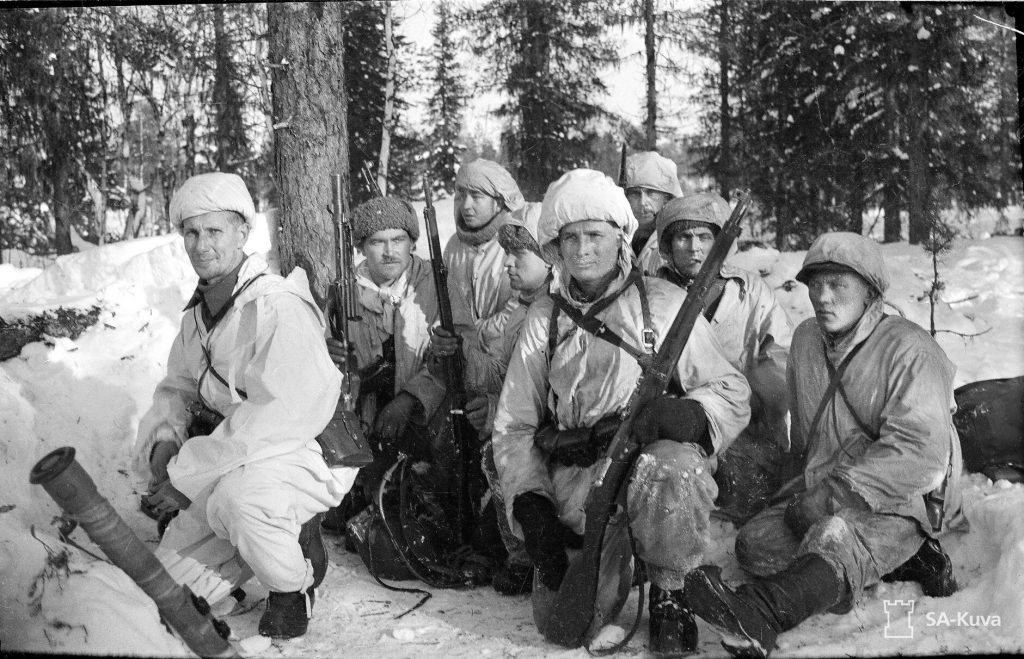
III. The Fighters in White: Finland’s Winter Warriors
Ski Soldiers of the North
Finland’s troops were mostly farmers, hunters, and woodsmen. They grew up in snow. Many could ski faster than horses could run. The Finns used skis to:
- Move silently
- Surround Soviet units
- Cut off supply lines
- Launch surprise raids
Soviet soldiers, wearing dark uniforms, sank into snow. Finnish troops, wearing white camouflage, vanished into the landscape.
Molotov Cocktails: Finland’s Homemade Tank Killer
Finland had almost no anti-tank weapons. So they invented a simple, deadly tool:
- A glass bottle filled with gasoline
- A burning rag as a wick
- Thrown onto a tank’s engine
They named it the Molotov Cocktail, mocking Soviet official Vyacheslav Molotov, who claimed the USSR was “dropping food supplies,” not bombs.
Finns joked:
“If Molotov gives us food, we will give him drinks in return.”
Simo Häyhä: The White Death
One man became a legend—the sniper Simo Häyhä. He operated alone, in temperatures below –30°C, using a basic rifle with no scope.
He recorded over 500 confirmed kills, making him the most effective sniper in history.
He never bragged. He simply said:
“I did what had to be done.”
His presence terrified Soviet units so much that they gave him a nickname:
The White Death.
IV. Soviet Mistakes: When the Giant Slipped
Poor Planning and Harsh Weather
The Soviets were not prepared for Arctic war. Their soldiers wore thin coats. Their trucks froze. Engines shut down. And their officers made critical mistakes:
- No understanding of terrain
- Tanks used in deep forests
- Long supply lines
- Soldiers marched in huge, easy-to-target columns
The Soviets had numbers. But Finland had the environment on its side.
The Raate Road Disaster
One of the worst defeats for the Soviet Army came on the Raate Road. A massive Soviet column became trapped on a narrow, snowy forest road.
Finnish forces executed the motti tactic—cutting the enemy into small pockets and destroying them one by one.
Thousands of Soviet soldiers froze, starved, or were captured. Entire divisions were wiped out.
V. The International Reaction: A Small Country Inspires the World
People Admired Finland’s Courage
Newspapers worldwide reported Finland’s bravery:
- “The tiny nation that refuses to fall.”
- “The Davids fighting a Soviet Goliath.”
Countries couldn’t send full armies, but volunteers came from:
- Sweden
- Denmark
- Norway
- Hungary
- Even the United States
Finland became a symbol of resistance.
The Soviet Union’s Embarrassment
Stalin expected a fast victory. Instead, the world mocked the USSR’s failures. Soviet generals were shocked at how badly their troops performed.
This humiliation pushed Stalin to escalate the war.
VI. The Final Phase: When Numbers Overwhelmed Courage
Soviets Return With Massive Force
By February 1940, the Soviets launched a second, much larger offensive:
- New commanders
- Better tactics
- More artillery
- More tanks
- More troops
They adjusted to Finnish defenses, used night attacks, and brought overwhelming firepower.
Finland Could Not Fight Forever
The Finnish army was brave but exhausted:
- Ammunition running low
- Food shortages
- Worn-out rifles
- No replacements
- Constant cold injuries
Eventually, the Mannerheim Line began to crumble.
VII. The Peace: Victory Through Survival
Finland Signs the Moscow Peace Treaty
On March 13, 1940, after 105 brutal days, Finland accepted peace terms. They had to give up:
- 11% of their territory
- Parts of Karelia
- Islands in the Gulf of Finland
- Key access to the Arctic
Over 400,000 Finns became refugees.
But Finland Remained Independent
The most important fact:
Finland did not fall.
Finland did not become Soviet territory.
They kept their government, their military, and their freedom.
In a war where they were outnumbered 20 to 1, simply surviving was a victory.
VIII. What Made Finland’s Defense So Impactful?
1. Tactical Innovation
Finland used:
- Ski warfare
- Motti tactics
- Ambushes
- Camouflage
- Night raids
They turned their weakness into new forms of warfare.
2. Morale and Unity
Finland fought as one nation. Rich or poor, city or village—everyone contributed.
3. Terrain Advantage
The Finns knew the land intimately. The Soviets did not.
4. Soviet Failures
Stalin’s purges removed many top officers. Logistics were poor. Strategies were outdated.
5. Weather
Temperatures fell to –40°C. The Finns survived. The Soviets did not.
Conclusion: How Finland Turned a Lost Cause Into a Legend
The Winter War was short but unforgettable. It showed that:
- Courage can outmatch numbers
- Good tactics can beat big armies
- A united nation can survive anything
- Even a giant can bleed
Finland lost land, but it kept its freedom. And its story inspired generations worldwide.
The Winter War remains one of history’s greatest examples of how a small nation, fighting in impossible conditions, refused to surrender—and won dignity, respect, and a place in military legend.
Citations
- Trotter, William R. A Frozen Hell: The Russo-Finnish Winter War of 1939–1940. Algonquin Books, 1991.
- Engle, Eloise & Paananen, Lauri. The Winter War: The Soviet Attack on Finland 1939–1940. Stackpole Books, 1973.
- Vehviläinen, Olli. Finland in the Second World War: Between Germany and Russia. Palgrave Macmillan, 2002.
- Upton, Anthony F. Finland in Crisis 1940–1941. University of Minnesota Press, 1964.
- Lunde, Henrik O. Finland’s War of Choice: The Troubled German-Finnish Alliance in World War II. Casemate Publishers, 2011.
 Vellum Insights