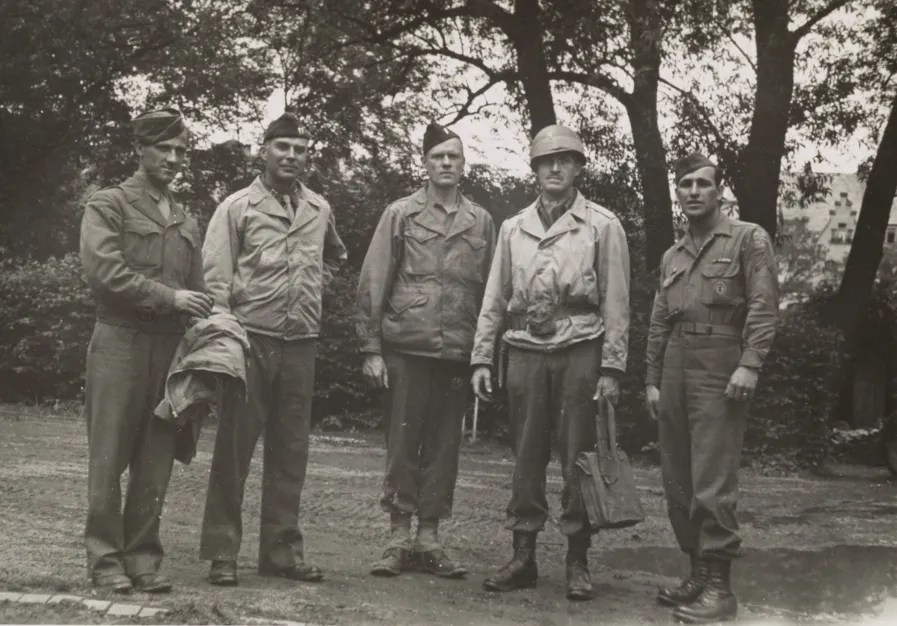
How a Small Group of Allied Heroes Saved Thousands of Years of Human Culture
Introduction: The Race to Save Civilization’s Treasures
World War II was the deadliest conflict in human history. It destroyed cities, nations, and millions of lives. But while armies fought on the front lines, another battle was happening in the shadows—a race to save the world’s greatest art from total destruction.
This mission fell to an unlikely group: museum curators, architects, artists, and scholars who became soldiers. They were officially called the Monuments, Fine Arts, and Archives Section (MFAA). But history remembers them by a simpler, more heroic name:
The Monuments Men.
Their mission was clear but nearly impossible:
- Save Europe’s art and historic buildings
- Track down priceless treasures stolen by the Nazis
- Stop the destruction of cultural heritage
- Preserve the identity of entire civilizations
Against bombs, collapsing museums, fleeing armies, and strategic chaos, they protected more than five million pieces of art and cultural property.
This is their story—how a small team protected the world’s culture during humanity’s darkest era.
I. Why Hitler Wanted Europe’s Art
To understand why the Monuments Men were needed, we first have to understand what the Nazis were trying to do.
Hitler’s Vision of a “Museum Empire”
Adolf Hitler saw himself not only as a political leader but as a failed artist who once dreamed of attending art school. When he gained power, he used the war to carry out a massive plan:
- Steal Europe’s greatest artworks
- Destroy anything he considered “degenerate”
- Build the Führermuseum, a giant museum in Austria filled with stolen masterpieces
The Nazis built special task forces to steal paintings, statues, books, and religious treasures from:
- Jewish families
- Museums
- Churches
- Palaces
- Universities
Hitler’s orders were simple:
“Take everything valuable. Leave nothing behind.”
(Source: Petropoulos, Art as Politics in the Third Reich)
By 1943, Nazi officers had taken more art than any empire in history.
The Risk: Europe Might Lose Its Culture Forever
The Nazis hid their stolen treasures in:
- Underground mines
- Secret bunkers
- Castles
- Abandoned churches
- Salt caverns
Some were booby-trapped. Some were hidden so well that even Nazi officers lost track of them. If the war destroyed these hiding places, thousands of years of human creativity would vanish.
This is why the Monuments Men were created.
II. Who Were the Monuments Men?
Not Typical Soldiers
The Monuments Men were:
- Art historians
- Sculptors
- Painters
- Photographers
- Professors
- Museum directors
- Architects
Most were middle-aged and not trained for combat. Some had never carried a gun. Their tools were flashlights, pencils, notebooks—and a deep love for human history.
Their Job Was Huge
The Monuments Men had to:
- Inspect bombed cities
- Identify endangered monuments
- Advise generals on which buildings not to bomb
- Locate stolen artworks
- Protect museums
- Recover treasure from collapsing front lines
At their peak, there were fewer than 350 of them, spread across all of Europe. (Source: Edsel, The Monuments Men)
III. The Daring Missions That Defined the Monuments Men
Mission 1: Saving the Churches and Monuments of Italy
As Allied forces fought through Italy, cities like Florence and Rome were covered in ancient art. The Monuments Men worked day and night to:
- Mark protected buildings
- Warn pilots
- Move fragile statues out of danger
In Florence, they helped protect the Ponte Vecchio, the only major bridge in the city not destroyed by retreating German forces. (Source: Nicholas, The Rape of Europa)
Mission 2: Chasing Art Across Bombed France
In France, the Nazis had looted thousands of artworks, including pieces from the Louvre Museum. The Monuments Men followed leads through small towns, destroyed rail stations, and abandoned chateaus.
They found many collections packed in crates, mislabeled to hide their value.
One of their most important findings was a cache containing:
- Renoirs
- Monets
- Manets
- Degas
- Van Goghs
All stolen from Jewish families forced to flee or sent to camps.
Every recovered crate was a step toward justice.
IV. The Hunt for the Hidden Mines
The Salt Mines: Underground Cities of Stolen Art
The Nazis stored much of their treasure underground. These salt mines were perfect:
- Dry
- Cool
- Protected from bombing
- Easy to guard
Inside these mines, Monuments Men found:
- The Ghent Altarpiece
- Michelangelo’s Madonna of Bruges
- German royal crown jewels
- Thousands of paintings from across Europe
Some rooms were stacked floor-to-ceiling with masterpieces wrapped in mattress padding or buried under coal.
In total, the Monuments Men recovered more than 1,500 major caches of stolen art. (Source: Edsel, Saving Italy)
One of the Most Dangerous Finds: The Altaussee Mine
In the Austrian mine of Altaussee, the team found:
- Over 6,500 paintings
- Sculptures
- Tapestries
- Rare books
- Furniture
- Gold and silver items
The mine was rigged with explosives. Nazi officers had been ordered to blow everything up rather than let the Allies take it.
Local miners, who feared losing their cultural heritage, secretly removed the explosives. Their bravery saved thousands of years of history. (Source: Petropoulos, The Faustian Bargain)
V. The Human Side of the Mission
Returning Art to Families Destroyed by War
After finding stolen pieces, the Monuments Men faced another challenge: returning them to their rightful owners.
This was heartbreaking work.
Many families who owned priceless paintings had been killed in the Holocaust. In those cases, the Monuments Men returned art to national museums, where it was kept for survivors who might one day claim it.
Their work became a symbol of dignity and justice.
They Worked Until the Last Day of the War—and After
Even after Germany surrendered, the Monuments Men stayed for years to finish the job:
- Tracking down records
- Interviewing locals
- Preserving ruins
- Restoring damaged buildings
- Cataloging millions of stolen items
Some continued until 1951.
The war ended, but the mission to protect culture never really stopped.
VI. Their Legacy: Why the Monuments Men Still Matter Today
The First Global Effort to Protect Culture in War
Before World War II, armies ignored cultural sites. After seeing how close humanity came to losing its heritage, the world changed.
Because of the Monuments Men, nations created new policies and organizations:
- UNESCO
- The Hague Convention
- International rules for protecting historic sites
- Museum standards for wartime protection
Their legacy still saves art today in conflicts in Syria, Ukraine, Iraq, and beyond.
A Reminder That Culture Is Worth Defending
The Monuments Men showed that wars are not only fought with tanks and planes. They are fought for:
- Identity
- Memory
- Belonging
- The story of humanity
They believed that saving a painting could be as important as saving a bridge—because art holds the meaning of a civilization.
Conclusion: A Legacy of Courage, Art, and Humanity
The Monuments Men were ordinary scholars who did extraordinary things. They had no special weapons, no large armies, and no guarantees of safety. Yet they saved more art than any group in history.
Their work proved something powerful:
When culture survives, humanity survives.
The treasures they rescued continue to inspire millions. Museums still display pieces that would have vanished without their courage.
They were quiet heroes—guardians of our shared human story.
And their mission will be remembered as long as art exists.
Citations
- Petropoulos, Jonathan. Art as Politics in the Third Reich. Harvard University Press, 1996.
- Edsel, Robert M. The Monuments Men: Allied Heroes, Nazi Thieves, and the Greatest Treasure Hunt in History. Center Street, 2009.
- Nicholas, Lynn H. The Rape of Europa: The Fate of Europe’s Treasures in the Third Reich and the Second World War. Knopf, 1994.
- Edsel, Robert M. Saving Italy: The Race to Rescue a Nation’s Treasures from the Nazis. W. W. Norton, 2013.
- Petropoulos, Jonathan. The Faustian Bargain: The Art World in Nazi Germany. Oxford University Press, 2000.
 Vellum Insights