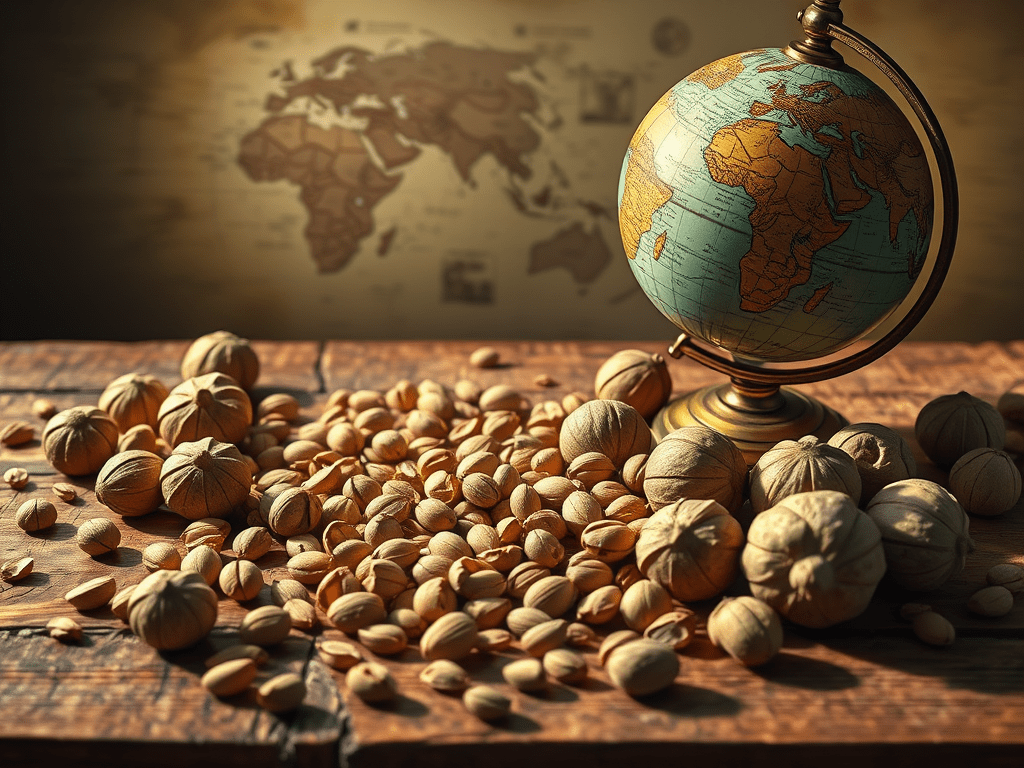
How a Tiny Seed Became the World’s First Billion-Dollar Commodity War
Introduction: The Most Valuable Food on Earth
Today, nutmeg is something you sprinkle on your latte. But 400 years ago, it was worth more than gold. This single spice sparked wars, massacres, secret missions, global monopolies, and the rise of modern capitalism.
For European powers in the 1500s–1700s, nutmeg was not a flavor — it was a weapon. Whoever controlled nutmeg could control a global fortune.
This is the story of how a tiny seed from a few islands in the middle of the Indian Ocean shaped:
- The rise and fall of empires
- The birth of corporate warfare
- The creation of global trade networks
- Early economic monopolies and market manipulation
- International treaties and territorial swaps
This is the geo-economic story of the Spice Wars — the world’s first true global commodity conflict.
Chapter 1: The Banda Islands — The Center of the World
Nutmeg only grew in one place on Earth for thousands of years:
A handful of volcanic islands called the Banda Islands, in modern-day Indonesia.
This made the Bandas the Saudi Arabia of the 1600s — tiny, remote, and absolutely essential.
Why Nutmeg Was So Valuable
Nutmeg had a mythical reputation in Europe:
- Thought to cure the plague
- Used in perfume, medicine, and food
- It grew nowhere else in the world
- Was transported by long, dangerous trade routes
- Had a markup of 5,000–10,000% when it reached Europe
Nutmeg wasn’t just a spice. It was a life-saving luxury, a status symbol, and a medical essential.
In many ways, nutmeg was the world’s first luxury microchip — tiny but able to shape economies.
Chapter 2: The First Spice Traders — Arab & Indian Merchants
Before Europe even knew the source of nutmeg, Arab traders controlled the market. They kept the Bandas secret and sold nutmeg in Constantinople, Venice, and Cairo.
This secrecy was their economic strategy:
- Hide the source
- Control supply
- Raise prices
They used a long chain of middlemen. By the time nutmeg reached Europe, each step added a new layer of profit.
This was early supply chain management, except guarded with strict secrecy and misinformation.
Chapter 3: Portugal Breaks the Monopoly
When Portugal reached the Indian Ocean in the early 1500s, everything changed.
They found out the spice source and wanted it for themselves.
Portugal’s Geo-Economic Plan
- Control the sea lanes
- Block Arab traders
- Force local rulers into exclusive deals
- Capture the Banda Islands
- Dominate the nutmeg trade
Portugal set up forts throughout Southeast Asia, but the Bandanese resisted.
The Portuguese held the islands only loosely — too loosely to control supply.
That weakness opened the door for the next empire.
Chapter 4: The Dutch Arrive — And Turn Nutmeg Into a Monopoly
No country exploited nutmeg like the Dutch.
In 1602, the Netherlands created the VOC — the Dutch East India Company, the world’s first multinational corporation and the first company to issue public stock.
But it wasn’t just a business.
The VOC was:
- A corporation
- A navy
- An army
- A tax collector
- A diplomatic force
It was the first time in history that a private company waged war for profit.
Their mission?
Seize the Banda Islands and create a global nutmeg monopoly.
The Banda Massacre (1621)
When Bandanese leaders refused Dutch trade terms, VOC governor Jan Pieterszoon Coen led a brutal assault. Thousands were killed or enslaved, and the survivors were expelled.
The Dutch then imported:
- Enslaved workers
- European planters
- A closed plantation system
By controlling the farmers, the land, and the ports, the Dutch created the world’s first vertically integrated monopoly.
This allowed them to:
- Control global supply
- Manipulate prices
- Destroy competitors
- Enforce exclusive trade routes
This is exactly how modern companies dominate markets — except the VOC did it with cannons.
Chapter 5: Economic Warfare — Burning Nutmeg to Raise Prices
The VOC had a shocking strategy:
They destroyed nutmeg harvests to keep prices high.
If the supply grew too much, the price dropped.
So the VOC ordered farmers to burn entire crops.
This is an early example of commodity price fixing, centuries before OPEC.
The Dutch maintained sky-high prices for decades because:
- They controlled 95% of the world’s nutmeg
- They controlled the only fertile islands
- They controlled the shipping lanes
- They punished any competition
This was economic warfare at a global scale — and it kept the Dutch rich.
Chapter 6: Britain Strikes Back — The Nutmeg Heist
The British did not accept losing the spice trade. They wanted nutmeg as badly as the Dutch.
They tried:
- Pirate raids
- Military assaults
- Smuggling operations
- Spy missions
Finally, during the Napoleonic Wars, they captured Run Island, the only Banda island the Dutch didn’t fully control.
Then Britain launched a daring move:
They stole nutmeg seedlings and transplanted them to:
- India
- Sri Lanka
- Zanzibar
This ended the Dutch monopoly overnight.
It was one of the greatest acts of agricultural espionage in history.
Chapter 7: The Most Important Real Estate Deal in History
The Spice Wars created one of the strangest deals ever:
The Treaty of Breda (1667)
Britain traded Run Island to the Dutch.
In exchange, Britain got a little island in North America:
Manhattan.
So yes —
New York City exists because of nutmeg.
This is the ultimate example of how a commodity war reshaped global geography.
Chapter 8: The End of the Monopoly — And the Birth of Global Markets
Once Britain spread nutmeg to other colonies, supply grew rapidly. Prices fell, and nutmeg became affordable around the world.
The Spice Wars left behind major legacies:
1. The rise of multinational corporations
The VOC created the blueprint for modern corporations like:
- Amazon
- Apple
- Exxon
- Walmart
Vertical integration, global trade control, stock trading — it began with nutmeg.
2. The birth of commodity markets
Nutmeg helped create:
- Futures trading
- Inventory management
- Price manipulation
- Market speculation
3. The first globalized trade war
European powers fought over a plant using:
- Armies
- Navies
- Diplomacy
- Espionage
4. The reshaping of national borders
The nutmeg trade influenced:
- Indonesia’s colonial history
- The rise of Dutch wealth
- British colonial expansion
- The founding of New York City
Nutmeg wasn’t just food.
It was power.
Conclusion: The World’s First Billion-Dollar Commodity War
The Spice Wars show how a simple product can reshape the world. Nutmeg:
- Sparked wars
- Created monopolies
- Built corporations
- Inspired espionage
- Shifted borders
- Influenced global trade
It is the earliest example of how economic competition fuels global conflict.
The same patterns appear today in:
- Oil
- Rare earth minerals
- Microchips
- Strategic metals
- Technology products
The Spice Wars prove a simple truth:
Control the key resource, and you control the world.
Nutmeg may not rule the global economy anymore, but the lessons of the Spice Wars still define global power today.
Sources & Citations
- Milton, Giles. Nathaniel’s Nutmeg: How One Man’s Courage Changed the Course of History. Sceptre, 1999.
- Hanna, Willard A. Indonesian Banda: Colonialism and Its Aftermath in the Nutmeg Islands. Equinox Publishing, 1978.
- National Archives of the Netherlands. “VOC Records and Banda Islands Collection.” (Accessed 2024).
- National Archives UK. “Treaty of Breda, 1667.” UK Government Historical Treaties Database.
- Britannica. “Nutmeg and Mace.” Encyclopedia Britannica, 2023.
- Ricklefs, M.C. A History of Modern Indonesia Since c. 1200. Stanford University Press, 2008.
- Subrahmanyam, Sanjay. The Portuguese Empire in Asia, 1500–1700. Wiley Blackwell, 2012.
- Reid, Anthony. Southeast Asia in the Age of Commerce, 1450–1680. Yale University Press, 1988.
- Yale University – Beinecke Library. “VOC Trade Documents and Privateering Records.”
- University of Oxford, Faculty of History. “The Global Impact of the East India Companies.”
 Vellum Insights