The Largest Naval Convoy Operation Since World War II and the Mission That Brought America Into the Tanker War
Introduction: When Oil Tankers Became Frontline Targets
In the summer of 1987, enormous oil tankers sailed through the waters of the Persian Gulf carrying one of the world’s most important commodities.
Oil.
Normally, these voyages would have been routine.
But the Persian Gulf was no longer a safe place.
The Iran–Iraq War had entered its seventh year, and both sides were attacking merchant shipping in what became known as the Tanker War.
Oil tankers were being struck by missiles.
Mines lurked beneath shipping lanes.
Warplanes hunted commercial vessels.
Insurance costs soared.
Ship captains feared every voyage might be their last.
The conflict threatened not only the economies of the Middle East but also the global energy supply.
Then the United States Navy launched one of the most ambitious maritime security operations of the Cold War.
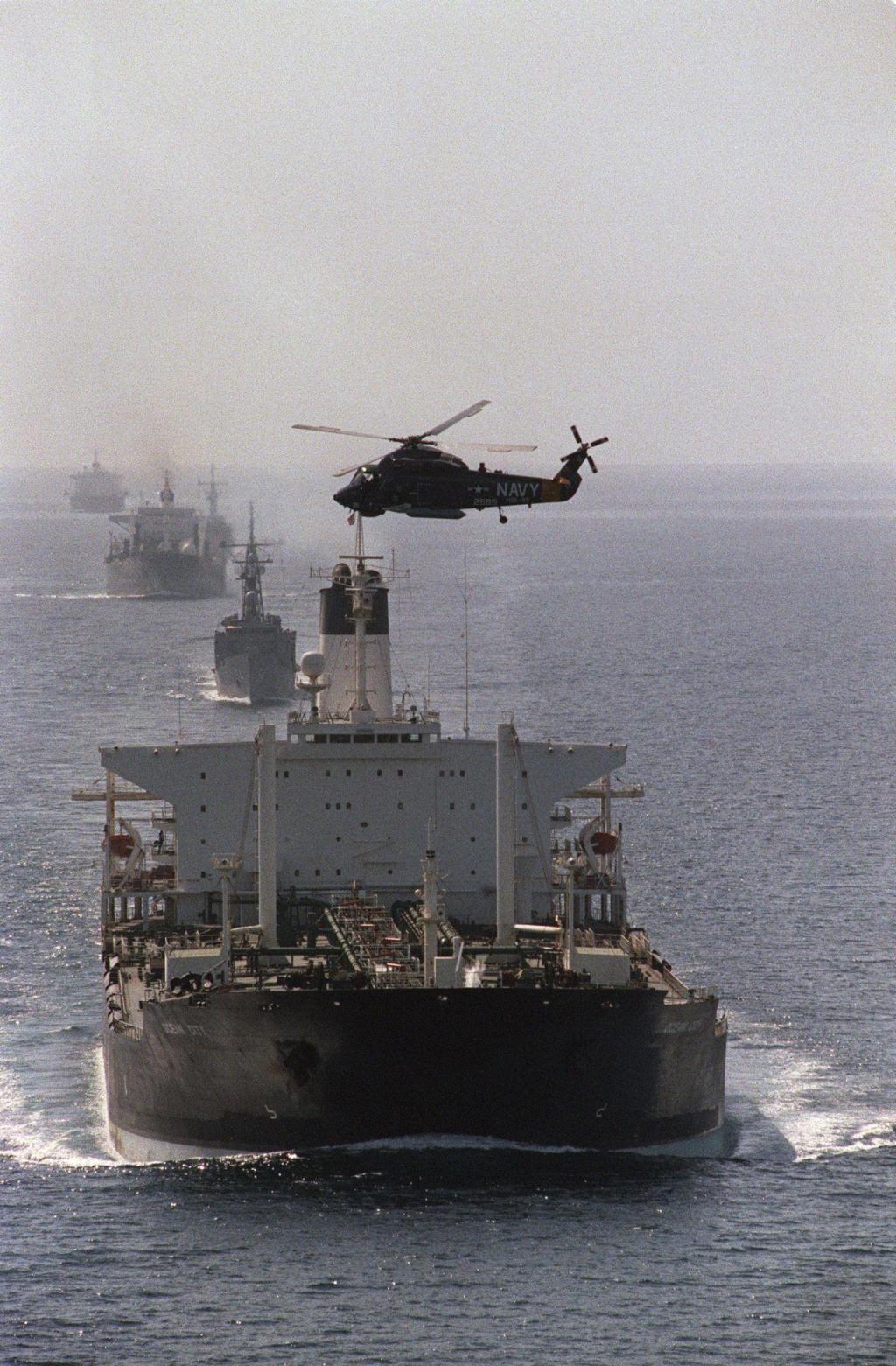
Known as Operation Earnest Will, the mission involved American warships escorting oil tankers through a war zone.
It became the largest naval convoy operation conducted by the United States since World War II.
More importantly, it marked a turning point in America’s military involvement in the Persian Gulf.
This is the story of how U.S. warships protected global oil supplies and found themselves drawn into one of the most dangerous maritime conflicts of the twentieth century.
Chapter 1: The Tanker War Escalates
By the mid-1980s, the Iran-Iraq War had become a brutal stalemate.
Neither side could achieve a decisive battlefield victory.
As a result, both countries increasingly targeted each other’s economic lifelines.
Oil exports became primary targets.
Iraq launched attacks against Iranian oil facilities, including the critical export hub at Kharg Island.
Iran responded by targeting shipping connected to Iraq and its regional supporters.
Soon, commercial vessels from many countries were caught in the middle.
Between 1984 and 1988, hundreds of merchant ships were attacked in the Persian Gulf.
Missiles, mines, and aircraft turned one of the world’s most important trade routes into a combat zone.
The danger extended far beyond the Middle East.
A significant portion of the world’s oil moved through Gulf shipping lanes.
Any disruption could affect global energy markets.
The international community began paying close attention.
Chapter 2: Kuwait’s Plea for Protection
One country found itself particularly vulnerable.
The small Gulf state of Kuwait relied heavily on maritime oil exports.
As attacks increased, Kuwaiti leaders worried their tankers could become easy targets.
Kuwait lacked the naval power needed to protect its shipping fleet.
In 1986, Kuwait sought assistance from major powers.
It approached both the United States and the Soviet Union.
For Washington, the request presented both risks and opportunities.
The United States wanted to ensure the continued flow of oil and maintain influence in a strategically vital region.
At the same time, direct involvement carried the danger of becoming entangled in an ongoing war.
Ultimately, the United States agreed to provide protection.
The result would be Operation Earnest Will.
Chapter 3: Reflagging the Tankers
Before American naval escorts could begin, an unusual legal and political solution was required.
Several Kuwaiti oil tankers were transferred to the American shipping registry.
This process became known as reflagging.
The vessels would now sail under the American flag.
This change carried major implications.
An attack against a reflagged tanker could potentially be viewed as an attack against a U.S.-flagged vessel.
The move provided a stronger legal justification for American military protection.
Eleven Kuwaiti tankers were eventually reflagged under U.S. registration.
These ships became the centerpiece of Operation Earnest Will.
The United States was now committed to protecting them.
Chapter 4: Convoys Return to the High Seas
The escort system used during Operation Earnest Will resembled convoy operations from World War II.
American warships accompanied merchant vessels through dangerous waters.
The convoy typically included:
- guided missile cruisers
- destroyers
- frigates
- logistics support vessels
The objective was straightforward.
Protect the tankers from attack while ensuring oil continued flowing to global markets.
Yet this mission was far from simple.
The Persian Gulf presented unique challenges.
The waterway was narrow.
Commercial traffic was heavy.
Potential threats could emerge from aircraft, missiles, speedboats, or hidden mines.
Unlike the Atlantic convoys of World War II, danger could appear from almost any direction.
Chapter 5: The Mine Threat Emerges
One of the most dangerous threats proved to be naval mines.
Unlike missiles or aircraft, mines are difficult to detect and relatively inexpensive to deploy.
A single mine can severely damage even a large vessel.
In July 1987, the reflagged tanker SS Bridgeton struck an Iranian mine during the operation.
The explosion tore a large hole in the ship’s hull.
Fortunately, the tanker remained afloat.
The incident exposed a major vulnerability.
Despite America’s powerful navy, mines could still threaten convoy operations.
The event embarrassed U.S. planners and highlighted the growing complexity of the mission.
Mine warfare would soon become one of the operation’s defining challenges.
Chapter 6: The Secret War at Sea
As the operation continued, American forces intensified surveillance efforts.
Special operations units and naval assets monitored suspected Iranian activities.
One notable development occurred when U.S. forces discovered Iranian vessels laying mines in international shipping lanes.
In September 1987, American helicopters and naval forces intercepted the Iranian ship Iran Ajr while it was allegedly deploying mines.
The vessel was seized, and evidence of mining operations was recovered.
The incident provided concrete proof that mines were being actively placed in shipping routes.
This discovery escalated tensions significantly.
The naval escort mission was increasingly becoming a direct confrontation.
Chapter 7: Operation Nimble Archer
By late 1987, the United States decided to respond more aggressively to attacks on shipping.
In October, U.S. forces launched Operation Nimble Archer.
The operation targeted Iranian offshore oil platforms that American officials believed were being used for military purposes.
Naval forces bombarded and destroyed several platforms.
The attack sent a clear message.
The United States was willing to use military force to defend Gulf shipping and deter further attacks.
For Iran, it demonstrated that actions against maritime traffic could carry significant consequences.
The conflict at sea was becoming increasingly dangerous.
Chapter 8: The USS Samuel B. Roberts Incident
The most serious challenge of the operation occurred in April 1988.
The guided missile frigate USS Samuel B. Roberts (FFG-58) struck an Iranian mine.
The explosion nearly destroyed the ship.
A massive hole was blown into its hull.
Several sailors were injured.
Only extraordinary damage control efforts by the crew prevented the vessel from sinking.
The incident shocked American leaders.
It demonstrated that the mine threat remained severe despite extensive naval operations.
Washington decided a major response was necessary.
Chapter 9: Operation Praying Mantis
In response to the mining incident, the United States launched Operation Praying Mantis on April 18, 1988.
It became the largest U.S. naval surface combat action since World War II.
American forces attacked Iranian naval assets across the Persian Gulf.
The operation resulted in:
- destruction of Iranian oil platforms
- sinking of Iranian warships
- damage to additional military vessels
The battle demonstrated overwhelming American naval superiority.
It also signaled that the United States was prepared to defend Gulf shipping with decisive force.
Many historians view Operation Praying Mantis as a turning point in the Tanker War.
Chapter 10: Why Operation Earnest Will Mattered
Operation Earnest Will achieved its primary objective.
Oil continued flowing through the Persian Gulf.
Despite ongoing attacks, global energy markets avoided the catastrophic disruption many had feared.
The operation also produced several lasting consequences.
It Expanded U.S. Presence in the Gulf
American military involvement in the region increased significantly.
It Demonstrated the Importance of Maritime Security
Global trade depended on secure shipping lanes.
It Highlighted the Power of Economic Warfare
The conflict showed how attacks on commercial infrastructure could have worldwide effects.
It Shaped Future U.S. Strategy
Many of the security relationships established during the operation continue to influence Gulf politics today.
Chapter 11: Lessons for Modern Geopolitics
The story of Operation Earnest Will remains highly relevant.
Modern geopolitical tensions continue to center around strategic waterways.
These include:
- Strait of Hormuz
- South China Sea
- Red Sea
- Bab el-Mandeb Strait
Just as in the 1980s, disruptions to shipping can have global economic consequences.
Recent attacks on commercial vessels in the Red Sea demonstrate that maritime security remains a critical geopolitical issue.
Operation Earnest Will offers valuable lessons about protecting trade routes in an increasingly uncertain world.
Conclusion: The Convoys That Protected the Global Economy
When people think about the Cold War, they often imagine nuclear standoffs, spies, and superpower rivalries.
Few remember the oil tankers that sailed through a war zone under naval escort.
Yet Operation Earnest Will was one of the most important maritime security operations of the era.
It protected vital energy supplies.
It demonstrated America’s commitment to maintaining freedom of navigation.
And it reshaped the security architecture of the Persian Gulf.
Most importantly, it proved a timeless truth.
Modern economies depend on secure sea lanes.
When those routes are threatened, warships often follow.
The convoy escorts of Operation Earnest Will were not merely protecting ships.
They were protecting the flow of energy that powered much of the modern world.
Sources & Citations
- Naval History and Heritage Command – Official records of Operation Earnest Will and Operation Praying Mantis.
- The Tanker War: The Assault on Merchant Shipping During the Iran-Iraq Conflict.
- U.S. Naval Institute – Analysis of convoy operations and Persian Gulf security.
- Center for Naval Analyses – Strategic studies on maritime security and Gulf operations.
- Naval War College – Research on naval strategy and the Tanker War.
- The Longest War: The Iran-Iraq Military Conflict.
- Congressional Research Service – Historical studies of U.S. military operations in the Persian Gulf.

