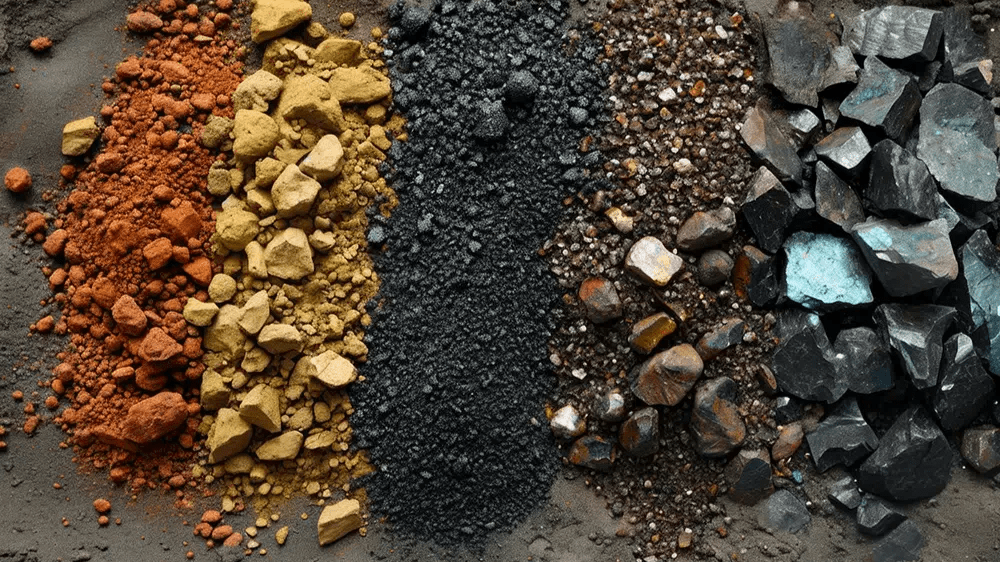
I) Why minerals = military power in 2025
Modern weapons (F-35 actuators, AESA radars, ship motors, hypersonics guidance, missiles), EVs, and wind turbines all hinge on rare earth permanent magnets (especially NdFeB: neodymium-iron-boron).
Control the three links—mining → processing → magnets—and you control industrial and military tempo.
China currently dominates the midstream and magnet manufacturing, which is the real choke point. Estimates: ~60–70% of global REE production, ~90% of processing, and the overwhelming majority of magnet output. CSISMining Technology
II) The battlespace: from NdPr to “stealth” chokepoints
- NdPr (Neodymium + Praseodymium): core feedstock for high-performance magnets that spin drones, missiles, ship propulsors, and EV motors. Western supply is scaling, but still behind China’s deeply integrated chain. MP MaterialsInvesting News Network (INN)
- Heavy rare earths (Dy, Tb): small additions of dysprosium or terbium keep magnets strong at high temperatures (missiles, jets). Non-Chinese heavy REE separation capacity is finally emerging in Malaysia via Lynas. Magnetics MagazineDiscovery Alert
- Not rare but critical: gallium, germanium, graphite, antimony—vital for semiconductors, IR optics, anodes, and munitions. Beijing’s recent export controls showed how fast these can become geopolitical levers. FastmarketsReutersAP News
III) China’s playbook: own the middle, shape the market
Beijing’s long game was to overbuild processing, consolidate magnet capacity at home, and then use licenses/quotas as tools.
The result: even if raw ore is mined abroad, much of it still goes to China for separation, metallization, and magnets.
Recent reports detail tightened export management, warnings against foreign stockpiling, and growing delays for medium/heavy REEs—pressuring global automakers and defense primes. CSISFinancial Times
Why it works
- Cost & scale: processing is chemically messy and capital-intensive; China made it cheap and centralised.
- Magnet moat: ~90% of NdFeB magnet production sits in China—own the magnets, own the battlefield tempo. CSISFinancial Times
IV) The counter-axis: how others are breaking dependence
- United States (MP Materials):
- Record 2024 output at Mountain Pass (45k t REO; 1,300 t NdPr oxide) and a DoD-backed push into domestic magnet plants—targeting a first truly “mine-to-magnet” U.S. chain in decades. MP MaterialsCGEP
- A recent DoD stake and multi-hundred-million funding aim to lift U.S. magnet capacity toward ~10,000 t/yr, roughly 2024 U.S. demand. Reuters
- Australia/Malaysia (Lynas):
- Scaling Mt Weld and heavy REE separation in Malaysia; first Dy and Tb separated in 2025—critical for high-temperature defense magnets. Magnetics MagazineDiscovery Alert
- Policy signal: Even as the U.S. diversifies, Chinese gallium/germanium/graphite controls reveal the wider critical-minerals toolset—expect more targeted levers. FastmarketsReutersPIIE
V) Real choke points (and how to neutralize them)
1) Processing (the true bottleneck)
- Offense: Countries can weaponize export permits for oxides/metals; slow rivals’ magnet lines without touching raw ore.
- Defense: Stand up regional separation hubs (US, EU, AUS, JP) with guaranteed offtake and environmental fast lanes; share reagents/solvent-extraction IP. CSIS
2) Magnets
- Offense: Restrict shipments of finished NdFeB and bonded magnets; target automotive & defense MRO timelines.
- Defense: Fund duplicate metallization + magnet lines near end-users; qualify multi-supplier specs across platforms (aviation, naval, missiles). Reuters
3) “Side minerals” (gallium, germanium, graphite, antimony)
- Offense: Narrow bans cause outsized pain in chips/IR/EV anodes.
- Defense: Byproduct recovery (e.g., Ga from bauxite/aluminum), recycling, and friendly-nation tolling to build redundancy. FastmarketsReuters
VI) Playbook for nations: build mineral deterrence
- Stacked redundancy
- Two independent sources for each step (mine, separation, metal, magnet) across two or more allied jurisdictions.
- Use defense procurement to pre-buy offtake; treat NdPr like fuel.
- Magnet mobilization
- Subsidize metallization & magnet lines colocated with EV/motor and defense OEMs.
- Mandate dual-qualified magnet designs (NdFeB + SmCo alternatives for high-temp systems).
- Strategic stockpiles 2.0
- Stockpile NdPr oxide, Dy/Tb additives, and finished magnets, not just mixed concentrates.
- Rotate via just-in-time swap programs with industry to keep inventories “fresh.”
- Materials R&D for substitution
- Dy/Tb thrift (grain-boundary diffusion), heavy-rare-earth-free high-coercivity magnets, motor topologies that reduce critical content.
- Fund recycling (shred-strip-separate) and urban mining from end-of-life motors/turbines.
- Market architecture
- Launch a transparent Western pricing index for NdPr and magnets to reduce exposure to administered pricing.
- Use long-term indexed contracts + floor/ceiling bands to stabilize CAPEX decisions. Reuters
- Lawfare & tradecraft
- Tighten end-use controls on magnets for defense.
- Anti-coercion tools for sudden export suspensions (snap-back tariffs, sanctions, emergency financing).
- Allied Industrial Corridors
- Stitch US–Australia–Japan–EU critical-minerals corridors with synchronized permits and tax credits; align on ESG to speed approvals and keep costs bankable. CSIS
VII) What to watch next
- China’s magnet export licensing cadence and any expansion of product-level controls. Financial Times
- U.S. magnet plants commissioning schedules (Texas + “10X” scale-up) and whether they reach 10k t/yr on time. CGEPReuters
- Lynas heavy-REE output consistency (Dy/Tb) and Kalgoorlie ramp implications for non-Chinese heavies. Lynas Rare EarthsMagnetics Magazine
- Any new controls on graphite/germanium/gallium—or relaxations if bargaining heats up. ReutersPIIE


 Vellum Insights