Tag: WWII psychological warfare

  • “Operation Bodyguard: The Web of Lies That Made D-Day Possible”

    “Operation Bodyguard: The Web of Lies That Made D-Day Possible”

    Introduction: A War Won Not Just by Battles – But by Deception

    When D‑Day came on June 6, 1944, the world saw thousands of Allied troops storm the beaches of Normandy.

    But hidden behind that dramatic morning was something nearly as vital: a vast deception plan. This plan was called Operation Bodyguard.

    The goal? Make the German commanders believe the invasion would come somewhere else, at another time. By misleading the enemy, the Allies gave themselves time, space, and the element of surprise. Wikipedia+2Military.com+2

    In this blog post we’ll explore:

    1. Why the Allies needed a deception at all.
    2. How Bodyguard was built and structured.
    3. The clever tricks and fake armies used.
    4. The impact it had on German decisions.
    5. What we can learn from it today.

    Let’s jump in.


    1. Why Deception Was Crucial

    The Allies faced a huge challenge: they needed to invade Germany-held Western Europe from the west. But the enemy expected them. Germany had built the Atlantic Wall and strengthened coastal defenses. The Allies knew that if the Germans discovered the when or where of the invasion early, they could mass troops and defeat the landing.

    That meant the Allies had to hide both the timing and the location of their attack. As Britannica states: “Bodyguard… set out an overall stratagem for misleading the Oberkommando der Wehrmacht as to the time and place of the invasion.” Wikipedia

    In short: the war would be won in part by what the enemy didn’t see.


    2. Planning the Deception: The Birth of Bodyguard

    Planning for Operation Bodyguard began in 1943 under the direction of the London Controlling Section (LCS), a secret Allied unit dedicated to deception strategy. iwm.org.uk+1

    The main aims:

    • Make the Germans believe the invasion would strike at Pas-de-Calais, not Normandy. iwm.org.uk+1
    • Hide the actual date of the landing.
    • Make the Germans keep large forces in wrong places, rather than reinforcing Normandy. Wikipedia+1

    Bodyguard was not just one operation—it was the umbrella for many sub-operations: Operation Fortitude (North & South), Operation Graffham, Operation Royal Flush, and more. dday.center+1


    3. The Tricks, the Tools & the Fake Army

    • Phantom Armies & Inflatable Tanks

    One of the centrepieces: the creation of a fake army group called First United States Army Group (FUSAG), supposedly under George S. Patton, based in southeast England facing Pas-de-Calais. The Germans had seen Patton as America’s top tank commander—so assigning him the fake army made the lie more convincing. dday.center+1

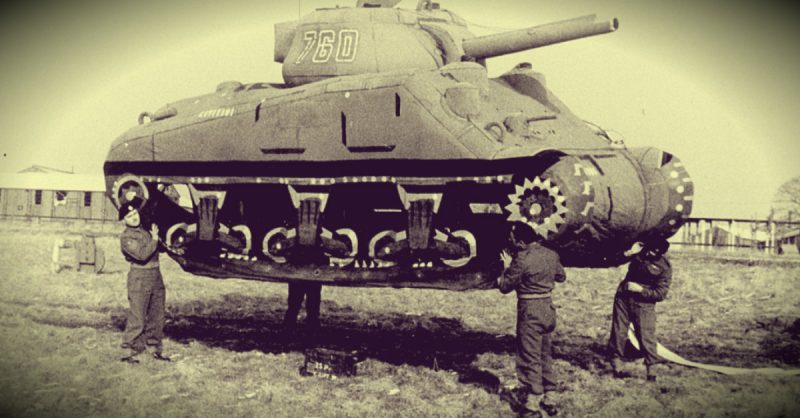
    Around the south coast of England, the Allies built inflatable tanks, dummy landing craft, fake airfields. Reconnaissance would spot what looked like build-up of invasion forces. iwm.org.uk

    • Fake Radio Traffic & Double Agents

    The Allies used double agents—such as the famous Juan Pujol Garcia (“Garbo”)—to feed German intelligence false stories. At the same time, Allied radio operators sent fake messages about troop and supply movements. HISTORY+1

    • The Date Trick

    Not only were the Germans led to expect an attack at Pas-de-Calais, they were also led to believe that the landing might be delayed. This caused hesitation in German command. iwm.org.uk

    • Diversionary Actions

    Operations like Fortitude North aimed to threaten Norway; and others made Germany think other invasion points (Mediterranean, Balkans) were active. dday.center

    All of these layered to create confusion, delay, and misallocation of German forces.


    4. Impact: What the Germans Did—and Why It Mattered

    Because of Bodyguard:

    • German high command kept large forces near Pas-de-Calais instead of sending them to Normandy. Encyclopedia Britannica
    • Hitler delayed moving some reinforcements from the Calais region for weeks—even after the landings had begun. dday.center+1
    • The real invasion force faced fewer German units at the critical moment—giving the Allies a critical early advantage.

    The deception didn’t guarantee victory—but it helped make success far more likely.


    5. Smaller Stories, Big Effects

    • Dummy tanks: The image of inflatable Shermans fooled aerial reconnaissance. iwm.org.uk
    • Fake operations: One double agent convinced Germany the Allies would invade Greece or the Balkans. dday.center
    • Intelligence synergy: The deception worked because it aligned with what the Germans wanted to believe. dday.center

    These human and creative details made Bodyguard a masterpiece of war craft.


    6. Why It Works: The Psychology of Deception

    Deception in war works when it:

    • Mimics what the enemy expects.
    • Delivers cues the enemy trusts (e.g., Patton in the fake army).
    • Delays their decision-making.
    • Shapes perception more than reality.

    Bodyguard didn’t overwhelm German intelligence—it manipulated their perceptions.


    7. Legacy: What We Learn Today

    Operation Bodyguard offers lessons for modern strategy:

    • Information warfare matters. Deception, misdirection, and intelligence shape outcomes.
    • Perception is real. Wars can be won by what the enemy believes.
    • Coordination of many tools. Fake armies, radio chatter, double agents—all had to work together.

    In the modern age of satellites and cyber-espionage, the scale of deception may change—but the principles remain.


    8. Conclusion: Victory’s Hidden Shadow

    On June 6, 1944, Allied troops flooded the beaches of Normandy. The guns, ships, and men took the spotlight. But behind the scenes, Operation Bodyguard was the hidden hand that made it happen.

    The campaign of lies, theater, and intelligence helped ensure the German response was slow and scattered. That gave the Allies a window to win.

    In war, truth may be precious—but so too is the ability to guard it with a bodyguard of lies.
  • 🎨 The Ghost Army: How Artists, Actors, and Illusionists Fooled the Nazis

    🎨 The Ghost Army: How Artists, Actors, and Illusionists Fooled the Nazis

    Ghost Army: The Combat Con Artists of World War II - Nevada Museum of Art

    Introduction: The Army That Fought With Illusions

    In 1944, somewhere in the French countryside, a group of American soldiers prepared for battle.
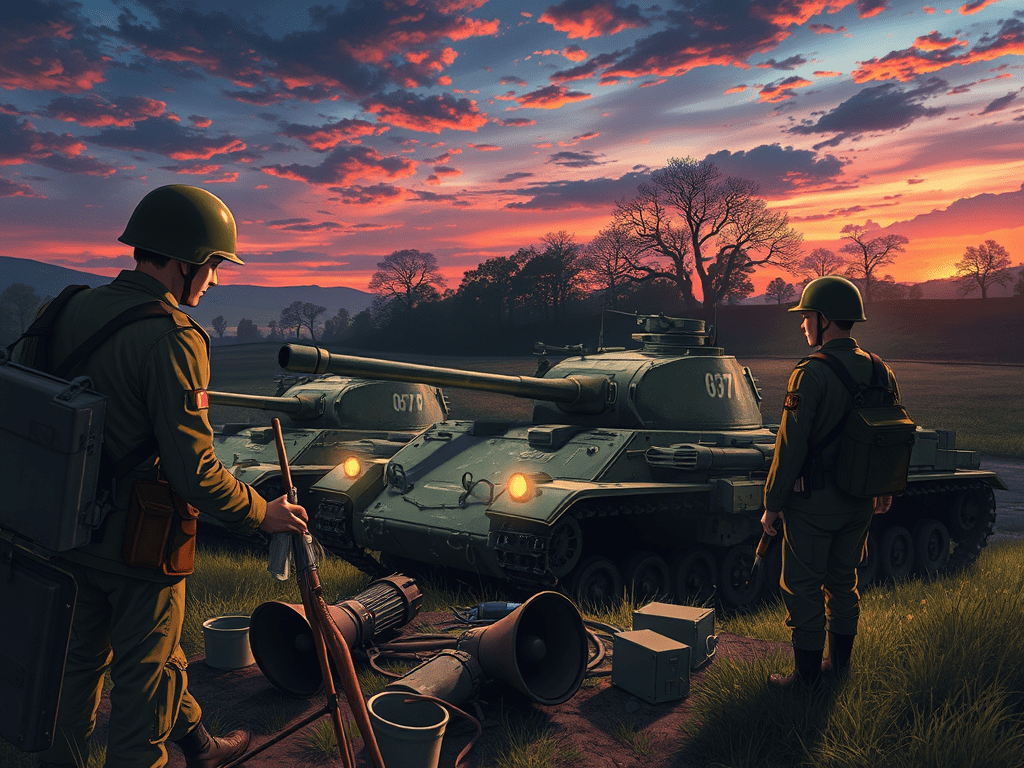
    But instead of rifles, they carried paintbrushes, loudspeakers, and inflatable tanks.

    This was the Ghost Army — officially known as the 23rd Headquarters Special Troops — a secret U.S. unit tasked with one extraordinary mission:

    “To deceive the enemy, confuse their intelligence, and win battles without firing a shot.”

    These artists, designers, and sound engineers used creativity as their weapon — and their art saved thousands of lives.

    For decades, their work was top secret.
    Now, their story can finally be told — a story of how illusion became one of the greatest strategic tools of World War II.


    1. The Problem: How Do You Trick a War Machine?

    By 1944, the Allies were fighting across Europe, pushing back Nazi Germany town by town.
    But every victory came at a heavy cost. The Germans were masters of counterattack — they moved quickly whenever they detected troop concentrations.

    So the Allies asked a radical question:
    What if we could make the Germans believe our army was somewhere else entirely?

    This idea gave birth to one of the most unusual units in U.S. military history — a “traveling circus of deception.”


    2. Building an Army of Illusion

    The Ghost Army was officially formed in January 1944 under the U.S. Army’s First Army Headquarters.
    It consisted of around 1,100 men, drawn not from traditional infantry but from art schools, advertising agencies, and Hollywood studios.

    Many were graduates of schools like Cooper Union and Pratt Institute.
    Some would later become famous — including fashion designer Bill Blass and artist Ellsworth Kelly.

    Their tools weren’t guns or grenades, but art supplies, rubber, and sound equipment.
    Their goal?

    To make a small unit look like a full division — 20,000 men strong.

    They did it through four layers of deception: visual, sonic, radio, and performance.


    3. Inflatable Tanks and Phantom Divisions

    US Ghost Army During WWII To Get Its Own Movie | War History Online

    The Ghost Army’s most famous trick was its inflatable decoy equipment — life-sized rubber replicas of Sherman tanks, jeeps, trucks, and artillery.

    A single truck could carry a full “tank platoon” of inflatable decoys.
    Within hours, the soldiers could inflate an entire fake armored column — realistic enough to fool German reconnaissance planes.

    From above, the scenes looked genuine: tire tracks carved into the mud, tents pitched, laundry hanging, even fake generals driving by in jeeps.

    When the Luftwaffe flew overhead, they saw what looked like thousands of troops preparing for battle.
    In reality, it was just a handful of clever Americans with air pumps and paintbrushes.


    4. Sound and Fury — The Power of Noise

    Combat Loudspeakers

    Visual deception was only part of the act. The Ghost Army also used audio illusions to make their fake armies sound real.

    Engineers from Bell Labs recorded real tank movements, construction sounds, and troop chatter.
    These recordings were played through massive speakers mounted on half-tracks — projecting the sound for miles.

    At night, Germans listening across the front could hear what they thought was an entire division moving in.

    The recordings were so detailed they could simulate specific vehicles — from the roar of Sherman engines to the clatter of pontoon bridges being built.


    5. Radio Trickery — Fooling the Enemy’s Ears

    In modern terms, you’d call it electronic warfare.
    The Ghost Army included expert radio operators trained to mimic the communication patterns of real divisions.

    They created fake radio traffic — sometimes even impersonating real officers — to sell the illusion that thousands of men were moving to new positions.

    These false transmissions were carefully timed and coded to match the fake visuals and sounds — completing the deception.

    For the German intelligence units listening in, the illusion was perfect.


    6. The Art of Acting Like an Army

    Perhaps the most overlooked part of the Ghost Army’s success was theatre.
    Soldiers were trained to act like soldiers from other units — adopting insignias, slang, and routines.

    They set up fake command posts, posed as officers in local towns, and spread rumors designed to reach German spies.
    Some soldiers even went into cafés wearing counterfeit patches, speaking loudly about “their” next big attack — which, of course, didn’t exist.

    This combination of visual, sonic, and behavioral deception made the Ghost Army’s operations astonishingly believable.


    7. Real Operations — Real Impact

    The Ghost Army conducted over 20 deception missions across France, Belgium, Luxembourg, and Germany from 1944 to 1945.

    Their most famous operation was near the Rhine River in March 1945.
    While the real U.S. Ninth Army secretly prepared to cross the river to attack Germany, the Ghost Army staged a massive fake build-up 20 miles away.

    They inflated hundreds of dummy tanks, blasted recorded sounds of construction, and transmitted fake radio chatter.

    German scouts took the bait.
    They diverted troops and artillery toward the fake site — giving the real army the element of surprise.

    The result?
    Thousands of Allied lives were saved, and one of the last German defensive lines was broken.


    8. The Hidden Heroes — Artists at War

    What makes the Ghost Army remarkable is not just its success — but who its soldiers were.

    Most were artists, illustrators, stage designers, and sound technicians — men who had never seen combat before.
    Yet they used creativity as their weapon.

    Instead of destruction, they specialized in deception.
    Instead of killing, they confused and diverted the enemy.

    As one member, Arthur Shilstone, said:
    “It was the only outfit in the Army where you could wear a beret and carry a paintbrush.”

    Their operations were top secret — even their own comrades didn’t know what they were doing.
    It wasn’t until 1996, more than 50 years later, that the Ghost Army’s work was officially declassified.


    9. Recognition and Legacy

    For decades, the Ghost Army’s existence was buried in classified files.
    Most of its members returned home quietly, never speaking of what they had done.

    But historians eventually uncovered their story, and in 2022, the U.S. Congress awarded the Ghost Army Congressional Gold Medal — recognizing their “unique and highly distinguished service.”

    Today, military academies study the Ghost Army as a model for modern psychological operations (PsyOps) and information warfare.

    Their techniques — blending art, technology, and psychology — paved the way for modern deception tactics still used today.


    10. The Art of War — Literally

    The Ghost Army proved that wars aren’t always won by who shoots first, but by who thinks smarter.

    They blurred the line between warfare and theater, turning imagination into a battlefield weapon.


    Every inflatable tank, fake radio call, and booming loudspeaker played a part in shaping the outcome of the war.

    Their legacy continues to inspire artists, strategists, and soldiers — a reminder that creativity can be as powerful as firepower.

    Conclusion: The Invisible Artists Who Saved Lives

    When people think of WWII heroes, they imagine soldiers storming beaches or flying bombers.
    But the Ghost Army fought a different kind of battle — one of illusion, sound, and storytelling.

    They used imagination to protect lives.
    They painted tanks that never fired, built armies that never existed, and staged battles that never happened — all to confuse the enemy and shorten the war.

    Their story reminds us that creativity, intelligence, and courage often win where brute force fails.
    And sometimes, the most powerful weapon on the battlefield…
    is art.