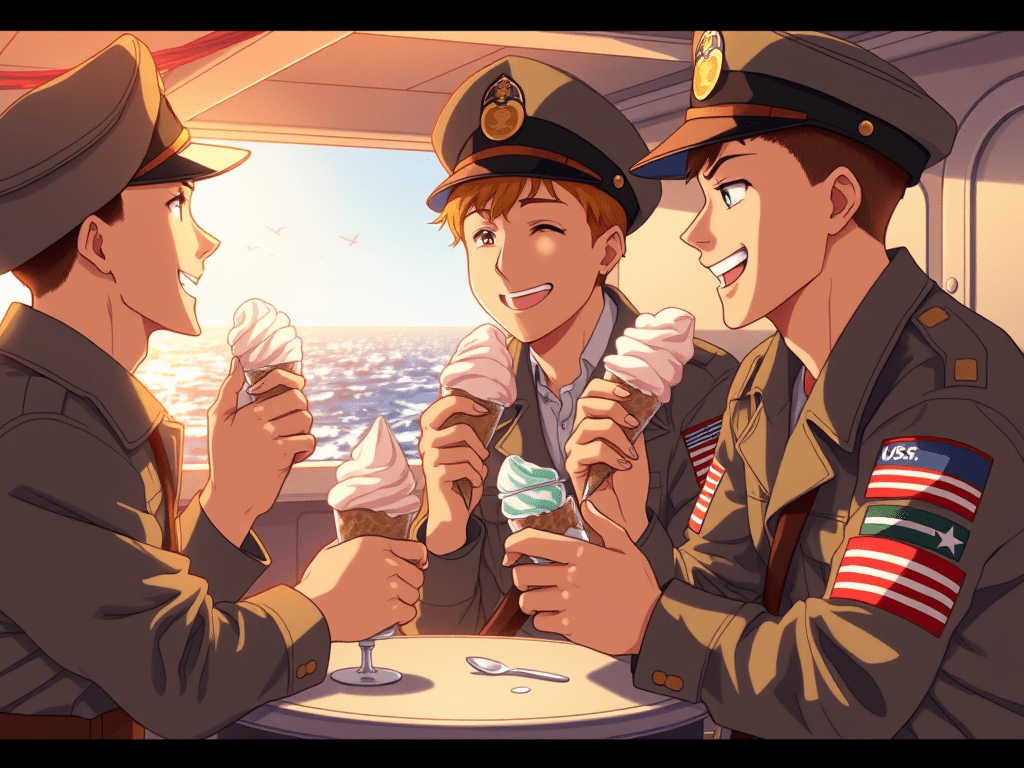
Imagine fighting on a hot, muddy island in the Pacific. You’re tired, hungry, and sleep is rare. Then one day a strange barge pulls up. It smells of sugar and milk. Sailors gather. A sailor scoops a pale frozen treat into a tin cup and hands it out. For a few minutes, the war isn’t all bombs and barking orders. It’s vanilla and chocolate and a little slice of home.
This isn’t a sweet myth. During World War II the U.S. military treated ice cream as real wartime strategy. The Navy and Army built refrigerated ships and barges that churned out ice cream for sailors, Marines, and even hospital patients. That small comfort did more than please taste buds. It lifted morale, reinforced discipline, and — by showing how well-supplied American forces were — it also helped shape how enemies saw the United States. In short: ice cream became a quiet tool of power. Military.com+1
This article tells that story in plain language. We’ll look at how the ice cream effort worked, why it mattered, and how the sight of well-fed Americans eating comforts like ice cream could affect enemy morale — including how it helped undermine Japanese propaganda and confidence during the Pacific war.
1) Why would ice cream matter in war?
It sounds silly at first. But human beings are not only bodies that need food. They are also minds that need comfort and hope. Food that reminds people of home — a treat, a ritual — gives rest to the mind. In war, small comforts can make big differences:
- Ice cream made men feel valued and cared for. That strengthens loyalty and unit spirit.
- It helped with recovery: hospital patients recovered better if morale stayed high.
- It replaced forbidden pleasures (like alcohol in the Navy) and became a morale tool aboard ships. The Atlantic
Military leaders understood this. The U.S. government and food industries treated ice cream as part of troop welfare. During WWII, the U.S. went so far as to fund machines, mixes, and even specialized vessels to keep ice cream flowing to the front. This wasn’t waste; it was logistics aimed at sustaining fighting strength. Military.com+1
2) How the U.S. made ice cream in the Pacific: BRLs and floating factories
The Pacific War posed a huge logistics problem. Islands were far apart. Temperatures were high. Soldiers and sailors were often far from regular supply lines. Perishable items like meat, milk, and ice cream are hard to deliver. The U.S. solved this with creativity.
One key solution was the BRL — “Barge, Refrigerated, Large.” These were concrete refrigerated barges and ships the military used to store and deliver frozen and chilled food to the fleet and island bases. Some of these barges were turned into floating ice-cream factories that could churn out large amounts of dessert and store tons of frozen goods. The Navy converted several of these concrete barges to carry and make ice cream in the Pacific. Wikipedia+1
A few facts to give scale:
- Some BRLs could churn out around 10 gallons of ice cream every seven minutes and carry thousands of gallons. That meant hundreds or thousands of servicemen could have a scoop, often daily. Business Insider+1
- The Navy turned at least three refrigerated barges into floating ice-cream factories in 1944–45. They were towed around supply anchorages and issued ice cream to ships and small craft that lacked their own refrigeration. usni.org+1
These floating factories gave sailors and Marines a taste of home where home was thousands of miles away. For hospital ships and field hospitals, ice cream also became a small but proven boost to recovery. Business Insider
3) Ice cream as a morale multiplier for U.S. forces
A little comfort goes far on a long deployment. Ice cream had several practical effects for U.S. forces:
- Routine and Normality: Getting a regular treat created a sense of normal life in abnormal times.
- Equalizer: Officers and enlisted men both stood in the same line for ice cream. This small equality built unit cohesion. Stories exist of senior commanders waiting in line with privates — a gesture that mattered. The Atlantic
- Reward and Rest: A scoop was a reward after a long watch or a successful mission. Rewards are short, powerful psychological tools.
- Hospital Comfort: In hospitals, ice cream calmed patients and helped recovery by improving appetite and morale. Business Insider
The U.S. military used ice cream intentionally. The Navy’s menu planning and the Army’s and Navy’s logistics teams included ice cream as part of the supply chain. Producers at home (dairy companies) worked with the military to deliver mix and powdered bases for battlefield use when fresh milk was unavailable. The Atlantic
4) How the Japanese and Axis propaganda looked at American abundance
This is where the story moves from morale to psychology and even propaganda.
Japan, like Germany, built wartime morale around sacrifice and scarcity. Propaganda often promoted the idea that hardship and self-denial were noble and that those who enjoyed luxury at home were weak. If soldiers believed their enemy had access to comfortable food and comforts in war zones, that challenged the narrative that sacrifice equals strength.
Captured Japanese sailors and airmen sometimes reported surprise at how well U.S. forces were supplied. Reports from interrogations and memoirs show prisoners remarking on the abundance they found — including new foods and sweets they had not seen. That contrast between what Japanese propaganda promised and what prisoners experienced could erode belief in the war message. The Atlantic+1
To be clear: ice cream alone did not “destroy” Japanese morale or cause defeat. But it was one visible sign of an important condition: the U.S. had an immense and reliable logistics system. That system meant U.S. forces could be fed, equipped, and rested even far from home. For the Japanese leadership and front-line troops facing shortages of fuel, food, and replacement parts, the visibility of American abundance could be demoralizing. It fed a growing realization that the Americans had resources Japan could not match. The Atlantic+1
5) Stories and anecdotes that show the effect
Small stories make the point better than abstract claims. Some wartime reports and later accounts highlight the symbolic power of ice cream:
- Prisoners’ surprise: Allied accounts record that some captured Japanese sailors were astonished at how well their captors were fed, mentioning sweets like ice cream as evidence of abundance. These reports spread back through interrogations and word of mouth. The Atlantic
- Navy traditions: Stories survive of sailors improvising ice cream (mixing chocolate with snow in helmets) and of aircraft crews making frozen treats at altitude during WWII. These stories reflect how much the treat mattered to morale and symbolized ingenuity. Smithsonian Magazine
- Public messaging: In the U.S., posters and press material framed ice cream for troops as both a health food and a morale booster. The image of a sailor eating ice cream underlined the message that American troops were being well cared for — and that the nation could sustain them. Business Insider+1
These anecdotes show that the ice-cream effort was part of a broader messaging effort: to show domestic and foreign audiences that the U.S. could feed and care for its forces overseas.
6) Why seeing comforts matters to an enemy
Psychology in war often depends on perception. If your soldiers or population believe your side is losing the ability to provide, or worse, that the other side enjoys comforts you cannot access, morale will decline.
Think of three simple signals:
- Food — If one side is hungry and the other is well-fed, the hungry side questions whether their nation can sustain their effort.
- Medical care — Better hospital care signals longevity and survival.
- Home comforts — Seeing the enemy enjoy comforts like ice cream suggests a quality of life that seems unbeatable.
In the Pacific, where many Japanese garrisons were isolated and facing supply shortages, seeing enemy ships pull up with refrigeration and treats was a visible symbol of American strength. That symbol reinforced the reality that the U.S. logistics machine could keep fighting for months or years. This fed into a growing sense that Japan might not be able to continue. blauberg+1
7) Ice cream as part of a bigger logistics story
Ice cream was not a standalone gimmick. It was visible proof of much larger things:
- Industrial capacity: The U.S. could produce, package, and ship huge food supplies.
- Supply lines: The U.S. built supply lines that reached across oceans to islands and forward bases.
- Allied organization: American industry, government, and the armed forces coordinated food production and delivery.
- Resilience: Even in hard conditions, the U.S. could adapt (powdered mix, BRLs, field churns).
That scale and resilience mattered more strategically than a scoop of vanilla. Ice cream simply made the invisible visible: it showed that supply chains worked, day after day. For enemies who struggled to feed their own troops, that picture could be damaging to morale and to the narrative of inevitable victory. Military.com+1
8) Did ice cream “destroy” Japanese morale? The careful answer
Short answer: no single food item destroyed an army’s morale by itself. Wars are complex. But ice cream played a symbolic role in a much larger picture.
Here’s what’s reasonable to say, and what’s not:
- Reasonable: Ice cream was a morale tool. It was intentionally used by the U.S. military to boost spirits. The sight of Americans enjoying such comforts sometimes surprised and demoralized captured or nearby enemy soldiers, because it made U.S. supply strength visible. usni.org+1
- Not reasonable: Claiming ice cream alone caused Japanese defeat is an overstatement. Japan’s defeat was caused by industrial imbalance, resource shortages, strategic losses, bombing campaigns, naval defeats, and the atomic bombs. Ice cream was a small, symbolic piece of the larger logistical and psychological puzzle. The Atlantic
So: ice cream helped chip away at morale indirectly by showcasing U.S. abundance and care for troops. It was a morale multiplier for Americans and one of many signals that told the world which side had staying power.
9) The broader lesson: logistics, image, and psychology
The ice-cream story teaches a bigger strategic lesson: logistics are a form of power, and visible comforts can be weapons in the battle for hearts and minds.
Three quick lessons for strategists and students of history:
- Logistics shape perception. When your logistics work, the enemy sees it. That matters. Military.com
- Small comforts have big effects. Ice cream did not win battles, but it kept troops resilient and reminded them they were supported. usni.org
- Propaganda meets reality. When propaganda promises sacrifice, but the enemy sees abundance, the message breaks down. Visible evidence undermines claims. blauberg
10) Final image: a scoop, a smile, a supply chain
Picture again that concrete barge near a sun-baked atoll. Sailors line up. A scoop of ice cream is handed out. For ten minutes the men are warm and human. They laugh, tell a joke, and think of home. They can simply be sailors, not just fighters.
That small moment is part of the long chain that allowed the U.S. to fight far from home: factories, farms, trucks, ships, barges, crews, and a nation organized to sustain men overseas. Ice cream was a small, sweet bookmark in a massive story of industrial effort. It gave Americans the energy to keep going — and it gave enemies one more sign that the United States could keep going for a long time.
In war, perception is power. A scoop of ice cream may look like dessert. But sometimes dessert is strategy.
Sources & Further Reading
(These are the key, trustworthy sources used to build the story and facts above.)
- “Why the US Navy Operated a Fleet of Ice Cream Ships During World War II,” Military.com. Military.com
- “Sailors Scream For Ice Cream! The US Navy and the Ice Cream Barges,” U.S. Naval Institute (USNI). usni.org
- “That time the Navy spent a million dollars on an ice cream barge,” MilitaryTimes. Military Times
- “How Ice Cream Helped America at War,” The Atlantic. The Atlantic
- “Ice cream barge” (BRL) entry and description, general background. Wikipedia
 Vellum Insights
Leave a comment