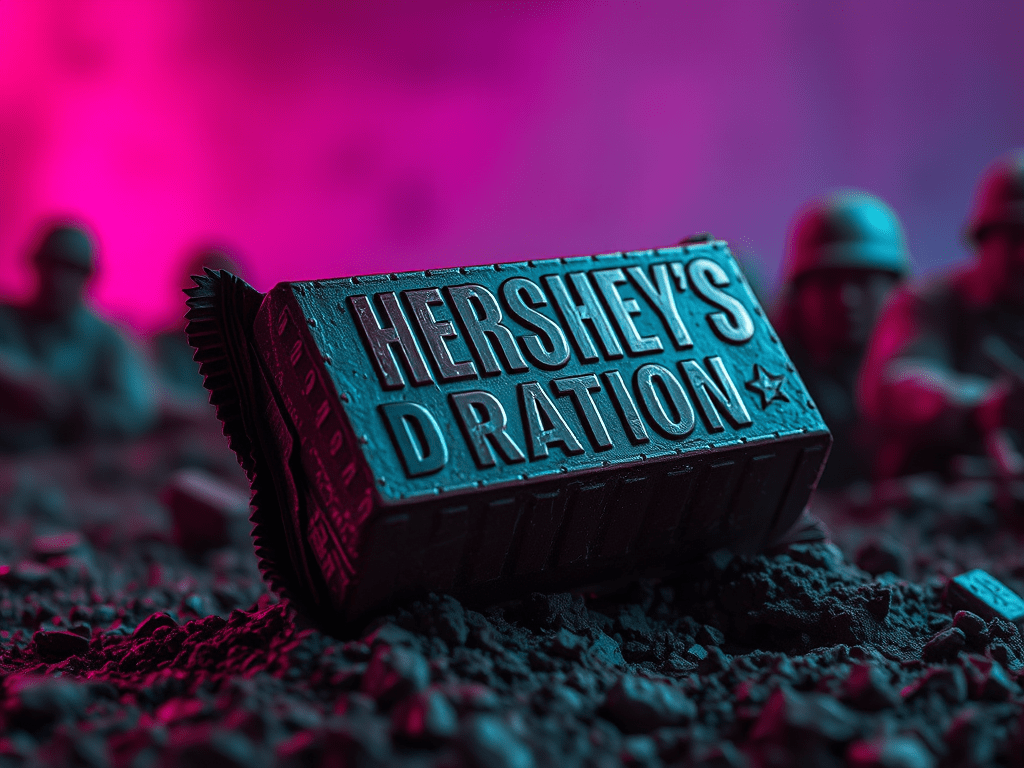
Introduction: The Sweetest Weapon on the Battlefield
In the chaos of World War II, soldiers carried rifles, grenades, and a curious little brown bar that was not quite candy and not quite food.
It was the Hershey’s D Ration Bar, a chocolate designed not for comfort — but for survival.
This small, bitter block of chocolate became an unexpected symbol of American strength, morale, and industrial power.
In fact, many soldiers joked that it was “the only weapon you could eat.”
This is the story of how a candy company helped win a world war — one chocolate bar at a time.
1. War on Every Front — Even the Kitchen
By 1941, the United States was preparing for total war. Every industry, from steel to soda, was asked to help the military effort.
The U.S. Army Quartermaster Corps — responsible for feeding millions of troops — faced a unique problem: how to provide energy-dense, portable food that could survive heat, humidity, and months of storage.
Ordinary candy bars melted. Biscuits crumbled.
So the Army reached out to Hershey Chocolate Corporation, asking for something radical:
“A high-energy bar that can withstand high temperatures and won’t taste so good that soldiers eat it too fast.”
That last part might sound strange, but the Army didn’t want soldiers treating rations like treats. The goal was nutrition, not pleasure.
2. The Birth of the D Ration Bar
In 1937, Colonel Paul Logan, an Army food technologist, met with Milton S. Hershey, founder of the chocolate empire.
Together with Hershey chemist Sam Hinkle, they created the D Ration Bar — a dense, bitter, almost brick-like chocolate.
Ingredients:
- Cocoa
- Sugar
- Skim milk powder
- Oats for texture
- A dash of vitamin B
Each bar weighed 4 ounces and packed 600 calories — enough to keep a soldier going for half a day. It could survive 120°F (49°C) heat without melting and fit neatly in a uniform pocket.
But it had one deliberate flaw — taste.
Soldiers described it as “a mouthful of clay” or “a chocolate-flavored gravel bar.”
One GI said: “You didn’t eat it unless you had to — which was the point.”
Despite its flavor, the D Ration became a standard-issue item for millions of troops.
3. From Factory to Frontline
Once America entered the war in 1941, Hershey’s Pennsylvania plant went into overdrive.
By 1945, the company had produced over 3 billion D Ration and tropical bars.
To achieve this, Hershey built special production lines, working closely with the military to meet strict specifications.
Factory workers — mostly women — labored around the clock, stamping, wrapping, and shipping bars by the ton.
The bars traveled everywhere:
- Tucked into K-Rations for paratroopers.
- Packed into lifeboats on Navy ships.
- Dropped from airplanes during supply runs.
Hershey even developed a Tropical Bar, modified to resist the melting heat of the Pacific.
4. Chocolate and Morale — Sweetness in the Trenches
Beyond calories, the D Ration Bar carried emotional weight.
For many soldiers, it was a tiny reminder of home — of mothers, sweethearts, and the normal lives they left behind.
In foxholes and jungles, that mattered.
“It wasn’t the taste,” wrote one U.S. Marine from Guadalcanal.
“It was the thought that somewhere, someone cared enough to send it.”
Psychologists later noted how simple comfort foods — chocolate, gum, coffee — played a major role in troop morale.
They reminded soldiers what they were fighting for.
In this sense, Hershey’s chocolate became more than food — it became a symbol of homefront love and American abundance.
5. Chocolate as Propaganda and Soft Power
The D Ration Bar also served a psychological role beyond the battlefield.
When Allied troops liberated villages in France, Italy, and the Philippines, they handed out chocolate to civilians — especially children.
Those simple gestures became powerful propaganda.
Photos of smiling kids clutching Hershey bars spread quickly, painting American soldiers as heroes and humanitarians.
To hungry civilians, the chocolate represented more than sweetness — it was a taste of freedom.
In contrast, Axis troops had no such luxuries. German and Japanese soldiers often suffered from food shortages and low morale.
The difference was clear: the Allies could afford to feed both soldiers and strangers.
Chocolate became an edible symbol of victory.
6. Behind the Scenes — Hershey’s War Machine
While candy might seem small in the grand scale of war, Hershey’s efficiency was extraordinary.
- The company worked with the U.S. War Department to improve packaging and nutrition.
- It received five Army-Navy “E” Awards for excellence in wartime production — an honor shared with major defense contractors.
- Hershey engineers developed mass production systems that later revolutionized food manufacturing.
Even after the war, Hershey’s innovations fed into postwar industry — from emergency rations to space food.
In many ways, the war turned Hershey from a candy brand into a national institution.
7. The Tropical Bar — Chocolate in the Pacific Inferno
The Pacific front presented new challenges: 100°F heat, humidity, and salt air destroyed most foods.
So in 1943, Hershey scientists created the Tropical Bar, a modified version of the D Ration.
It could withstand temperatures up to 130°F (54°C) without melting — a crucial innovation for jungle warfare.
The Tropical Bar became standard in the Pacific Theater, feeding Marines and sailors from Guadalcanal to Iwo Jima.
However, soldiers continued to dislike the taste.
“We’d trade three of those bars for one can of peaches,” wrote a Navy man in 1944.
“But if it was the only thing left — you thanked God for Hershey.”
Even so, its role in preventing hunger and sustaining morale cannot be overstated.
8. After the War — From Ration to Brand Power
When WWII ended in 1945, Hershey’s chocolate factories returned to civilian production.
But the war had changed everything.
Millions of returning veterans already knew the Hershey name — they’d lived on it for years.
That built-in loyalty helped Hershey dominate the postwar candy market.
Even foreign markets opened. Hershey bars became a symbol of American generosity, often handed out during the Marshall Plan years to rebuild Europe.
In a strange way, the company had done what armies and politicians couldn’t: win hearts through sweetness.
9. The Legacy of the D Ration Bar
The D Ration Bar remains one of the most unusual chapters in food and military history.
It wasn’t delicious. It wasn’t fancy. But it represented something deeper:
- The partnership between science and spirit.
- The idea that even small comforts could sustain courage.
- The power of innovation in unexpected places.
Modern armies still use lessons learned from the D Ration:
- Calorie-dense, compact foods are standard in MREs (Meals Ready-to-Eat).
- Temperature-resistant packaging continues to evolve for combat and space missions.
And Hershey’s partnership with the U.S. military continues to this day — from humanitarian relief rations to space snacks aboard the International Space Station.
10. Sweet Victory: The Human Side of War
For all the machinery, maps, and might of WWII, sometimes victory came down to simple things — a letter, a photograph, a piece of chocolate.
It’s easy to forget how much morale mattered.
A soldier who believed in what he was fighting for — who could taste a little piece of home — could endure more than anyone expected.
And in that sense, Hershey’s D Ration Bar was a tiny but mighty weapon.
It didn’t explode.
It didn’t kill.
But it gave strength, comfort, and a moment of normalcy — and that might have made all the difference.
 Vellum Insights
Leave a comment