
Introduction: The Forgotten Lifeline of D-Day
In the summer of 1944, after Allied troops stormed the beaches of Normandy, victory seemed close — but there was one huge problem.
The tanks, trucks, and troops racing across France were running out of fuel, food, and ammunition faster than anyone expected.
The frontlines moved hundreds of miles ahead of supply bases.
Trains couldn’t reach the soldiers, roads were bombed out, and ports were still in ruins.
That’s when a daring idea was born — a rolling highway of trucks that would deliver everything the army needed, day and night.
It was called the Red Ball Express — and it became the engine behind the Allied push toward victory in Europe.
1. The Problem: Armies March on Their Stomachs — and Gas Tanks
By August 1944, the Allied advance after D-Day was lightning fast.
General Patton’s Third Army, in particular, was racing through France toward Germany.
But every tank needed gas. Every rifleman needed food. Every gun needed shells.
And the supply lines?
They were still stuck on the beaches of Normandy.
The U.S. Army realized that if it couldn’t move supplies fast enough, the entire invasion could stall.
In war, logistics are everything — and the Allies were in danger of running dry.
“My men can eat their belts,” Patton famously said, “but my tanks have got to have gas.”
So, the Quartermaster Corps came up with a radical solution: build a non-stop convoy highway — dedicated only to trucks hauling supplies.
2. The Birth of the Red Ball Express
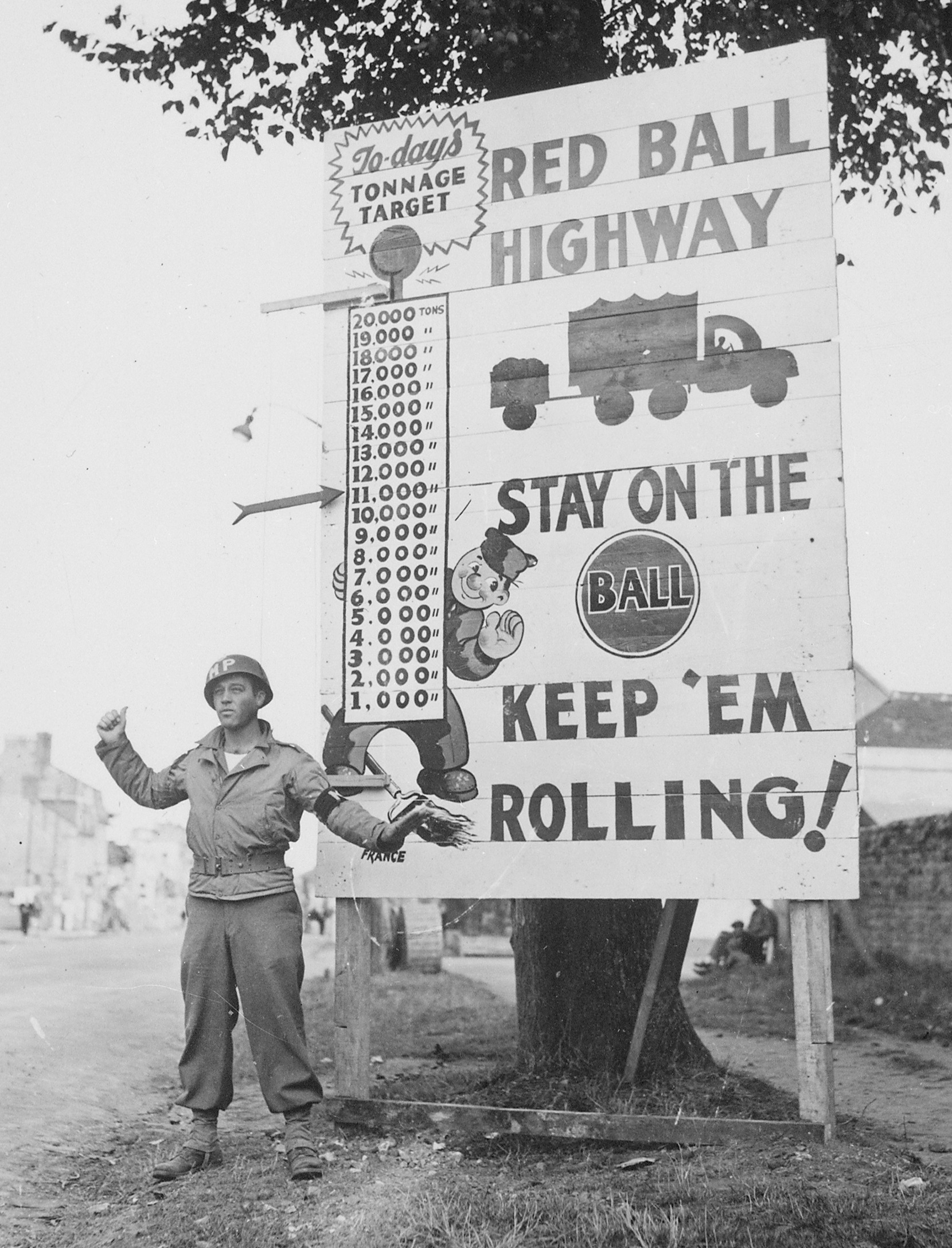
The name “Red Ball” wasn’t random.
In American railroads, a red ball marked express freight lines that had absolute priority — nothing could delay them.
In August 1944, that idea was reborn on French soil.
The U.S. Army designated a special route from the beaches of Normandy to the advancing front lines near Chartres and beyond — nearly 700 kilometers (435 miles) of road.
Only Red Ball trucks could use it.
Signs with big red circles were placed along the way, and Military Police enforced the rules:
“No unauthorized vehicles. No stopping. No excuses.”
At its peak, the Red Ball Express moved 12,500 tons of supplies every day — fuel, food, ammo, medicine — everything the war machine needed.
3. The Drivers Who Made It Happen
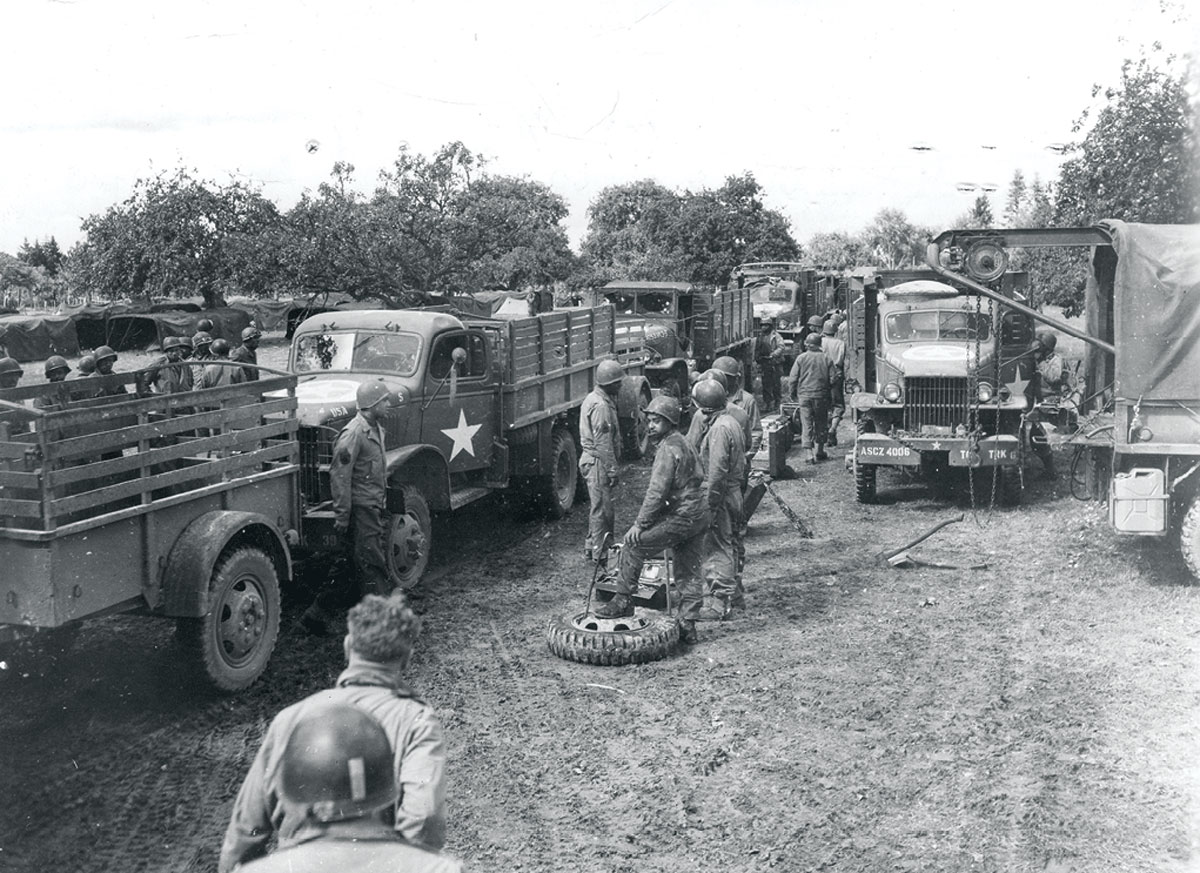
The real heroes of the Red Ball Express were the drivers — most of them young, inexperienced, and often from segregated African American units.

Out of roughly 23,000 drivers, about 75% were Black soldiers from support regiments.
At a time when the U.S. Army was still segregated, these men proved their courage not in the trenches — but behind the wheel.
They drove day and night through mud, rain, and bombed-out roads.
Sometimes they were attacked by Luftwaffe planes or snipers.
Sleep was rare. Rest stops didn’t exist.
They often kept the trucks running with spare parts scavenged from wrecks — and pure determination.
Their motto became: “Keep ’Em Rolling.”
4. The Machines That Never Slept
The Red Ball fleet ran mostly on GMC “Deuce-and-a-Half” trucks — 2.5-ton beasts that could haul heavy loads over bad terrain.
Each truck carried around 2,500 pounds of cargo, and each driver would make the round trip — up to 1,000 miles a week.
The route had two parallel roads:
- One for northbound loaded trucks,
- One for southbound empties returning for more cargo.
To speed things up, the convoys ran 24 hours a day, guided by blackout lights at night.
Even the smallest delay could ripple through the entire chain.
At the height of operations, more than 6,000 trucks were on the road every single day.
5. Challenges on the Road
Driving for the Red Ball Express was no easy task.
Drivers faced:
- Narrow French farm roads barely wide enough for two trucks.
- Bridges damaged by German retreating forces.
- Fuel shortages even for the supply trucks themselves.
- Constant exhaustion — and danger.
To make matters worse, there was no GPS, no modern maps, and no headlights allowed at night.
Drivers relied on instinct, road markers, and sometimes just the taillight of the truck in front.
Many slept in their seats, eating cold rations while engines ran.
Yet they kept going.
6. How the Red Ball Express Fueled Victory
By September 1944, the Red Ball Express had delivered over 400,000 tons of supplies.
That fuel allowed Patton’s tanks to cross France in record time.
Artillery units had the shells they needed.
Infantry had food, boots, and ammo.
It wasn’t glamorous work — but it was decisive.
Without it, the Allied advance might have slowed to a crawl, giving Germany precious time to regroup.
Historians often say that logistics wins wars — and the Red Ball Express was proof.
It turned chaos into rhythm, and supply lines into a living artery of victory.
7. Race, Recognition, and Reality
Despite their crucial role, most of the African American drivers of the Red Ball Express received little recognition at the time.
In official Army reports, they were rarely mentioned by name.
Racism was still rampant — the Army was segregated, and many white officers doubted the skill and bravery of Black troops.
Yet when the Allies needed men who could drive 18 hours straight under fire, these soldiers delivered.
After the war, historians began to recognize their contributions.
Documentaries, memorials, and even Hollywood films like The Red Ball Express (1952) helped bring their story to light.
Today, their legacy stands as one of endurance, discipline, and quiet heroism.
8. The End of the Line
The Red Ball Express ran for only 82 days, from August 25 to November 16, 1944.
Once the Allies captured major ports like Antwerp and Le Havre, supplies could arrive by ship and train again.
But in those three months, the Express had done its job — keeping an entire army alive and moving.
By the time it shut down, the Red Ball had logged over 20 million truck miles across France and Belgium.
9. Lessons in Logistics: Then and Now
The Red Ball Express became a model for future military supply chains.
Its lessons echo in every modern army:
- Mobility is power. Logistics must move as fast as the fight.
- Road control is strategy. Securing routes is as vital as holding ground.
- Morale matters. Drivers were not just transporters — they were lifelines.
Even in modern conflicts — from Iraq to Ukraine — rapid resupply remains a top priority.
The U.S. military still studies Red Ball’s operations to understand how to move massive resources under pressure.
10. The Human Engine of War
War is often told in stories of generals and battles, but behind every tank that rolled and every soldier that fought was a driver who delivered the fuel, the food, and the ammo.
They were the invisible warriors — men whose steering wheels were their weapons, whose courage came from duty, not glory.
The Red Ball Express wasn’t just about logistics.
It was about belief — that no matter how long the road, or how hard the drive, the mission would continue.
As one driver said: “We didn’t have heroes’ names. We had jobs. And we did them.”
Conclusion: The Convoy That Won the War
When people think of World War II, they picture D-Day, the Battle of the Bulge, or the raising of the flag at Iwo Jima.
But none of those moments could have happened without the steady hum of engines on the back roads of France.
The Red Ball Express didn’t fire a single bullet — but it delivered every one.
It didn’t storm a beach — but it made sure those who did had what they needed to survive.
In the end, the war was won not just by strategy or strength, but by stamina — and the will to keep rolling, no matter what.
The Red Ball Express proved that heroes don’t always carry rifles.
Sometimes, they drive trucks.
 Vellum Insights
Leave a comment