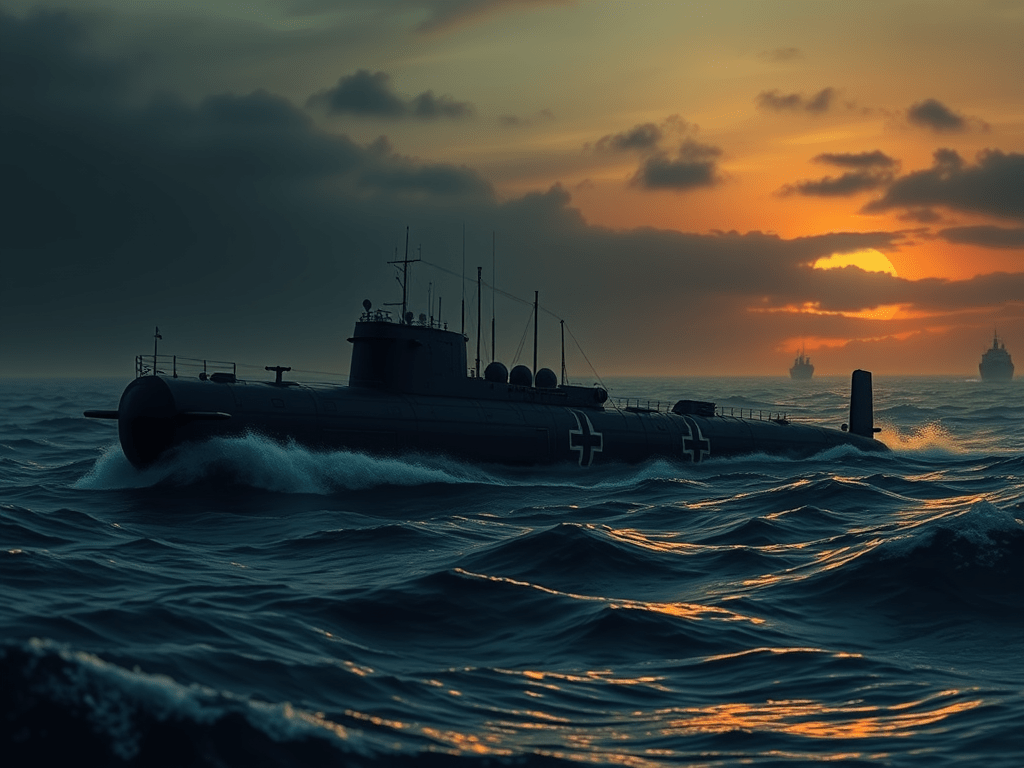
Introduction: Hidden Danger Beneath the Waves
In World War II, not all battles happened on beaches or in the skies. One of the most important fought beneath the waves. German submarines — known as U-Boats — prowled the Atlantic Ocean, targeting the huge flow of ships carrying food, fuel, and equipment from America to Europe.
For the United States and its allies, keeping those supply lines open was a matter of life or death. If shipments stopped, the whole war effort stalled. This is the story of how U-Boats threatened that lifeline — how they struck, how the U.S. responded, and how the turning tide changed the war.
1. Why the Atlantic Supply Lines Mattered
When America entered the war in December 1941, it suddenly had to send vast amounts of materiel across the ocean: tanks, planes, ammunition, food, fuel. Britain and the Soviet Union depended on these supplies. If shipping stopped, the war could be lost.
The Atlantic shipping lanes were the superhighways of war. Each troop, each shell, each gallon of petrol had to cross the sea. If the U-Boats cut that route, the Allies faced a blockade worse than any they had seen.
As noted by Britannica: “The United States’ formal entry into the war opened a vast new area for U-boat operations shipping losses spiked.” Encyclopedia Britannica+2dday.center+2
Thus, protecting the seas became one of the most urgent tasks of the U.S. Navy and its allies.
2. The U-Boat Threat Begins: Wolf-Packs & Unrestricted Warfare
Germany’s navy, the Kriegsmarine, had learned from World War I that submarines were a cost-effective way to strike at an island power’s supply lines. Encyclopedia Britannica+1
By 1940–41, Germany had U-Boats operating from French Atlantic ports (after France fell) which gave them access to the Atlantic without going around Britain. Encyclopedia Britannica
The tactic: groups of U-Boats called wolf-packs would hunt Allied merchant convoys at night, on the surface, using torpedoes and deck guns. These attacks were deadly. For example: “From January to August 1942, German U-boats destroyed 868 ships, totaling 3.1 million tons.” dday.center+1
The U-Boats threatened not just the British, but American shipping too. In early 1942, the U.S. East Coast and Caribbean waters became hunting grounds for German submarines. NOAA Ocean Exploration
It was a crisis: a submarine campaign designed not to sink battleships, but to starve the allies of supplies.
3. U.S. Shipping Under Fire: The “Happy Times” for U-Boats
The Americas were hit hard. In 1942 especially, U-Boats roamed off the U.S. coast in what has been called the “Second Happy Time” for German subs. HISTORY+1
According to sources: “In early 1942 … German submarines sank between March 15 and April 20 about 2.2 ships per day off the U.S. coast.” U.S. Department of War
The results:
- Merchant vessels sank, leaving gaps in supplies.
- Insurance and shipping costs soared.
- American shipyards were forced into overdrive to replace losses.
The U-Boat threat made clear: the war depended not just on armies and guns, but on uninterrupted shipment of goods thousands of miles across the ocean.
4. The Impact on the U.S. War Effort
When ships sink, the consequences ripple through the entire war machine.
a) Loss of Personnel and Ships
Thousands of merchant mariners and naval escort crews died. According to the D-Day Center: “Over 3,500 merchant ships were sunk” in the U-Boat campaign. dday.center+1
b) Slowed Supplies
Delays in food, fuel, ammunition, and vehicles directly hampered operations. Without fuel, tanks can’t move; without shells, guns stay silent.
c) Economic and Psychological Toll
Huge sums were required to build replacements. And for sailors on crossing ships, the fear of being torpedoed added stress and lowered morale.
One U.S. Army naval study noted: “Without control of the seas, the United States … could not hope to ship the requisite men and supplies.” U.S. Department of War
Together, these facts show: the U-Boats threatened to deliver a strategic knockout punch — not via bombers or tanks, but via shipping destruction.
5. Turning the Tide: Allied Response & Innovation
The Allies were threatened — and they responded.
Convoy System
The use of escorted convoys — groups of merchant ships protected by warships and aircraft — became a backbone of defense. Britannica records that by late 1942 the Allies shifted the western terminus for convoys to New York and improved monitoring. Encyclopedia Britannica+1
Technology & Intelligence
- Radar and sonar improved detection of subs. Smithsonian Magazine
- The cracking of the German Enigma code let Allies track U-Boat positions. dday.center
- Escort carriers and long-range patrol aircraft closed the “air gap” in the mid-Atlantic. atlanticocean.info
By mid-1943 the U-Boat threat began to decline sharply. The Battle of the Atlantic flipped. Encyclopedia Britannica+1
Shipbuilding Output
The U.S. shipyard could produce Liberty ships and Victory ships faster than the U-Boats could sink them. Massive industrial output made the strategic balance tip. HISTORY
Together, these actions stopped the bleeding of shipping losses and secured the Atlantic lifeline.
6. The U-Boats’ Decline and Final Years
After 1943, the German U-Boat campaign faltered. Losses mounted. Technology favored the Allies. The mid-Atlantic became increasingly safe for shipping.
According to one source: “Germany built 1,162 U-boats; of those 785 were destroyed.” Encyclopedia Britannica
The war for the Atlantic ended with the Allies in control of the seas. The U.S. Navy’s focus could shift to the Pacific, and supplies to Europe flowed steadily. The threat of subs had been neutralized.
7. The Human Side: Merchant Mariners & Silent Heroes
It’s easy to talk about ships and tonnage. But each lost vessel meant human loss. Merchant mariners died at high rates. They were civilians fighting without front-line glory.
One site notes: “Merchant Mariners had the highest casualty rate of any service.” Reddit
Their courage was vital. They kept supplying the war, under threat of torpedo and mine.
8. Why the Atlantic Battle Matters for the U.S. Navy
For the U.S. Navy, this campaign changed everything:
- It proved that logistics are as important as firepower.
- It showed that commerce protection is a war mission.
- It led to doctrines of anti-submarine warfare (ASW) still used today. atlanticocean.info
- It reinforced the idea that marching armies depend on ships crossing oceans.
Without winning the Battle of the Atlantic, the U.S. and its allies might have been defeated even without a major land battle.
9. Lessons for Today: Supply Chains, Vulnerability & Resilience
The story of U-Boats isn’t just history. It holds lessons for modern times:
- Supply chains are vulnerable. Disruption of shipping routes can cripple nations.
- Technology and intelligence can overcome even major threats.
- Sea power remains vital in an era of global trade.
- Protecting commerce is an element of national defence.
Whether it’s pipelines, digital cables, or container ships — the basic logic remains. The sea lanes are lifelines.
10. Conclusion: Victory Under the Sea
The war fought beneath the waves was silent but decisive.
German U-Boats came close to strangling Allied supply lines. For a while they threatened to change the outcome of the war. But through resolve, innovation, and industrial might, the U.S. and its allies turned the tide.
For America’s war effort, saving the shipping lanes meant winning the war. Without that victory, victory on land and in the skies might never have come.
So the next time you think of WWII heroes, remember the ships that sailed across the Atlantic — and the submarines that tried to stop them. Because in those dark waters, the fate of the free world was decided.
 Vellum Insights
Leave a comment