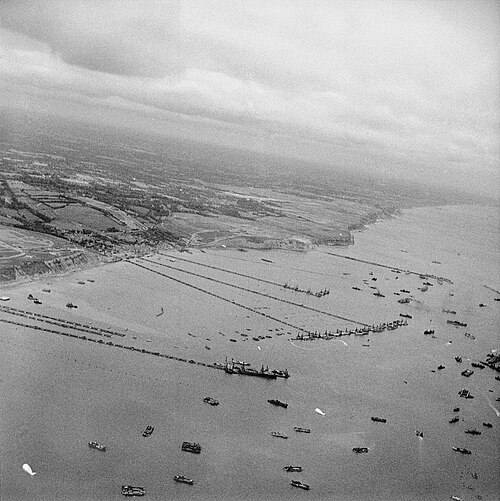
Prelude to the Invasion: The Impossible Problem
On June 6, 1944, thousands of Allied ships crossed the English Channel toward Normandy in what would become the largest amphibious invasion in history — D-Day. But behind the courage of the soldiers storming the beaches was a quieter, equally daring operation — one that involved not rifles and tanks, but engineering and imagination.
The problem was simple but brutal:
Once the Allies landed in France, they needed a way to bring in supplies — fuel, ammunition, food, and reinforcements — faster than the Germans could counterattack.
The French ports, like Cherbourg and Le Havre, were heavily defended or destroyed. Landing craft could unload tanks and trucks on beaches, but not enough to sustain an army of millions.
So Churchill posed a bold idea:
“If we cannot capture a port, we must take one with us.”
That line birthed one of the greatest engineering miracles of the war — the Mulberry Harbours.
The Great Gamble: Building a Port That Floats
In 1943, British and American engineers began planning what seemed impossible: portable harbors that could be assembled off the coast of Normandy.
The plan called for two artificial ports:
- Mulberry “A” for the Americans at Omaha Beach
- Mulberry “B” for the British at Arromanches
Each harbor would include:
- Massive concrete caissons (called Phoenixes) to form breakwaters
- Old, scuttled ships (Gooseberries) sunk in a line to block waves
- Floating pier roadways (Whales) connecting the sea to shore
- Pierheads (Spuds) that could rise and fall with the tide
In total, the project required over 600,000 tons of concrete, 33 jetties, and 10 miles of floating roadways — all secretly built in British shipyards.
To hide the project, the parts were built in pieces and moved under the cover of night. Workers had no idea what the final structure would become. Some even thought they were helping build an “invasion bridge” or “floating fort.”
The Engineering Genius Behind It
Each Mulberry was like a giant mechanical organism.
- The Phoenix caissons were hollow concrete boxes the size of apartment buildings, sunk in precise positions to form an artificial breakwater.
- The Whale roadways were steel bridges mounted on floating pontoons, flexible enough to withstand waves but strong enough to carry tanks.
- The Spud pierheads were adjustable platforms supported by massive legs that rested on the seabed — allowing ships to unload regardless of tide levels.
Together, these components turned open water into a fully functioning port — capable of unloading thousands of tons of supplies daily.
This was logistics warfare at its peak. It was about not just winning battles, but feeding victory.
D-Day and the Arrival of the Mulberries
When D-Day began on June 6, 1944, the first landings were chaotic. Beaches were littered with wreckage, men, and machines. The Mulberry harbors wouldn’t arrive for several days — but when they did, they changed everything.
By June 9, convoys began towing the giant pieces across the Channel. The operation was immense: over 140 tugboats hauling 200 prefabricated parts through rough seas.
The British Mulberry (“B”) at Arromanches became operational first. Within days, ships were unloading tanks, trucks, ammunition, and food directly onto the floating piers — all without needing a natural harbor.
The American Mulberry (“A”) at Omaha Beach also began unloading cargo — until a violent storm hit on June 19, 1944.
The Storm That Tested the Steel
For three days, the worst storm in 40 years battered the Normandy coast. Winds reached 65 miles per hour, waves as high as 20 feet smashed into the floating structures.
Mulberry “A” was destroyed — broken apart and scattered across the sea. The Americans salvaged what they could, but most of it was beyond repair.
The British Mulberry “B,” however, survived — damaged but functional. The British engineers worked tirelessly to repair it, and it remained operational for the next 10 months.
This single harbor, nicknamed “Port Winston,” became the lifeline of the Allied advance.
Feeding the Front: The Numbers That Won the War
What Mulberry “B” achieved was staggering.
Between June 1944 and May 1945, Port Winston handled:
- Over 2.5 million men
- 500,000 vehicles
- 4 million tons of supplies
That’s the equivalent of an entire modern army — all funneled through a floating harbor made from steel, concrete, and vision.
Without it, the Normandy invasion might have stalled before Paris. The Allies would have struggled to maintain momentum, and the war in Europe could have dragged on for months longer.
The Hidden Legacy of Mulberry
After the war, most of the Mulberry structures were dismantled, but parts still remain off the coast of Arromanches — silent relics of innovation and determination.
The engineering lessons from the Mulberry Harbours influenced:
- Modern modular construction
- Offshore oil platforms
- Temporary bridge systems
- Disaster relief logistics
Today, military planners still study Operation Mulberry as a case study in adaptive logistics and rapid infrastructure deployment.
It’s proof that wars aren’t only won by soldiers — they’re also won by engineers, builders, and dreamers.
Quote from the Front
“Amateurs talk about tactics. Professionals talk about logistics.”
— General Omar Bradley
Conclusion: The Ports That Won the War
The Mulberry Harbours were more than concrete and steel — they were symbols of ingenuity and courage under pressure.
When soldiers stormed the beaches, they carried rifles. But behind them came the builders, welders, and engineers who built the invisible bridges to victory.
Their floating ports didn’t just carry supplies — they carried hope, one wave at a time.
 Vellum Insights
Leave a comment