Introduction: A War Won Not Just by Battles – But by Deception
When D‑Day came on June 6, 1944, the world saw thousands of Allied troops storm the beaches of Normandy.
But hidden behind that dramatic morning was something nearly as vital: a vast deception plan. This plan was called Operation Bodyguard.
The goal? Make the German commanders believe the invasion would come somewhere else, at another time. By misleading the enemy, the Allies gave themselves time, space, and the element of surprise. Wikipedia+2Military.com+2
In this blog post we’ll explore:
- Why the Allies needed a deception at all.
- How Bodyguard was built and structured.
- The clever tricks and fake armies used.
- The impact it had on German decisions.
- What we can learn from it today.
Let’s jump in.
1. Why Deception Was Crucial
The Allies faced a huge challenge: they needed to invade Germany-held Western Europe from the west. But the enemy expected them. Germany had built the Atlantic Wall and strengthened coastal defenses. The Allies knew that if the Germans discovered the when or where of the invasion early, they could mass troops and defeat the landing.
That meant the Allies had to hide both the timing and the location of their attack. As Britannica states: “Bodyguard… set out an overall stratagem for misleading the Oberkommando der Wehrmacht as to the time and place of the invasion.” Wikipedia
In short: the war would be won in part by what the enemy didn’t see.
2. Planning the Deception: The Birth of Bodyguard
Planning for Operation Bodyguard began in 1943 under the direction of the London Controlling Section (LCS), a secret Allied unit dedicated to deception strategy. iwm.org.uk+1
The main aims:
- Make the Germans believe the invasion would strike at Pas-de-Calais, not Normandy. iwm.org.uk+1
- Hide the actual date of the landing.
- Make the Germans keep large forces in wrong places, rather than reinforcing Normandy. Wikipedia+1
Bodyguard was not just one operation—it was the umbrella for many sub-operations: Operation Fortitude (North & South), Operation Graffham, Operation Royal Flush, and more. dday.center+1
3. The Tricks, the Tools & the Fake Army
• Phantom Armies & Inflatable Tanks
One of the centrepieces: the creation of a fake army group called First United States Army Group (FUSAG), supposedly under George S. Patton, based in southeast England facing Pas-de-Calais. The Germans had seen Patton as America’s top tank commander—so assigning him the fake army made the lie more convincing. dday.center+1
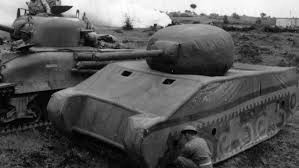
Around the south coast of England, the Allies built inflatable tanks, dummy landing craft, fake airfields. Reconnaissance would spot what looked like build-up of invasion forces. iwm.org.uk
• Fake Radio Traffic & Double Agents
The Allies used double agents—such as the famous Juan Pujol Garcia (“Garbo”)—to feed German intelligence false stories. At the same time, Allied radio operators sent fake messages about troop and supply movements. HISTORY+1
• The Date Trick
Not only were the Germans led to expect an attack at Pas-de-Calais, they were also led to believe that the landing might be delayed. This caused hesitation in German command. iwm.org.uk
• Diversionary Actions
Operations like Fortitude North aimed to threaten Norway; and others made Germany think other invasion points (Mediterranean, Balkans) were active. dday.center
All of these layered to create confusion, delay, and misallocation of German forces.
4. Impact: What the Germans Did—and Why It Mattered
Because of Bodyguard:
- German high command kept large forces near Pas-de-Calais instead of sending them to Normandy. Encyclopedia Britannica
- Hitler delayed moving some reinforcements from the Calais region for weeks—even after the landings had begun. dday.center+1
- The real invasion force faced fewer German units at the critical moment—giving the Allies a critical early advantage.
The deception didn’t guarantee victory—but it helped make success far more likely.
5. Smaller Stories, Big Effects
- Dummy tanks: The image of inflatable Shermans fooled aerial reconnaissance. iwm.org.uk
- Fake operations: One double agent convinced Germany the Allies would invade Greece or the Balkans. dday.center
- Intelligence synergy: The deception worked because it aligned with what the Germans wanted to believe. dday.center
These human and creative details made Bodyguard a masterpiece of war craft.
6. Why It Works: The Psychology of Deception
Deception in war works when it:
- Mimics what the enemy expects.
- Delivers cues the enemy trusts (e.g., Patton in the fake army).
- Delays their decision-making.
- Shapes perception more than reality.
Bodyguard didn’t overwhelm German intelligence—it manipulated their perceptions.
7. Legacy: What We Learn Today
Operation Bodyguard offers lessons for modern strategy:
- Information warfare matters. Deception, misdirection, and intelligence shape outcomes.
- Perception is real. Wars can be won by what the enemy believes.
- Coordination of many tools. Fake armies, radio chatter, double agents—all had to work together.
In the modern age of satellites and cyber-espionage, the scale of deception may change—but the principles remain.
8. Conclusion: Victory’s Hidden Shadow
On June 6, 1944, Allied troops flooded the beaches of Normandy. The guns, ships, and men took the spotlight. But behind the scenes, Operation Bodyguard was the hidden hand that made it happen.
The campaign of lies, theater, and intelligence helped ensure the German response was slow and scattered. That gave the Allies a window to win.
In war, truth may be precious—but so too is the ability to guard it with a bodyguard of lies.
 Vellum Insights
Leave a comment