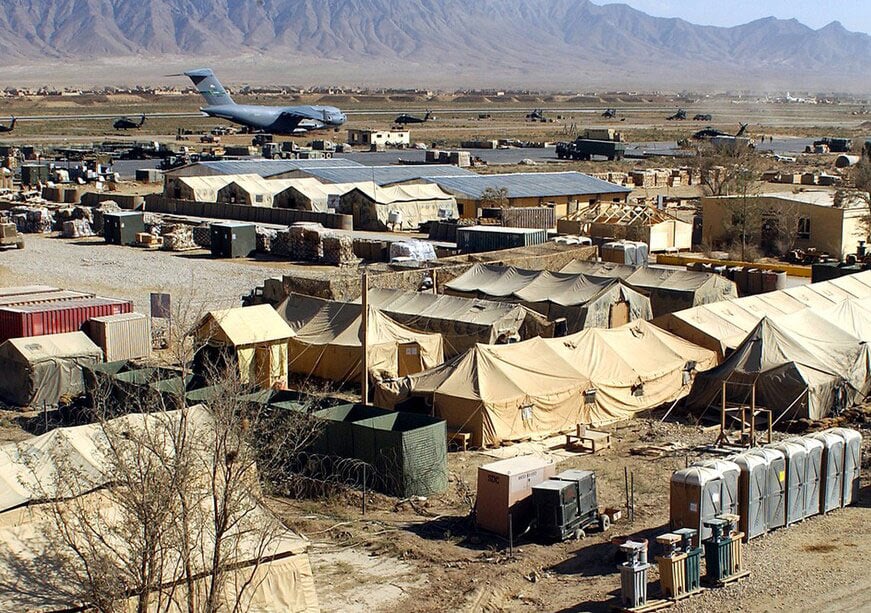
How one decision changed the end of the Afghanistan War — and shaped America’s exit forever.
🔎 Introduction: The Base That Held a War Together
For almost 20 years, Bagram Air Base was the center of America’s mission in Afghanistan. It was more than a runway. It was a symbol of strength, a shield for Afghan forces, a staging point for U.S. troops, and the heart of intelligence, drones, transport, and medical support.
But in July 2021, the United States left Bagram overnight.
No ceremony.
No hand-off.
No public warning.
Within weeks, the Afghan government collapsed. The Taliban swept across the country. Kabul fell. And the world watched chaos unfold at the Hamid Karzai International Airport—a place never designed for mass evacuation.
Many experts now say:
“Losing Bagram doomed Afghanistan.”
This article explains why.
1. What Bagram Really Was: The Brain, Heart, and Lungs of a War
To understand the collapse, we must first understand Bagram’s role. It wasn’t just a military base. It was the glue that held the Afghan war effort together.
1.1 A Strategic Fortress
Bagram had:
- Two massive runways
- Space for tens of thousands of troops
- Three rings of defenses
- Advanced radar and air-defense systems
- A full field hospital
- The main drone command center
It was the only base in the country capable of:
- Sustained heavy airlift
- 24/7 drone missions
- Large-scale logistics operations
- Supporting NATO coalition traffic
1.2 Air Power: The Afghan Army’s Life Support
The Afghan National Army (ANA) heavily depended on U.S. airpower for:
- Air strikes
- Medical evacuations
- Supply drops
- Transport of reinforcements
- Surveillance and intelligence
Losing Bagram meant losing:
- 90% of U.S. airstrike capability
- All heavy logistics capacity
- Command-and-control systems for Afghan pilots
This left Afghan troops blind, isolated, and cut off.
SIGAR (Special Inspector General for Afghanistan Reconstruction) later wrote:
“Once U.S. air support ended, the Afghan Army’s ability to fight collapsed almost instantly.”
— SIGAR, Why the Afghan Security Forces Collapsed, 2023
2. Why Bagram Was Abandoned: The Doha Trap
To understand why Bagram was closed, we must look at the Doha Agreement (February 2020).
This was the U.S.–Taliban deal under which:
- The U.S. promised to leave Afghanistan
- The Taliban promised not to attack withdrawing forces
- The Afghan government was excluded from negotiations
- Taliban leaders gained international legitimacy
But the biggest problem was hidden in the fine print:
The U.S. agreed to reduce all forces to a level too small to hold major bases.
By early 2021:
- Only 2,500 U.S. troops remained
- Just enough to hold one base — not Bagram
The Biden administration reviewed the agreement but concluded the U.S. was trapped:
“Staying meant breaking the deal and restarting the war. Leaving meant accepting the risks.”
— U.S. National Security Review Summary, 2021
The Pentagon recommended keeping Bagram.
The White House chose full withdrawal.
That meant:
- Bagram had to be abandoned
- A single airport (Kabul International) had to handle the evacuation
- Afghan forces were left without air support
- Taliban forces gained momentum across the country
3. The Night Bagram Went Dark: A Silent Exit
On July 1, 2021, U.S. troops shut off the electricity, packed their vehicles, and left Bagram in the middle of the night without informing the Afghan commander.
Afghan General Mir Asadullah Kohistani later said:
“We woke up and found they were gone. The Americans left without saying goodbye.”
The base was instantly looted by local civilians.
The Afghan Army took over, but they didn’t have:
- Enough troops
- Enough pilots
- Enough maintenance crews
- Any ability to defend the perimeter
Bagram was now:
- Too big to hold
- Too complex to operate
- Too costly to maintain
Within 40 days, it fell to the Taliban without a fight.
4. How Losing Bagram Collapsed the Afghan State
4.1 No Air Support = No Army
The Afghan military was built around one idea:
American airpower will stop large Taliban attacks.
But once Bagram fell:
- Afghan helicopters ran out of spare parts
- Drones stopped flying
- Airstrikes stopped
- Troops in remote bases were isolated
- Desertions skyrocketed
SIGAR wrote:
“Removing U.S. advisers and air support crippled Afghan forces more than any Taliban offensive.”
— SIGAR, 2023
4.2 The Taliban’s Blitzkrieg
With Bagram gone, the Taliban launched a lightning campaign:
- Attack isolated bases
- Cut off supply lines
- Force local commanders to surrender
- Capture equipment
- Move rapidly from city to city
By late July:
- 200+ district centers fell
- Taliban captured U.S.-supplied vehicles
- Entire brigades surrendered without firing a shot
It was a domino effect.
4.3 Psychological Collapse
Bagram’s fall signaled:
- The U.S. is truly leaving
- There will be no rescue
- No more airstrikes
- No logistics
- No backup
Afghan troops lost faith.
Local warlords switched sides.
Provincial governors negotiated surrender deals.
Once morale broke, the collapse was unstoppable.
5. Kabul Without Bagram: A Deadly Funnel
When the Taliban closed in on Kabul, the U.S. needed an evacuation point.
But there was a huge problem:
Bagram was gone.
The only option was:
- A small civilian airport
- In the middle of the city
- With no secure perimeter
- Surrounded by Taliban fighters
This led to:
- Chaotic crowds
- A deadly ISIS-K suicide bombing
- Billions in abandoned equipment
- Desperate evacuations on cargo planes
The Pentagon later admitted:
“Without Bagram, we had limited options for a safe and orderly evacuation.”
— U.S. Defense Department After-Action Review, 2022
6. How the Taliban Used Bagram After the Capture
Once the Taliban took Bagram:
- They freed thousands of prisoners, including ISIS-K fighters
- They seized helicopters, armored vehicles, weapons, and ammunition
- They gained access to advanced equipment left behind
- They used the base as their new military HQ
One decision had changed the balance of power.
7. The Strategic Lessons: What Bagram Teaches the World
Lesson 1: Airpower keeps weak states alive
Without U.S. planes, the Afghan Army was not a 300,000-man force.
It was a patchwork of disconnected outposts.
Lesson 2: Never give up your strongest military base first
Bagram was:
- Defensible
- Equipped
- Spacious
- Internationally connected
Giving it up made everything worse.
Lesson 3: Diplomacy can trap militaries
The Doha Agreement removed the U.S.’s freedom to choose:
- timelines
- troop levels
- base structure
- withdrawal positioning
It was a military retreat shaped by political pressure.
Lesson 4: Morale collapses before armies do
Afghanistan did not fall militarily.
It fell psychologically.
Lesson 5: Evacuations require planning years ahead
Kabul airport was doomed to fail the moment Bagram closed.
Conclusion: How One Base Decided the Fate of a Nation
The fall of Afghanistan was not caused by:
- Lack of bravery
- Poor training
- Weak soldiers
- Taliban strength
It was caused by structural collapse.
Bagram was the backbone.
Once it was gone, the Afghan military lost:
- mobility
- coordination
- firepower
- intelligence
- morale
In the end, the fall of Bagram was not one event.
It was the moment the war became unwinnable.
The story of Bagram is a lesson for all future conflicts:
Never walk away from the anchor that holds everything together.
Sources
- SIGAR (Special Inspector General for Afghanistan Reconstruction), Why the Afghan Security Forces Collapsed, 2023.
- Department of Defense, Afghanistan After-Action Review, 2022.
- Graeme Herd, The Causes and Consequences of Strategic Failure in Afghanistan, Marshall Center, 2021.
- Al Jazeera, “US auditor: Washington, Ghani to blame for Afghanistan’s fall,” 2022.
- The National, “Afghan Army collapse was years in the making,” 2021.
 Vellum Insights
Leave a comment