How Low-Cost Drones Are Reshaping Warfare in the Middle East and Beyond
Introduction: The Rise of the Drone Battlefield
In modern warfare, some of the most powerful weapons no longer come from expensive fighter jets or billion-dollar warships.
Instead, they come from small, inexpensive drones.
Over the last decade, Iran has developed one of the world’s most extensive drone programs. These unmanned aerial vehicles (UAVs) have become a central part of Iran’s military strategy.
Unlike traditional air forces, drone warfare allows countries to launch attacks that are:
- cheap
- difficult to detect
- easy to mass produce
- capable of overwhelming air defenses
Iran has exported these drones to allied groups and partner states across the Middle East, turning them into one of the most influential tools in modern asymmetric warfare.
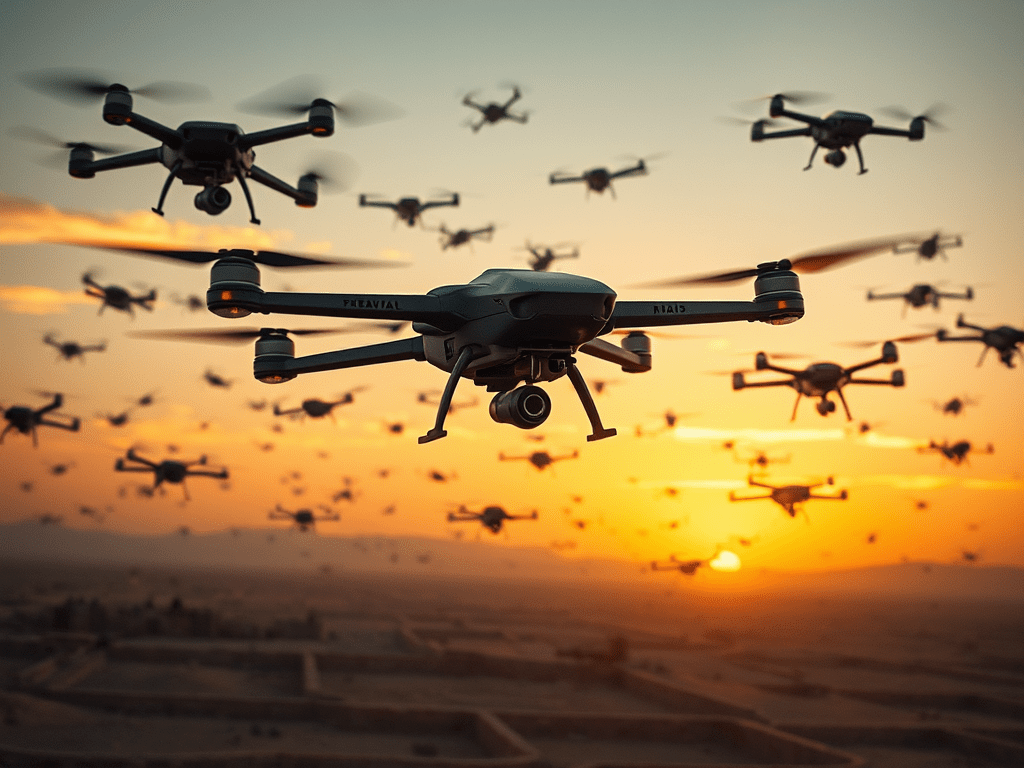
This strategy—sometimes described as drone swarm doctrine—is now reshaping military planning worldwide.
Chapter 1: Why Drones Became Iran’s Weapon of Choice
For decades, Iran has faced strict military sanctions and technological restrictions.
These limits made it difficult for the country to acquire advanced aircraft comparable to those operated by rivals such as:
- Israel
- United States
- Saudi Arabia
Instead of trying to compete directly in expensive airpower, Iran developed an alternative strategy.
Military planners focused on asymmetric warfare—using inexpensive technologies to challenge technologically superior opponents.
Drones offered several advantages:
- They cost far less than fighter aircraft.
- They can travel long distances.
- They can be launched in large numbers.
- They reduce risk to human pilots.
By combining these advantages, Iran created a system where dozens of drones could be launched simultaneously, overwhelming traditional air defenses.
Chapter 2: The Evolution of Iran’s Drone Program
Iran’s drone program began during the Iran–Iraq War in the 1980s.
At the time, early UAVs were used mainly for reconnaissance missions.
Over the decades, the technology improved dramatically.
Iran eventually developed several types of combat drones capable of performing missions such as:
- reconnaissance
- precision strike attacks
- loitering munitions (kamikaze drones)
One of the most widely discussed models is the Shahed‑136 loitering munition, a small drone designed to fly long distances before crashing into its target with an explosive payload.
These drones are relatively simple compared to advanced Western UAVs, but they are cheap and easy to produce in large numbers.
This is exactly what makes them strategically powerful.
Chapter 3: The Power of Drone Swarms
Traditional air defenses are designed to intercept a small number of incoming missiles or aircraft.
Drone swarm tactics challenge this system.
Instead of sending one large weapon, attackers launch dozens or even hundreds of drones simultaneously.
This creates several problems for defenders:
Air Defense Saturation
Missile defense systems have limited interceptors.
If too many drones approach at once, defenses may run out of missiles before destroying every target.
Cost Imbalance
Defending against drones can be extremely expensive.
For example:
- A drone might cost $20,000–$50,000 to build.
- A missile used to intercept it might cost hundreds of thousands of dollars.
This creates a cost imbalance, where defenders spend far more money than attackers.
Radar Detection Challenges
Many drones fly at low altitude and have small radar signatures.
This makes them harder to detect than conventional aircraft.
Chapter 4: Iran’s Proxy Drone Network
Iran’s drone strategy extends far beyond its own military.
Tehran has supplied drones to allied groups across the Middle East.
This network includes organizations such as:
- Hezbollah in Lebanon
- Houthi movement in Yemen
- various militias in Iraq and Syria
By distributing drones to partner forces, Iran can influence conflicts across the region without deploying its own troops.
This strategy allows Iran to conduct what analysts sometimes call “remote warfare.”
Drone attacks launched by proxy groups can strike targets hundreds or even thousands of kilometers away.
Chapter 5: The Impact on Global Warfare
Iran’s drone tactics have influenced conflicts well beyond the Middle East.
In recent wars, drone swarms have been used to attack:
- military bases
- air defense systems
- shipping vessels
- energy infrastructure
These attacks demonstrate how drones can disrupt both military operations and civilian economies.
Major powers are now racing to develop counter-drone technologies, including:
- electronic jamming systems
- laser defenses
- anti-drone missiles
- radar systems designed for small UAV detection
Even advanced militaries are still adapting to this new type of threat.
Chapter 6: Drone Warfare and the Strait of Hormuz
The drone threat is especially significant in maritime chokepoints such as the Strait of Hormuz.
Shipping lanes in the region are narrow and crowded.
This makes commercial vessels vulnerable to aerial attacks.
Drone strikes could target:
- oil tankers
- cargo ships
- naval vessels
- port infrastructure
Even a small number of successful attacks could disrupt global shipping and energy supplies.
This connection between drone warfare and maritime strategy is one reason the Strait of Hormuz remains such a critical geopolitical flashpoint.
Chapter 7: The Future of Drone Warfare
Military analysts believe drones will play an even larger role in future conflicts.
Several trends suggest drone warfare will continue expanding:
Artificial Intelligence
Future drones may operate with increasing autonomy, allowing swarms to coordinate attacks without human control.
Mass Production
Advances in manufacturing make drones easier and cheaper to produce.
Global Proliferation
More countries are developing drone technology, spreading these capabilities worldwide.
As these trends continue, drone warfare may become one of the defining features of 21st-century conflict.
Conclusion: The New Airpower Revolution
For most of the 20th century, airpower depended on expensive fighter jets, massive aircraft carriers, and highly trained pilots.
Today, that model is changing.
Cheap drones can now threaten some of the most advanced military systems ever built.
Iran’s drone swarm doctrine shows how smaller or sanctioned states can challenge powerful adversaries using innovation and asymmetric tactics.
The result is a new era of warfare where quantity, affordability, and adaptability may matter as much as technological superiority.
And as conflicts continue to evolve across the Middle East and beyond, drone warfare is likely to remain one of the most important military developments of the modern age.
Sources & Citations
- International Institute for Strategic Studies – Reports on Iranian UAV capabilities.
- Center for Strategic and International Studies – Analysis of drone swarm warfare.
- U.S. Department of Defense – Assessments of Iranian military technology.
- RAND Corporation – Studies on unmanned aerial systems and asymmetric warfare.
- Stockholm International Peace Research Institute – Global proliferation of drone technology.
 Vellum Insights
Leave a comment