
I. Historical & Strategic Context
Turkey has long viewed itself as a bridge between Europe, the Middle East, and Central Asia, but in recent years, it has evolved into a military-industrial powerhouse with global reach. No longer a passive NATO border state, Turkey under Erdoğan is increasingly projecting influence:
- North Africa (Libya)
- The Caucasus (Azerbaijan-Armenia war)
- Levant and Gulf (Qatar, Iraq, Syria)
- East Africa (Somalia, Red Sea bases)
Strategic Shift: From reactive defense to neo-Ottoman influence projection, blending soft and hard power.
II. Defense Industry as a Foreign Policy Weapon
Turkey is one of the world’s top 10 arms exporters—a remarkable shift over the past decade. Key defense assets include:
Bayraktar TB2 & Akinci Drones
- Used in Libya, Syria, Nagorno-Karabakh, and Ukraine with lethal efficiency
- Proven value: Affordable, modular, and swarm-capable
- Exported to over 30 countries
Domestic Naval Power
![ANALYSIS] TCG Anadolu: the most powerful warship and the flagship of the Turkish Navy - Turkish Minute](https://www.turkishminute.com/wp-content/uploads/2022/12/tcg-anadolu.jpg)
- TCG Anadolu: Turkey’s first aircraft carrier (drone carrier)
- Development of homegrown submarines, corvettes, and missile boats
- Naval projection into Red Sea and Gulf waters via bases in Qatar and Somalia
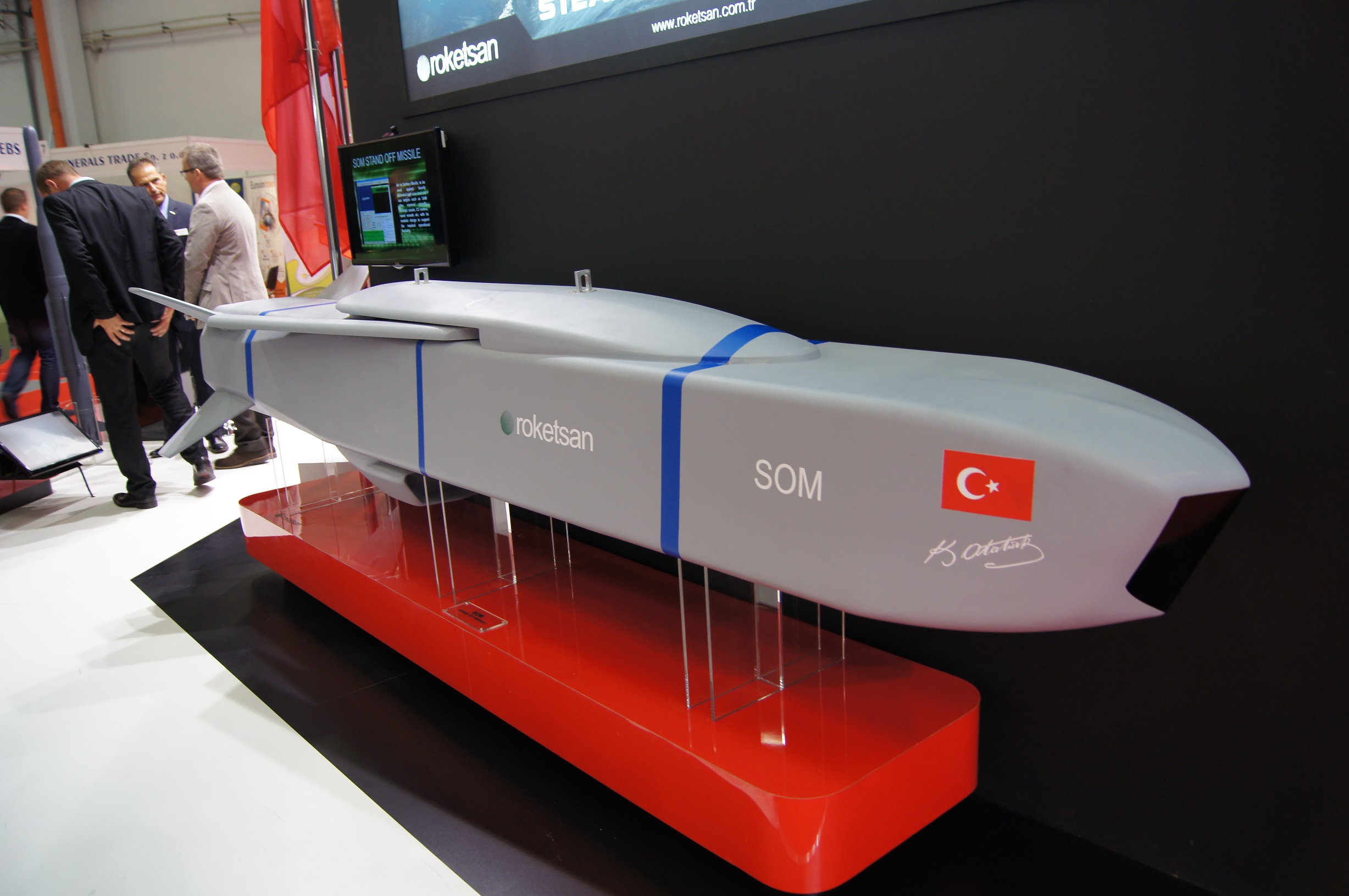
Roketsan & ASELSAN Weapon Systems
- Indigenous missile tech (SOM cruise missiles, surface-to-air platforms)
- Electronic warfare, SIGINT, and AI-based C4ISR platforms
III. Turkey’s Military Footprint in the Gulf & Red Sea
Qatar: The Core Gulf Ally
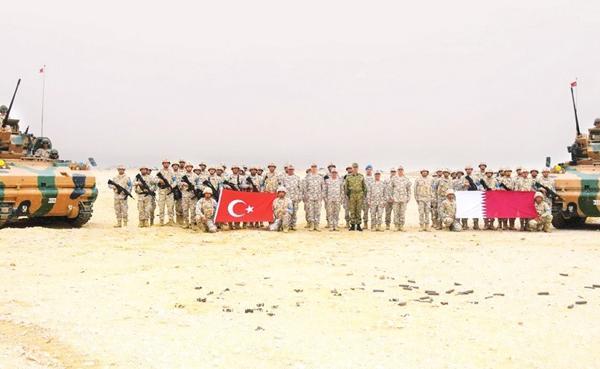
- Permanent Turkish base in Qatar (Tariq bin Ziyad Base) since the 2017 Gulf blockade
- Trains Qatari military officers and provides a counterbalance to Saudi-UAE axis
- Shared interests in Islamic soft power and Muslim Brotherhood-aligned networks
Somalia & Horn of Africa
- Camp TURKSOM: Largest Turkish overseas base, training Somali forces
- Gateway to Red Sea, Indian Ocean routes, and Gulf of Aden chokepoints
- Turkey is viewed by local governments as an alternative to Western and Chinese influence
Levant & Iraq
- Deep involvement in northern Iraq operations (anti-PKK) and northern Syria
- Construction of semi-permanent military zones near Mosul and Afrin
- Facilitates indirect influence over Kurdish and Shia corridors leading into Iran and the Gulf
IV. Strategic Military Doctrine: Asymmetric, Exportable, Agile
Turkey’s emerging doctrine can be summarized as “Agile Strategic Presence”:
- Exportable Firepower: Drones, missiles, and electronic systems designed for “plug-and-play” use by allies and proxies
- Hybrid Warfare: Combines conventional operations with proxies (e.g., Syrian militias), drones, cyber ops, and psychological warfare
- Strategic Basing: Establishing forward bases without requiring full occupation—training partners, guarding ports, building schools and airfields
V. Strategic Recommendations: How Turkey Can Solidify Gulf Influence
- Expand Naval Presence into Western Gulf
- Leverage Qatar to co-develop naval facilities
- Introduce drone naval platforms in Hormuz-Red Sea corridor
- Create a Turkish-Gulf Defense Education Exchange
- Offer military academies in Africa and Asia under Turkish branding
- Counterbalance Western training programs with Islamic-friendly curriculum
- Cyber-Islamic Coalition
- Build digital alliances with Muslim-majority countries (Malaysia, Indonesia, Pakistan) using shared AI, cyberdefense, and drone doctrine
- Present this as a “non-aligned Islamic defense bloc”
- Weaponize Infrastructure
- Package military presence with hospitals, mosques, infrastructure deals
- Lock in multi-domain loyalty among unstable regimes (Sudan, Djibouti, Libya)
Table comparison with UAE & Saudi Arabia
| Dimension | Turkey | UAE | Saudi Arabia |
|---|---|---|---|
| Military Doctrine | Agile & Hybrid Warfare | Tech-first asymmetric deterrence | Strategic autonomy, conventional |
| Regional Ally | Qatar, Somalia | Egypt, Jordan, Israel (informal) | Pakistan, Egypt, Jordan |
| Defense Industry | Drones, missiles, naval | Drones, EW, AI weapons | Land vehicles, missiles, MRO |
| Influence Method | Proxy warfare + soft power | Tech diplomacy + training | Arms deals + economic leverage |
Sidenote: Hi guys, im trying my best to pump out the content. Life has been hectic lately.




 Vellum Insights