Tag: news

  • Rare Earths Warfare: How Magnets and Critical Minerals Decide Modern Wars

    Rare Earths Warfare: How Magnets and Critical Minerals Decide Modern Wars

    I) Why minerals = military power in 2025

    Modern weapons (F-35 actuators, AESA radars, ship motors, hypersonics guidance, missiles), EVs, and wind turbines all hinge on rare earth permanent magnets (especially NdFeB: neodymium-iron-boron).

    Control the three linksmining → processing → magnets—and you control industrial and military tempo.

    China currently dominates the midstream and magnet manufacturing, which is the real choke point. Estimates: ~60–70% of global REE production, ~90% of processing, and the overwhelming majority of magnet output. CSISMining Technology


    II) The battlespace: from NdPr to “stealth” chokepoints

    • NdPr (Neodymium + Praseodymium): core feedstock for high-performance magnets that spin drones, missiles, ship propulsors, and EV motors. Western supply is scaling, but still behind China’s deeply integrated chain. MP MaterialsInvesting News Network (INN)
    • Heavy rare earths (Dy, Tb): small additions of dysprosium or terbium keep magnets strong at high temperatures (missiles, jets). Non-Chinese heavy REE separation capacity is finally emerging in Malaysia via Lynas. Magnetics MagazineDiscovery Alert
    • Not rare but critical: gallium, germanium, graphite, antimony—vital for semiconductors, IR optics, anodes, and munitions. Beijing’s recent export controls showed how fast these can become geopolitical levers. FastmarketsReutersAP News

    III) China’s playbook: own the middle, shape the market

    Beijing’s long game was to overbuild processing, consolidate magnet capacity at home, and then use licenses/quotas as tools.

    The result: even if raw ore is mined abroad, much of it still goes to China for separation, metallization, and magnets.

    Recent reports detail tightened export management, warnings against foreign stockpiling, and growing delays for medium/heavy REEs—pressuring global automakers and defense primes. CSISFinancial Times

    Why it works

    • Cost & scale: processing is chemically messy and capital-intensive; China made it cheap and centralised.
    • Magnet moat: ~90% of NdFeB magnet production sits in China—own the magnets, own the battlefield tempo. CSISFinancial Times

    IV) The counter-axis: how others are breaking dependence

    • United States (MP Materials):
      • Record 2024 output at Mountain Pass (45k t REO; 1,300 t NdPr oxide) and a DoD-backed push into domestic magnet plants—targeting a first truly “mine-to-magnet” U.S. chain in decades. MP MaterialsCGEP
      • A recent DoD stake and multi-hundred-million funding aim to lift U.S. magnet capacity toward ~10,000 t/yr, roughly 2024 U.S. demand. Reuters
    • Australia/Malaysia (Lynas):
      • Scaling Mt Weld and heavy REE separation in Malaysia; first Dy and Tb separated in 2025—critical for high-temperature defense magnets. Magnetics MagazineDiscovery Alert
    • Policy signal: Even as the U.S. diversifies, Chinese gallium/germanium/graphite controls reveal the wider critical-minerals toolset—expect more targeted levers. FastmarketsReutersPIIE

    V) Real choke points (and how to neutralize them)

    1) Processing (the true bottleneck)

    • Offense: Countries can weaponize export permits for oxides/metals; slow rivals’ magnet lines without touching raw ore.
    • Defense: Stand up regional separation hubs (US, EU, AUS, JP) with guaranteed offtake and environmental fast lanes; share reagents/solvent-extraction IP. CSIS

    2) Magnets

    • Offense: Restrict shipments of finished NdFeB and bonded magnets; target automotive & defense MRO timelines.
    • Defense: Fund duplicate metallization + magnet lines near end-users; qualify multi-supplier specs across platforms (aviation, naval, missiles). Reuters

    3) “Side minerals” (gallium, germanium, graphite, antimony)

    • Offense: Narrow bans cause outsized pain in chips/IR/EV anodes.
    • Defense: Byproduct recovery (e.g., Ga from bauxite/aluminum), recycling, and friendly-nation tolling to build redundancy. FastmarketsReuters

    VI) Playbook for nations: build mineral deterrence

    1. Stacked redundancy
    • Two independent sources for each step (mine, separation, metal, magnet) across two or more allied jurisdictions.
    • Use defense procurement to pre-buy offtake; treat NdPr like fuel.
    1. Magnet mobilization
    • Subsidize metallization & magnet lines colocated with EV/motor and defense OEMs.
    • Mandate dual-qualified magnet designs (NdFeB + SmCo alternatives for high-temp systems).
    1. Strategic stockpiles 2.0
    • Stockpile NdPr oxide, Dy/Tb additives, and finished magnets, not just mixed concentrates.
    • Rotate via just-in-time swap programs with industry to keep inventories “fresh.”
    1. Materials R&D for substitution
    • Dy/Tb thrift (grain-boundary diffusion), heavy-rare-earth-free high-coercivity magnets, motor topologies that reduce critical content.
    • Fund recycling (shred-strip-separate) and urban mining from end-of-life motors/turbines.
    1. Market architecture
    • Launch a transparent Western pricing index for NdPr and magnets to reduce exposure to administered pricing.
    • Use long-term indexed contracts + floor/ceiling bands to stabilize CAPEX decisions. Reuters
    1. Lawfare & tradecraft
    • Tighten end-use controls on magnets for defense.
    • Anti-coercion tools for sudden export suspensions (snap-back tariffs, sanctions, emergency financing).
    1. Allied Industrial Corridors
    • Stitch US–Australia–Japan–EU critical-minerals corridors with synchronized permits and tax credits; align on ESG to speed approvals and keep costs bankable. CSIS

    VII) What to watch next

    • China’s magnet export licensing cadence and any expansion of product-level controls. Financial Times
    • U.S. magnet plants commissioning schedules (Texas + “10X” scale-up) and whether they reach 10k t/yr on time. CGEPReuters
    • Lynas heavy-REE output consistency (Dy/Tb) and Kalgoorlie ramp implications for non-Chinese heavies. Lynas Rare EarthsMagnetics Magazine
    • Any new controls on graphite/germanium/gallium—or relaxations if bargaining heats up. ReutersPIIE

  • From Starlink to Killer Satellites: The Future of Space as a Battlefield.

    From Starlink to Killer Satellites: The Future of Space as a Battlefield.

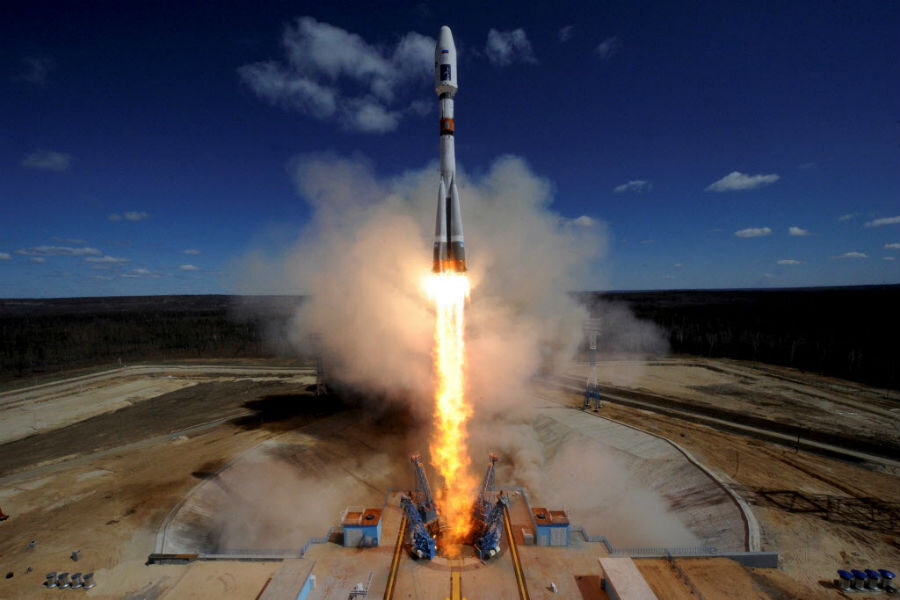
    I. Why Space is the Next Battlefield

    In the 20th century, wars were fought over land, sea, and air. In the 21st century, the fifth domain of warfare—space—has emerged as the ultimate strategic high ground.

    Whoever controls Earth’s orbit controls global communications, missile defence, intelligence gathering, and even economic stability.

    Satellites are the nervous system of modern militaries:

    • GPS-guided missile strikes
    • Intelligence, surveillance, and reconnaissance (ISR)
    • Encrypted communications between field units
    • Early-warning detection for nuclear launches

    Destroy these satellites, and you can blind, confuse, and cripple an enemy before the first shot is fired on Earth.


    II. The Main Players in Space Militarization

    United States

    Opinion | Why giving the Space Force naval ranks might widen the schism  with the Air Force - POLITICO
    • US Space Force was formed in 2019 to consolidate orbital defences
    • X-37B Spaceplane: Reusable, autonomous, and potentially able to deploy small payloads or intercept satellites
    • Satellite constellations like Starlink are now integrated into defence planning (Ukraine war proved its military relevance)

    China

    • Shijian-17 satellite with robotic arm capable of grabbing other satellites
    • DF-21D ASAT missile program for direct satellite destruction
    • Expanding BeiDou navigation system as an alternative to GPS

    Russia

    • Pioneer in co-orbital ASAT weapons since the Cold War
    • Suspected of testing “nesting” satellites that can release smaller killer satellites
    • Blending cyber warfare with space attacks (e.g., Viasat hack in early Ukraine war)

    India

    Mission Shakti - Wikipedia
    • 2019 “Mission Shakti” ASAT test proved capability to shoot down satellites
    • Dual-use civilian and military space program with rapid tech growth

    III. How Space Can Be Weaponized

    1. Direct-Ascent Anti-Satellite Weapons (DA-ASAT)

    Russia launches anti-satellite weapon: A new warfront in space ...
    • Ground-launched missiles destroy satellites in low Earth orbit (LEO)
    • Downside: Creates dangerous orbital debris

    2. Co-Orbital Killers

    • Satellites placed near enemy satellites, capable of disabling or “bumping” them
    • Can be disguised as repair or inspection satellites

    3. Cyber and Signal Warfare

    • Hacking ground stations or intercepting satellite communications
    • Jamming GPS signals over battlefields

    4. Orbital Energy Weapons

    • It is theoretical, but potential for lasers or kinetic projectiles deployed from orbit (“Rods from God” concept)

    IV. The Strategic Risks of Space War

    • Kessler Syndrome: A chain reaction of debris collisions could make low Earth orbit unusable for decades
    • Civilian Dependency: GPS, weather forecasts, global internet all rely on satellites
    • Escalation Risk: Attacking space assets could trigger immediate nuclear alert status in some nations

    V. Strategic Recommendations for Nations

    1. Satellite Resilience & Redundancy
      • Deploy constellation swarms of small satellites (harder to destroy all)
      • Rapid launch capabilities for replacements (SpaceX model)
    2. Hardened Ground Infrastructure
      • Secure satellite control stations against cyber intrusions
      • Backup terrestrial navigation systems
    3. Space Domain Awareness (SDA)
      • Build AI systems to track, classify, and predict satellite maneuvers in real time
    4. International “Space Rules of Engagement”
      • Create treaties defining thresholds for hostile action in orbit (similar to naval law of the sea)

    VI. The Future: From Defense to Domination

    By the 2030s, we could see:

    • Orbital military outposts servicing small fleets of defensive drones
    • Space-based missile shields covering entire continents
    • Commercial space companies becoming de facto military contractors

    In the words of military planners, space is “the ultimate high ground”—and history shows that whoever holds the high ground dictates the terms of battle.

  • Turkey: The Third Gulf Axis Of Power

    Turkey: The Third Gulf Axis Of Power

    Turkey Is Modernizing Its Military to Send Message to the Rest of NATO -  Business Insider

    I. Historical & Strategic Context

    Turkey has long viewed itself as a bridge between Europe, the Middle East, and Central Asia, but in recent years, it has evolved into a military-industrial powerhouse with global reach. No longer a passive NATO border state, Turkey under Erdoğan is increasingly projecting influence:

    • North Africa (Libya)
    • The Caucasus (Azerbaijan-Armenia war)
    • Levant and Gulf (Qatar, Iraq, Syria)
    • East Africa (Somalia, Red Sea bases)

    Strategic Shift: From reactive defense to neo-Ottoman influence projection, blending soft and hard power.

    II. Defense Industry as a Foreign Policy Weapon

    Turkey is one of the world’s top 10 arms exporters—a remarkable shift over the past decade. Key defense assets include:

    Bayraktar TB2 & Akinci Drones

    • Used in Libya, Syria, Nagorno-Karabakh, and Ukraine with lethal efficiency
    • Proven value: Affordable, modular, and swarm-capable
    • Exported to over 30 countries

    Domestic Naval Power

    ANALYSIS] TCG Anadolu: the most powerful warship and the flagship of the  Turkish Navy - Turkish Minute
    TCG Anadolu
    • TCG Anadolu: Turkey’s first aircraft carrier (drone carrier)
    • Development of homegrown submarines, corvettes, and missile boats
    • Naval projection into Red Sea and Gulf waters via bases in Qatar and Somalia

    Roketsan & ASELSAN Weapon Systems

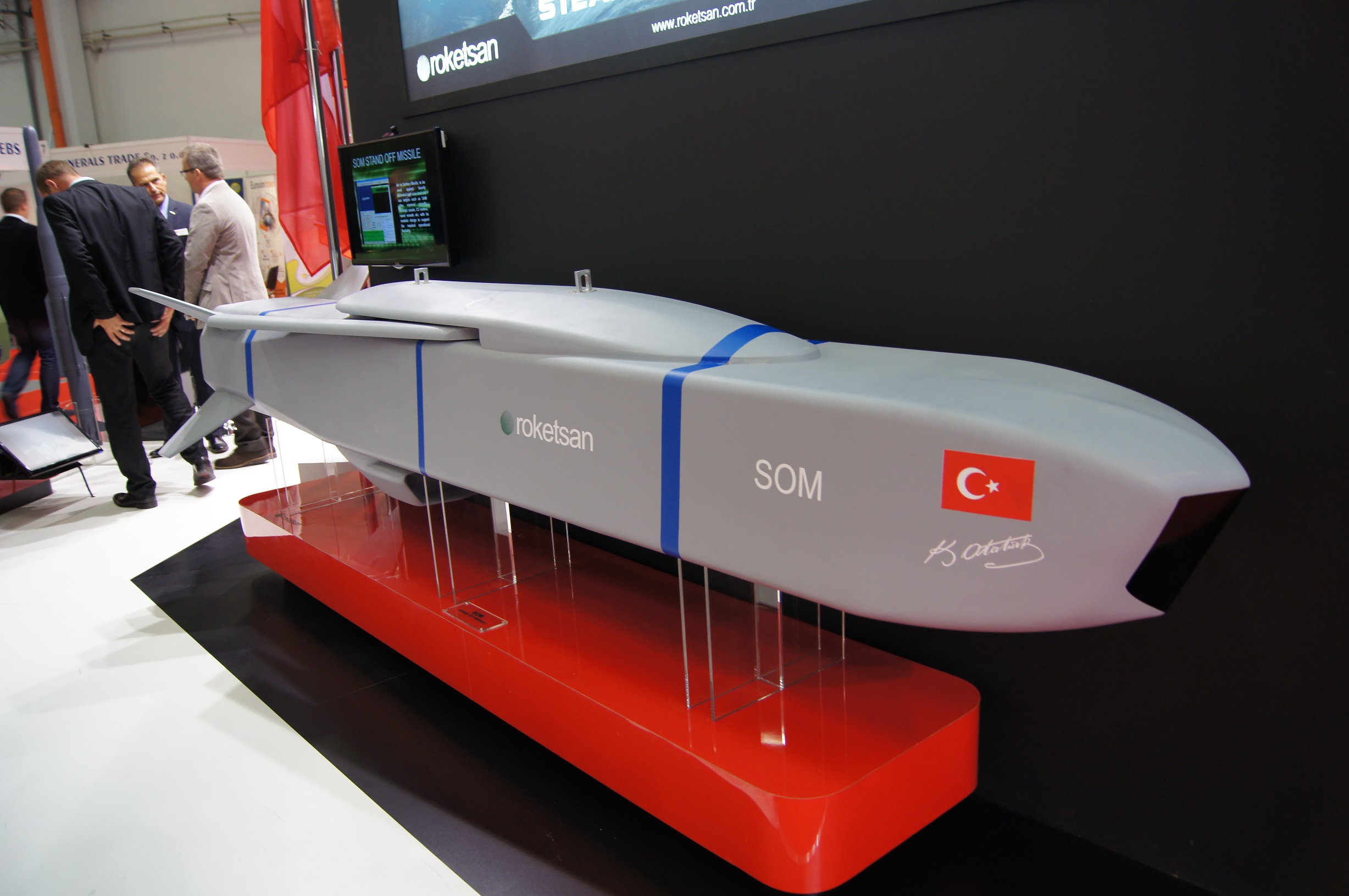
    • Indigenous missile tech (SOM cruise missiles, surface-to-air platforms)
    • Electronic warfare, SIGINT, and AI-based C4ISR platforms
    SOM (missile) - Wikipedia

    III. Turkey’s Military Footprint in the Gulf & Red Sea

    Qatar: The Core Gulf Ally

    New military base in Qatar to inaugurate in autumn - Türkiye News
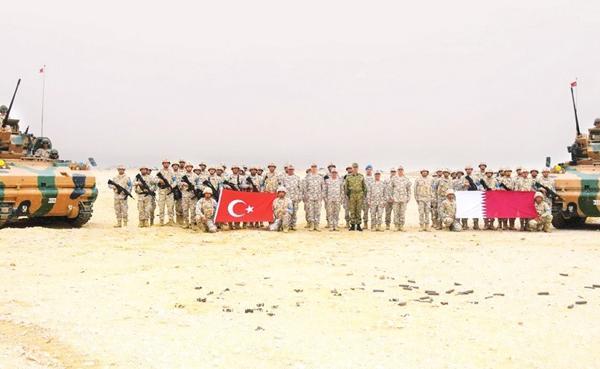
    • Permanent Turkish base in Qatar (Tariq bin Ziyad Base) since the 2017 Gulf blockade
    • Trains Qatari military officers and provides a counterbalance to Saudi-UAE axis
    • Shared interests in Islamic soft power and Muslim Brotherhood-aligned networks

    Somalia & Horn of Africa

    • Camp TURKSOM: Largest Turkish overseas base, training Somali forces
    • Gateway to Red Sea, Indian Ocean routes, and Gulf of Aden chokepoints
    • Turkey is viewed by local governments as an alternative to Western and Chinese influence

    Levant & Iraq

    • Deep involvement in northern Iraq operations (anti-PKK) and northern Syria
    • Construction of semi-permanent military zones near Mosul and Afrin
    • Facilitates indirect influence over Kurdish and Shia corridors leading into Iran and the Gulf

    IV. Strategic Military Doctrine: Asymmetric, Exportable, Agile

    Turkey’s emerging doctrine can be summarized as “Agile Strategic Presence”:

    • Exportable Firepower: Drones, missiles, and electronic systems designed for “plug-and-play” use by allies and proxies
    • Hybrid Warfare: Combines conventional operations with proxies (e.g., Syrian militias), drones, cyber ops, and psychological warfare
    • Strategic Basing: Establishing forward bases without requiring full occupation—training partners, guarding ports, building schools and airfields

    V. Strategic Recommendations: How Turkey Can Solidify Gulf Influence

    1. Expand Naval Presence into Western Gulf
      • Leverage Qatar to co-develop naval facilities
      • Introduce drone naval platforms in Hormuz-Red Sea corridor
    2. Create a Turkish-Gulf Defense Education Exchange
      • Offer military academies in Africa and Asia under Turkish branding
      • Counterbalance Western training programs with Islamic-friendly curriculum
    3. Cyber-Islamic Coalition
      • Build digital alliances with Muslim-majority countries (Malaysia, Indonesia, Pakistan) using shared AI, cyberdefense, and drone doctrine
      • Present this as a “non-aligned Islamic defense bloc”
    4. Weaponize Infrastructure
      • Package military presence with hospitals, mosques, infrastructure deals
      • Lock in multi-domain loyalty among unstable regimes (Sudan, Djibouti, Libya)

    Table comparison with UAE & Saudi Arabia

    DimensionTurkeyUAESaudi Arabia
    Military DoctrineAgile & Hybrid WarfareTech-first asymmetric deterrenceStrategic autonomy, conventional
    Regional AllyQatar, SomaliaEgypt, Jordan, Israel (informal)Pakistan, Egypt, Jordan
    Defense IndustryDrones, missiles, navalDrones, EW, AI weaponsLand vehicles, missiles, MRO
    Influence MethodProxy warfare + soft powerTech diplomacy + trainingArms deals + economic leverage

    Sidenote: Hi guys, im trying my best to pump out the content. Life has been hectic lately.

  • How Drones Are Revolutionizing Combat Strategies

    High Energy Laser with Integrated Optical-dazzler and Surveillance -  Wikipedia

    With reference to my previous blog on the Iron Dome system, I would like to delve into the ever-changing landscape of warfare with the introduction of laser systems, drones and the impact of them into defence systems infrastructure.

    Laser Systems – Cost effective Defences?

    How Ukraine soldiers use inexpensive commercial drones on the battlefield |  PBS News

    The main advantage of laser systems over traditional missile defence systems are mainly in cost per firing. Having a low cost per firing at US$2 – US$10 versus a Tamir interceptor firing at $50,000 or even a Patriot Missile at US$3-US$4 million, it is a no brainer on why advanced militaries such as the U.S are looking into it.

    Laser systems help flip the cost-inefficient attrition of defending against low cost attack modes such as drones into a sustainable high volume defence force. Arguably the cost to train personal to operate and maintain such a defence is also a net gain towards saving dollars.

    Currently, the Iron Beam system is projected to target smaller munitions such as drones to a distance of up to 10km. A far cry from the Tamir’s 150 square kilometer radius, however with the pace of technology evolving i find that this is not a big issue in terms of scalabality.

    Countermeasures: Mother Nature, fog, rain and smoke are some uncontrollable ways that reduce laser system’s combat effectiveness. Theoretically, if an enemy wants to increase their chances of breaking through such defences, they could have an smoke artillery barrage around the surrounding systems and quickly lead up with a drone attack.

    If a country were to be dependent on laser systems, their power stations and electrical grid will be key targets of attack as well, leading to more passive defences having to be placed around said infrastructure.

    Drone Warfare

    Russia is seeking more attack drones from Iran after depleting stockpile,  White House says | PBS News

    As seen in the Ukraine-Russian War, drone warfare is in its infancy. Intelligence gathering, Surveillance and Reconnaissance (ISR) once limited to the U.S UAV series is now widely available to even the smallest of paramilitaries.

    Drones offer precision strikes along with swarm attacks whilst being cheap to produce and offering close to zero risk of danger to its operators.

    Defending against such threats does not come cheap. With current tech, active defences such as interceptor missiles are expensive. Trying to counter drones with foot soldiers with shotguns (duck hunting experience preferred) is not feasible either.

    Right now, it remains to be seen on who can perfect the drone swarm advantage and which country can produce the first cost effective defence and adopt to the doctrine the fastest.

    Nation Defences

    If I were advising a defence ministry, I would propose:

    1. Build a counter-drone layered defence with lasers, jammers, and AI fire control
    2. Train civilian drone reserves for local ISR
    3. Stockpile cheap expendable drones for surge wartime use
    4. Harden comms against jamming and GNSS denial
    5. Integrate drones with existing artillery and air power for coordinated multi-domain operations
    6. Start building swarm doctrines for both attack and defense

    Usage of cheap defences such as camouflage netting for hiding key defence points, underground shelters for troops and counter drone tactics are the way i would minimise my losses in event of a war

    Thanks for reading, Im still getting used to wordpress and formatting my blog, if anyone has any tips do not hesitate and reach out to me! i wont bite promise!

    Disclaimer time!: I am not a professional, all my writings are my own personal opinion. Nothing I say should be taken as financial advice.

  • The Costs of the Iron Dome & Going Forward

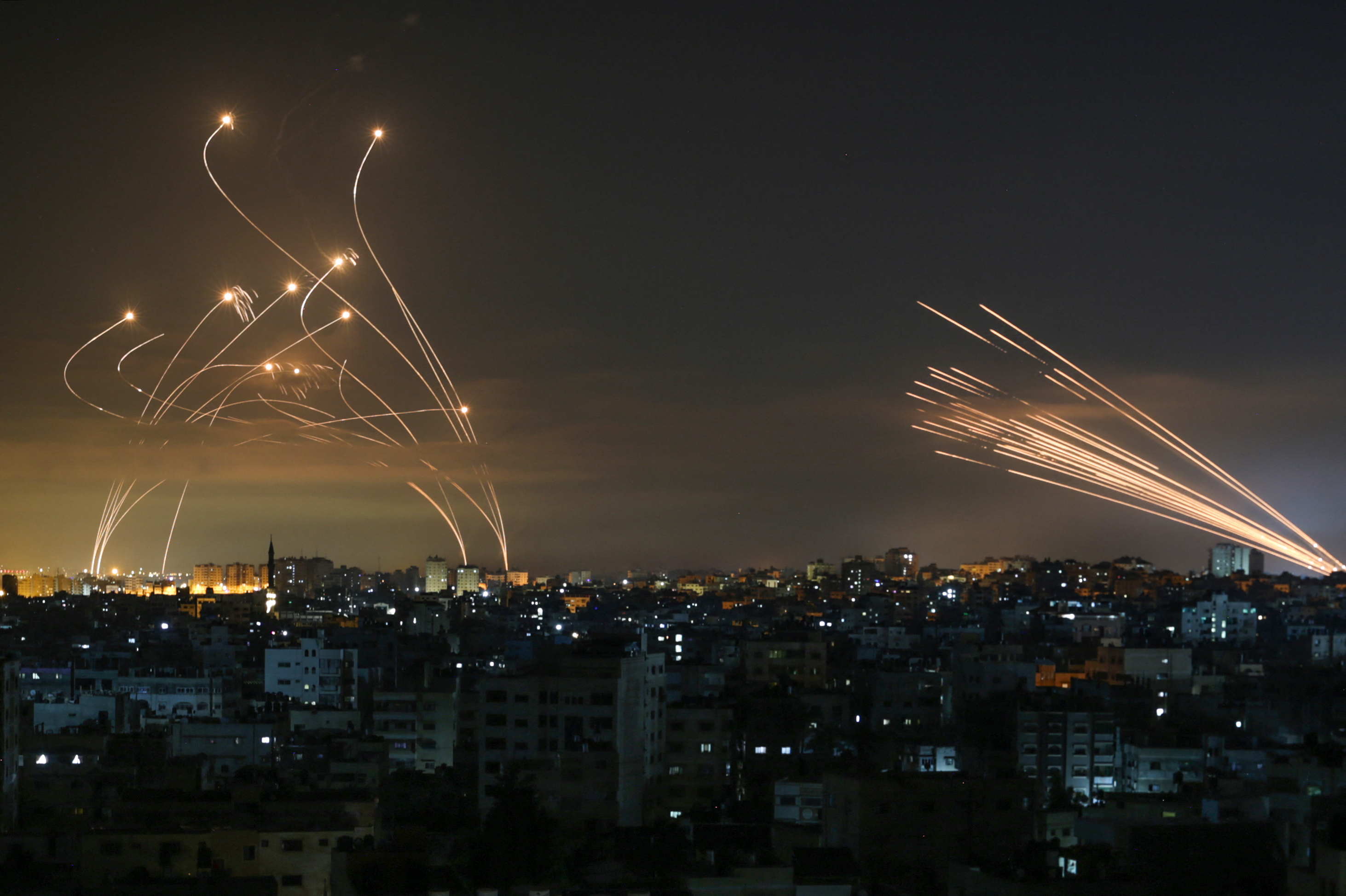
    The Famous Iron Dome Firing.

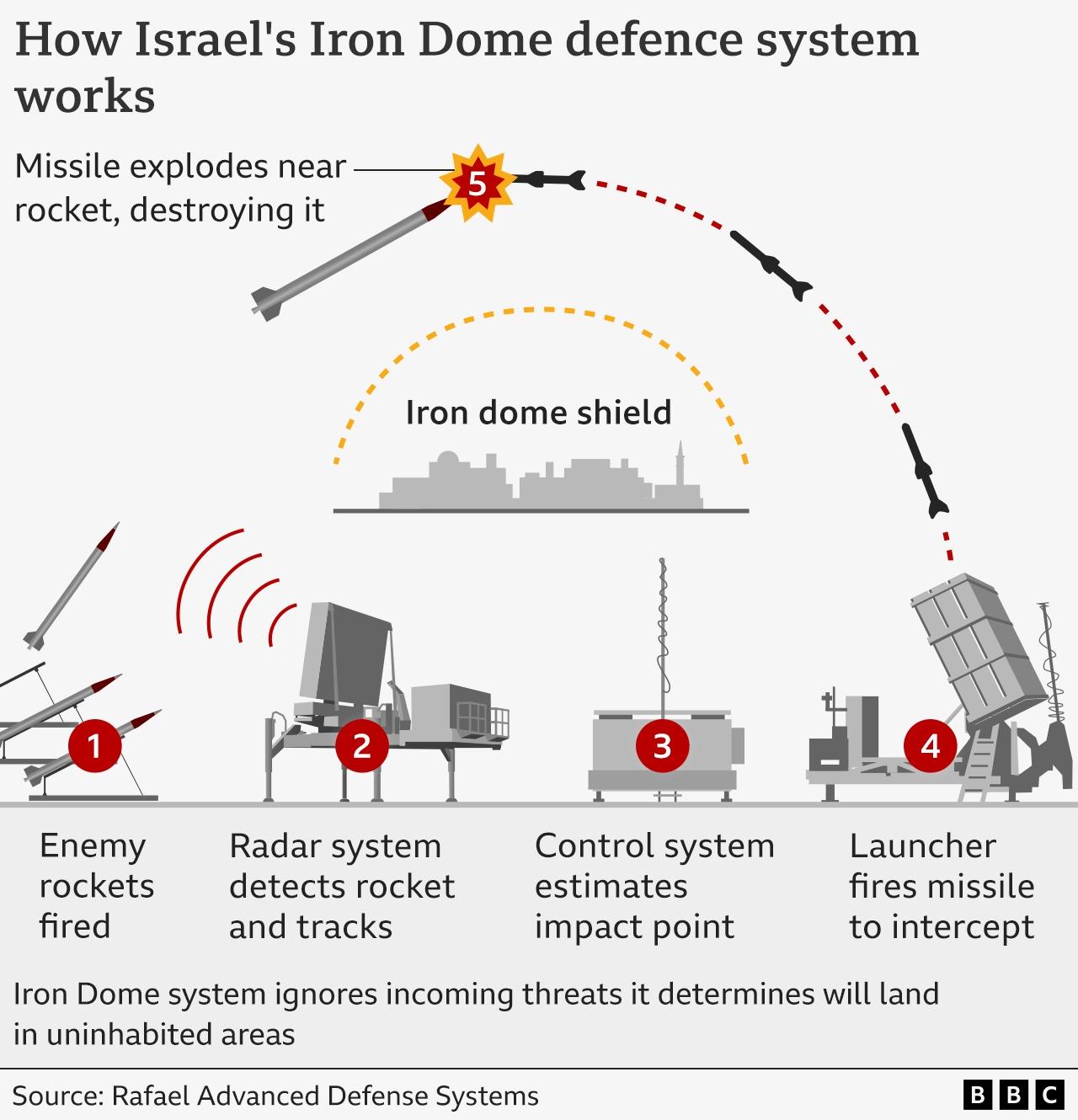
    The costly albeit effective Iron Dome system implemented in 2011 has protected Israel for the past 14 years, with each battery approximately costing between $50 to $80 million it is generally accepted that the strategy for its unfriendly neighbours over Israel is constant attrition.

    With each cheap $500 Qassam Rocket or Shahed drone getting hurled at Israel getting met with a $50,000 Tamir missile, Israel is imposed with a cost efficiency dilemma. How is it being solved?

    So far, U.S co-funding (over $5B since 2011), prioritising interception (to conserve missiles) and increased integration with the David’s Sling and arrow system has assisted in absorbing the costs associated to defend the population of almost 10 million.

    Effectiveness In Conflicts

    What is Israel's 'Iron Dome' and how does it stop rockets from Hamas? : NPR

    Key Tests in the Gaza Conflicts from (2012, 2014, 2021, 2023, 2024), May 2021 saw 4,000+ rockets fired, with a claimed ~90% interception rate. Given footages, it is clear that the system works however nothing is foolproof and some missiles still do make it through causing damage to civilian infrastructure and potential damage to key military installations however that it is strictly censored due its sensitivity.

    That does not mean it is a futile effort, by having the system implemented the strategic value for Israel has been proven so far.

    The prevention civilian casualties has been the first and foremost reason on the weapons system being created. Civilians are the backbone of any country’s economy, defence and offence. With Israel’s high conscription rate, every citizen is a asset to the country.

    Every casualty as a result of the Iron Dome system failing is one loss towards compounded knowledge that the person may have had and perhaps decades of experience which for a country with a specialised workforce is an extreme price to pay for which Israel chose to prevent with the Iron Dome System.

    Forward Strategy: Future Developments & Alternatives

    Images from the “Iron Beam”

    Israel is currently undergoing testing and possibly live testing on its Iron Beam system. With a supposed cost to fire of just US$3 per intercept, implementation of this weapons system slated to be in service in the later parts of this year. This could solve the cost efficiency dilemma and pour funds from the Tamir system towards other systems and R&D.

    Laser guided systems are potentially a new way countries are able to protect against the new age of drone warfare. With the U.S Navy’s HELIOS (High Energy Laser with Integrated Optical Dazzler and Surveillance) being deployed and tested for use against drone targets, this is a topic in which I wish to delve in deeper in future blog posts.

    Thank you for taking the time to read my first blog post! My blog may be not be as optimised for now but il get to the hang of it!

    Disclaimer: I am not a professional, all my writings are my own personal opinion. Nothing I say should be taken as financial advice.