How the Skies Over Korea Became the Birthplace of the Jet Age
Introduction: A New Kind of War in the Skies
In the early 1950s, as the Korean War raged across the peninsula, another kind of battle unfolded far above the clouds.
This wasn’t like the dogfights of World War II — propeller planes circling in the blue sky. This was something entirely new.
Jet engines.
Supersonic speeds.
Split-second decisions that decided life or death.
Over a narrow stretch of northwestern Korea, near the Yalu River, pilots from the United States and the Soviet Union (though Moscow denied it) faced off in the world’s first major jet-versus-jet combat.
They called it MiG Alley — a place where skill, nerves, and technology were pushed to their limits.
What happened in those skies would change the future of air combat forever.
The Setting: The Birth of Jet Warfare
By the time the Korean War broke out in June 1950, jet aircraft were still new technology.
Both sides started the war flying World War II–era propeller planes — the U.S. used the F-51 Mustang, and the North Koreans flew Soviet-built Yak-9 fighters.
But that changed fast.
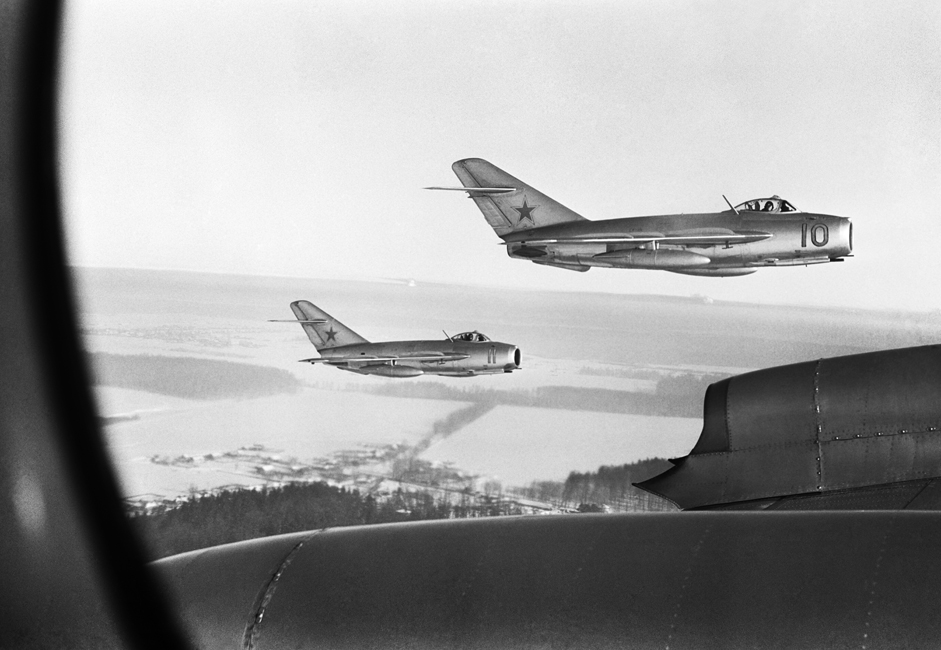
When the Soviet-built MiG-15 appeared in late 1950, everything changed.
With swept wings, a pressurized cockpit, and a powerful jet engine, the MiG could climb higher, fly faster, and turn tighter than anything the U.N. forces had seen before.
It could reach speeds of almost 670 miles per hour and operate at altitudes above 50,000 feet — well beyond the reach of older aircraft.
For a while, the skies over North Korea belonged to the enemy.
Enter the F-86 Sabre: America’s Answer
The U.S. needed something to match the MiG — and fast.
Enter the North American F-86 Sabre, one of the most advanced fighter jets of its time.
It had swept wings like the MiG, radar-assisted gunsights, and powerful .50 caliber machine guns.
But the Sabre’s real strength wasn’t just speed — it was stability and precision.
At high speeds, it was easier to control than the MiG, giving American pilots an edge in tight maneuvers.
When the Sabre took to the skies in late 1950, the stage was set for a clash unlike any before.
MiG Alley: The Deadliest Airspace on Earth
The battles took place over a stretch of northwestern Korea along the Yalu River, near the Chinese border.
The area soon earned a name whispered with respect and fear — MiG Alley.
It became the hunting ground of the USAF’s 4th Fighter Interceptor Wing and the Soviet 64th Fighter Aviation Corps.
American pilots were told to stay south of the Yalu to avoid provoking China or the USSR, but MiGs would swoop down from the north, strike, and retreat across the river to safety.
The result?
A daily aerial chess match between two of the most advanced fighter forces on the planet.
The Men Behind the Machines
The dogfights of MiG Alley weren’t just about machines — they were about the men who flew them.
U.S. pilots were veterans of World War II — experienced, disciplined, and aggressive.
They called themselves the “Sabre Men.”
Their Soviet opponents were equally skilled, though officially “volunteers.”
They wore Chinese or North Korean uniforms, flew aircraft with red star insignias, and operated under strict secrecy.
Among them was Soviet ace Nikolai Sutyagin, who scored 22 kills — one of the highest of the war.
On the American side, Captain Joseph McConnell became the top U.S. ace with 16 victories.
These pilots lived by the second — and often died by it.
Dogfighting at the Speed of Sound
Air combat over MiG Alley was brutal and fast.
A pilot had less than a few seconds to spot, target, and fire before the enemy disappeared into a blur.
The F-86 Sabre’s advanced gyro gunsight gave it an edge — it predicted enemy movement, helping pilots lead their shots.
But the MiG-15 had superior climb and altitude performance, often using “boom and zoom” tactics — diving from above, firing, and escaping skyward.
The result was a deadly dance of angles and velocity.
At these speeds, every decision was instinct.
Every mistake, fatal.
As one Sabre pilot later said:
“You didn’t fight the MiG. You fought the man flying it.”
The Shadow War: Soviets in the Sky
Officially, the Soviet Union never fought in the Korean War.
Unofficially, they were deeply involved.
From late 1950 onward, Soviet pilots secretly flew hundreds of missions from air bases in Manchuria.
Their jets carried North Korean or Chinese markings, and radio operators spoke in broken Korean to maintain the illusion.
But American pilots weren’t fooled.
Intercepted radio chatter and combat reports revealed that many of the MiG pilots spoke perfect Russian — and fought with precision far beyond what North Korea could train.
In truth, MiG Alley had become the first direct aerial clash between American and Soviet pilots — the Cold War’s hidden front.
Tactics and Technology: The Future Takes Shape
The duels in MiG Alley changed air combat forever.
Fighter tactics evolved from turning dogfights to energy warfare — controlling altitude, speed, and position to gain the advantage.
The concept of the “kill zone” — a cone of fire extending from a jet’s nose — became the standard in aerial gunnery.
New innovations also emerged:
- Radar control and early warning systems to guide intercepts.
- Mid-air refueling to extend range.
- Jet training schools focused on energy management and teamwork.
The lessons learned over MiG Alley would shape every air force in the world for decades to come.
Life and Death in the Cockpit
Behind every dogfight was a young man pushing the limits of fear and physics.
Sabre pilots often flew two or three missions a day, facing freezing altitudes and crushing G-forces.
Cockpits were cramped, noisy, and dangerous.
When hit, a pilot had seconds to eject — hoping his chute opened before the ground reached him.
If captured in North Korea, his fate was uncertain.
But despite the risks, pilots volunteered in droves. The skies over MiG Alley became the ultimate test of skill, courage, and endurance.
The Numbers: Victory and Controversy
Official U.S. Air Force records claimed 792 MiGs destroyed for 78 Sabres lost — a stunning 10-to-1 kill ratio.
Soviet records, however, told a different story, claiming 600 U.N. aircraft destroyed for 335 MiG losses.
The truth likely lies somewhere in between.
But what’s undisputed is this — the F-86 Sabre dominated the skies in the war’s later years, and MiG Alley became the proving ground for the modern fighter jet.
Legacy: The Jet Age Is Born
When the Korean War ended in 1953, MiG Alley faded into history — but its influence did not.
The dogfights there were the prototype for modern air combat: radar-guided missiles, supersonic speeds, and electronic warfare.
Many of the pilots who fought there would go on to shape the Cold War’s air strategy, train new generations of aviators, and even fly in Vietnam.
And the lessons learned — about technology, adaptability, and pilot psychology — still guide air combat training today.
As aviation historian Walter Boyne wrote:
“MiG Alley was where the jet age was baptized by fire.”
Conclusion: The Battle Above the Yalu
MiG Alley wasn’t just a stretch of sky — it was the dawn of a new era.
In that cold, thin air, the world saw what war in the modern age would look like: faster, deadlier, and fought with machines that left no room for error.
It was a clash of ideologies, nations, and nerves.
And for the men who fought there, it was the place where courage met speed — and history took flight.
Cited Sources
- Boyne, Walter J. MiG Alley: The Fight for Air Superiority. Smithsonian Books, 2000.
- Thompson, Warren. F-86 Sabre vs MiG-15: Korea 1950–53. Osprey Publishing, 2010.
- Futrell, Robert F. The United States Air Force in Korea, 1950–1953. U.S. Air Force Historical Study, 1983.
- Werrell, Kenneth P. Sabres Over MiG Alley. Naval Institute Press, 2005.
- National Museum of the United States Air Force Archives.
 Vellum Insights
Leave a comment