How China Built a Vast Secret Tunnel System to Protect Its Nuclear Arsenal
Introduction: The Secret Beneath the Mountains
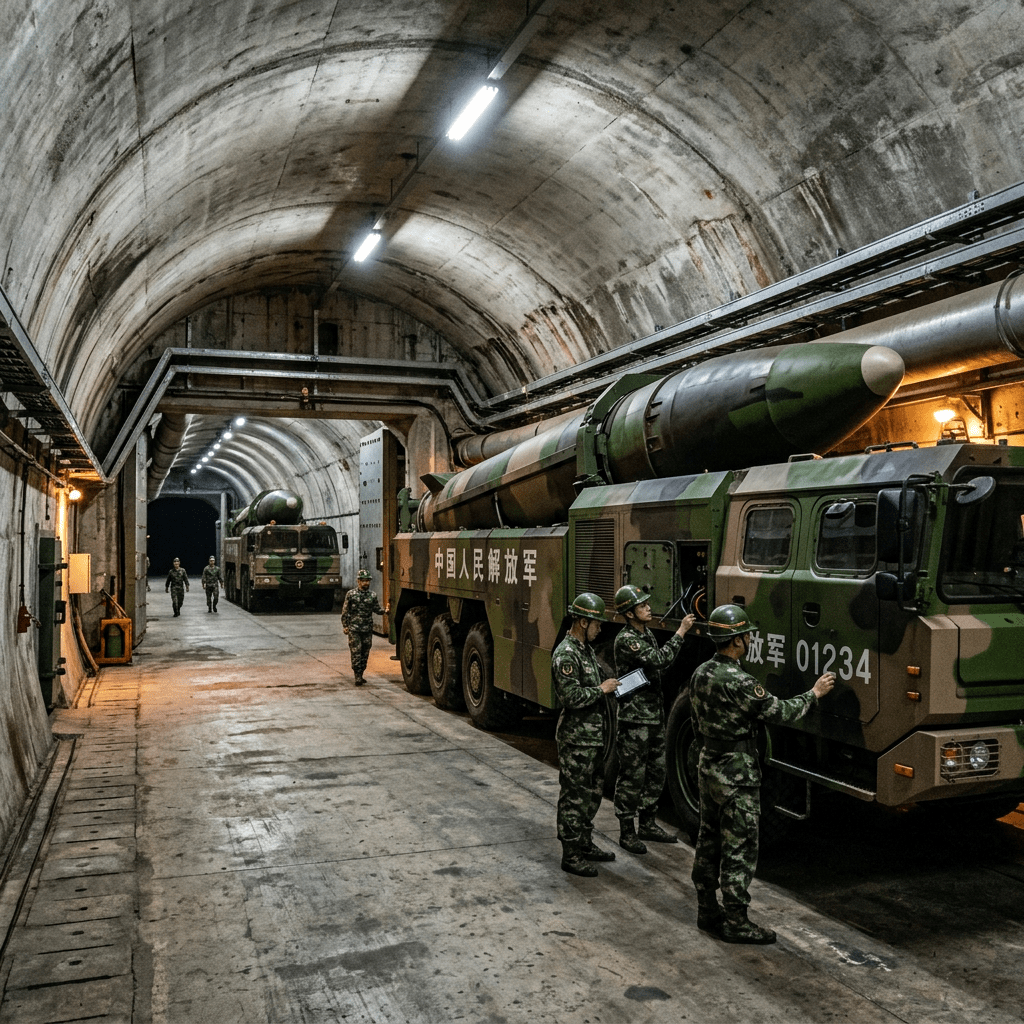
Deep beneath mountains and remote landscapes across China, an enormous underground network stretches for thousands of kilometers.
This hidden infrastructure is often referred to by analysts as China’s “Underground Great Wall.”
Built to protect the country’s nuclear weapons, the network consists of tunnels, bunkers, missile storage facilities, and command centers designed to survive even the most powerful military attacks.
While much of the system remains classified, defense analysts believe it is one of the most extensive underground military networks ever constructed.
The tunnel system is operated by the People’s Liberation Army Rocket Force, the branch of China’s military responsible for the country’s strategic missile arsenal.
By hiding nuclear missiles deep underground, China aims to ensure that its nuclear deterrent would survive any first strike in a potential conflict.
In modern nuclear strategy, survivability is everything. If a country’s nuclear weapons can survive an attack, it can retaliate—and that threat of retaliation is what prevents nuclear war.
China’s Underground Great Wall is built around that principle.
Chapter 1: The Origins of China’s Underground Defense Strategy
China’s focus on underground military infrastructure dates back to the early years of the Cold War.
After the establishment of the People’s Republic of China in 1949, the country quickly found itself facing powerful rivals.
During the 1950s and 1960s, tensions escalated with both the United States and the Soviet Union.
Chinese leaders feared that their young nuclear program could be destroyed by a surprise attack.
In response, they began developing strategies to protect their growing missile arsenal.
One solution was to hide these weapons underground.
China’s mountainous terrain made this possible.
By digging tunnels into mountainsides, missiles could be stored safely out of sight and protected from aerial bombardment.
This approach became a core element of China’s nuclear strategy.
Chapter 2: The Birth of China’s Nuclear Arsenal
China officially became a nuclear power in 1964 when it conducted its first successful atomic test.
This test took place at the Lop Nur Nuclear Test Site, located in the remote deserts of western China.
With this achievement, China joined the small group of nuclear-armed nations that already included the United States, the Soviet Union, and the United Kingdom.
However, China’s nuclear arsenal remained much smaller than those of the superpowers.
Rather than competing in a massive nuclear arms race, Chinese strategists adopted a different approach.
China developed a doctrine known as “minimum deterrence.”
Under this strategy, China would maintain only enough nuclear weapons to guarantee a devastating retaliatory strike if attacked.
For this strategy to work, the country’s nuclear weapons had to be extremely difficult to destroy.
This requirement helped drive the creation of the underground missile tunnel network.
Chapter 3: Building the Underground Great Wall
The construction of China’s missile tunnels accelerated during the late Cold War.
The project was overseen by the military branch that would later become the People’s Liberation Army Rocket Force.
According to military researchers, the tunnel network may extend for thousands of kilometers beneath mountains and remote regions.
Some analysts estimate the network could exceed 5,000 kilometers (3,100 miles) in total length.
The tunnels serve several critical functions:
- storing nuclear missiles
- protecting mobile launchers
- hiding warheads
- allowing missiles to move secretly between launch sites
These tunnels are often carved directly into mountains, making them extremely difficult to detect or destroy.
In many cases, entrances are hidden behind reinforced doors or disguised structures.
From the outside, these entrances may look like ordinary industrial buildings or warehouses.
But behind them lies an underground military infrastructure designed to withstand modern warfare.
Chapter 4: Mobile Missiles and Strategic Mobility
One of the key advantages of the tunnel network is that it allows China to operate mobile missile launchers.
Unlike fixed missile silos, mobile launchers can move between different locations.
This mobility makes it far harder for enemy forces to locate and destroy them.
Many of China’s modern nuclear missiles are designed to be transported on large military vehicles known as transporter erector launchers (TELs).
These vehicles can travel along roads and inside tunnels before emerging to launch missiles from hidden sites.
The ability to move missiles through underground tunnels means that even if satellites detect a launcher leaving a tunnel entrance, it may be impossible to know where it will emerge.
This uncertainty complicates the targeting plans of potential adversaries.
Chapter 5: Protecting China’s Nuclear Deterrent
The Underground Great Wall plays a crucial role in China’s nuclear deterrence strategy.
China’s nuclear doctrine includes a no-first-use policy, meaning the country pledges not to launch nuclear weapons unless it is attacked first.
For this policy to remain credible, China must ensure its nuclear arsenal can survive an initial strike.
Underground tunnels help accomplish this goal in several ways.
First, they protect missiles from aerial attacks.
Mountains and reinforced tunnels provide strong physical protection against bombs and missiles.
Second, the tunnels create uncertainty.
Even advanced satellite surveillance may not be able to track missile movements underground.
Third, the network allows missiles to be dispersed across large areas, reducing the chances that they could all be destroyed at once.
This survivability is the foundation of nuclear deterrence.
If adversaries know that China’s missiles cannot be eliminated in a first strike, they may be less likely to attack.
Chapter 6: The Role of the PLA Rocket Force
The responsibility for operating this system falls to the People’s Liberation Army Rocket Force.
This branch of China’s military manages both conventional and nuclear missile forces.
The Rocket Force operates a wide range of missile systems, including:
- intercontinental ballistic missiles (ICBMs)
- intermediate-range ballistic missiles
- conventional strike missiles
These weapons can target locations thousands of kilometers away.
China’s modern nuclear missiles include systems capable of reaching targets across the United States, Russia, and other regions.
Many of these missiles are believed to be stored and maintained within the underground tunnel network.
The Rocket Force trains extensively to move missiles quickly from storage to launch positions if needed.
Chapter 7: Satellite Surveillance and Modern Intelligence
In the modern era, satellites play a major role in monitoring military activity.
Countries such as the United States operate advanced reconnaissance satellites capable of detecting missile launches, troop movements, and military infrastructure.
However, underground tunnels present a unique challenge.
While satellites can observe surface activity, they cannot see deep underground.
This makes it difficult for intelligence agencies to determine exactly how many missiles are stored within the tunnel system.
Some analysts believe the network could conceal far more missiles than publicly estimated.
Others argue that the tunnels primarily serve to protect a smaller number of weapons.
Because the system is so secretive, the true scale of China’s underground missile network remains uncertain.
Chapter 8: Expansion of China’s Nuclear Forces
In recent years, reports have suggested that China is expanding its nuclear capabilities.
Satellite imagery has revealed new missile silo construction in several regions of China.
At the same time, the country has continued developing new missile technologies.
These include:
- multiple-warhead ballistic missiles
- hypersonic glide vehicles
- advanced submarine-launched nuclear missiles
The underground tunnel system may play an important role in supporting these expanding capabilities.
By providing protected storage and mobility for missile forces, the network helps maintain the survivability of China’s growing arsenal.
Chapter 9: Strategic Implications for Global Security
China’s Underground Great Wall has important implications for global security.
For military planners in other countries, the existence of such a network complicates strategic calculations.
Because the exact number and location of China’s nuclear weapons are difficult to determine, adversaries cannot easily eliminate them in a single attack.
This uncertainty strengthens China’s deterrence.
At the same time, the secrecy surrounding the system can create concerns among other nations.
If countries believe their rivals are expanding hidden nuclear capabilities, they may respond by increasing their own arsenals.
This dynamic has the potential to fuel new nuclear competition.
In the modern geopolitical environment, underground infrastructure has become an important component of national defense strategies.
Conclusion: The Hidden Backbone of China’s Nuclear Strategy
China’s Underground Great Wall is one of the most mysterious military projects in the world.
Stretching beneath mountains and remote regions, the tunnel network was designed to protect the country’s nuclear arsenal from surprise attack.
By hiding missiles deep underground and allowing them to move secretly between launch sites, the system helps ensure that China’s nuclear deterrent remains credible.
Even in the age of satellites and advanced surveillance technologies, underground infrastructure continues to provide strategic advantages.
While many details about the network remain classified, its existence highlights a broader reality of modern geopolitics.
In a world where nuclear weapons still play a central role in global security, survivability is the key to deterrence.
And deep beneath China’s mountains, the Underground Great Wall exists to ensure that deterrence remains intact.
Sources & Citations
- Federation of American Scientists – Research on China’s nuclear forces and missile infrastructure.
- U.S. Department of Defense – Annual reports on Chinese military power.
- Center for Strategic and International Studies – Strategic missile and deterrence analysis.
- International Institute for Strategic Studies – Global nuclear weapons assessments.
- Stockholm International Peace Research Institute – Nuclear forces and strategic weapons data.
 Vellum Insights
Leave a comment